
Spoilers!
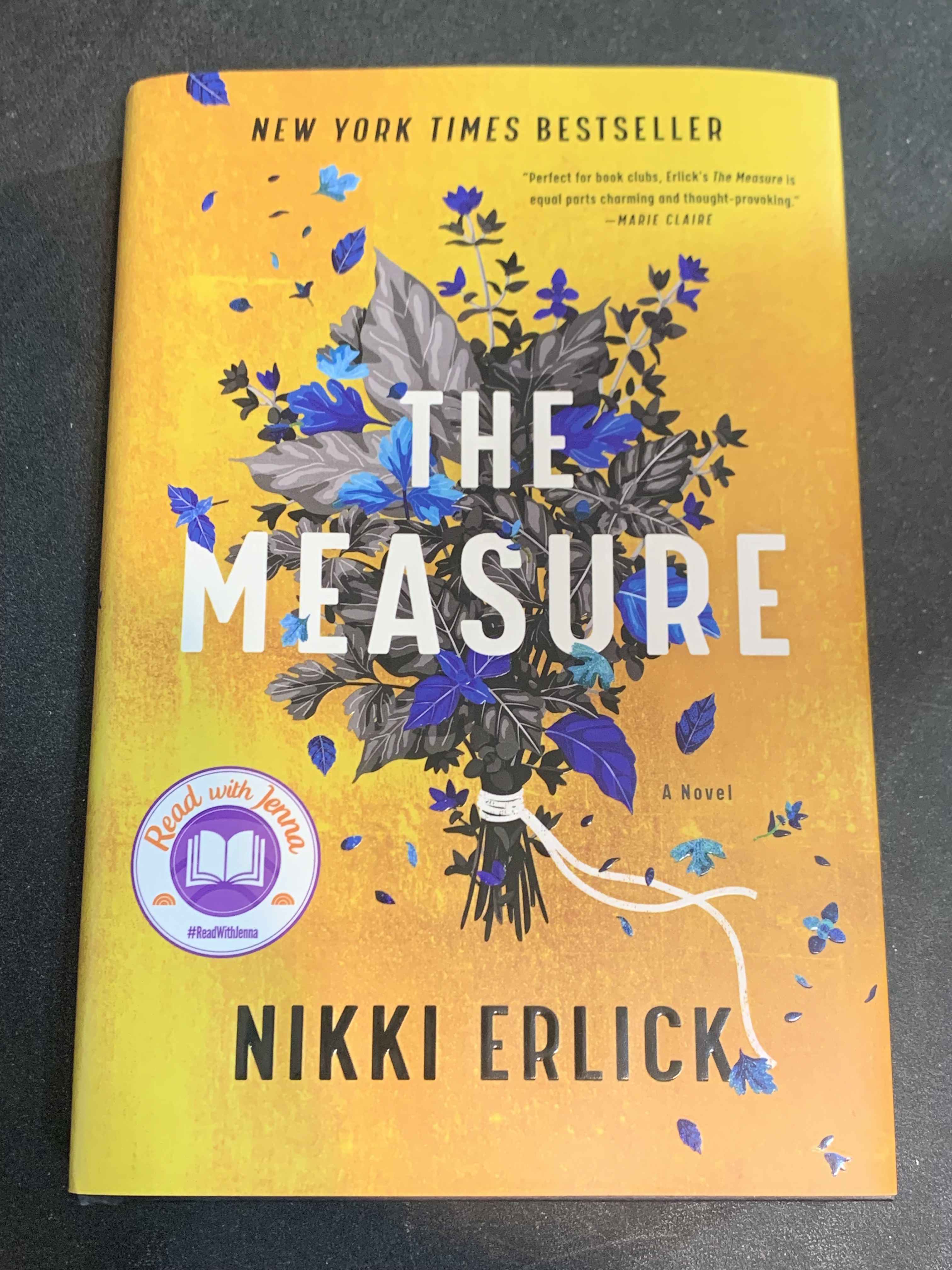
To play on René Descartes’ “I think, therefore I am,” humans innately need to tangibly express, “I was here.” And perhaps more pointedly, “I mattered.” That is the philosophical underpinnings of Nikki Erlick’s achingly beautiful debut book, 2022’s The Measure. We’re all going to die; it’s a fait accompli within our conscious minds. Yet, between the conscious awakening to this fact, and the end, what’s the measure of our lives? How do we measure our lives, and that we did, indeed, matter? These are questions Erlick tries to probe with a premise primarily made fascinating by its simplicity: What if everyone 22-years-old and older in the world received a box with a string inside that was the measurement of their quantity of life? Which manifests an age-old philosophical question: If you could know, with to-the-month precision, when you would die, would you want to know? Would you open the box and look? (It is interesting to consider why those under 22-years-of-age wouldn’t receive boxes with strings since obviously, a great many under-22-year-olds die.)
Of course, there’s also the larger issues — philosophical, metaphysical, religious, supernatural, cosmological — of how and why the boxes arrived at all, consisting of a material unknown to man, indestructible, and of course, foretelling everyone on Earth’s longevity. But Erlick is more interested in the aforementioned philosophical questions and what that does to individuals, relationships, families, and society writ large. I think rightly, as it would be easy to be bogged down by the latter and there wouldn’t necessarily be an explanation (aliens! God! a future human race!) that would be satisfactory in the end.
Erlick’s book takes place over the four seasons after the boxes arrive, interspersing the lives of Ben, an architect with a short string (his ex-girlfriend looked for him, hence “ex”); Amie, a fanciful schoolteacher in Manhattan, who declined to open her box; Nina (long string) and Maura (short string), who are on the cusp of marriage; Anthony Rollins, a presidential candidate with a long string, and his nephew, Jack Hunter, who switches his long string with his best friend, Javi’s, short string, so the latter can stay with the military after society begins excluding and discriminating against short-stringers; and Hank, an ER doctor, with a very short-string.
Ben, Maura, and Hank, who declined to join the very short-string support group, all join a support group for short-stringers held at a local school after Rollins, playing on the fears of the public in a way that felt reminiscent of both COVID and Trump in different ways, fear-mongers about the dangers of short-stringers — the rationale being that because they have nothing more to live for, short-stringers are inherently violent and ticking time bombs. While at the support group, in such a lovely and beautiful addition to the book, Ben begins writing letters back and forth as “B” to “A” (who turns out to be Amie) since the support group is held in her classroom.
What Erlick demonstrates with her cast of characters, some already interconnected, both long-stringers and short-stringers — and what the short-stringers and long-stringers in the book come to realize to push back against punitive laws and fear-mongering — is that humans are interconnected because of the innate bonds we share. That is, we’re bonded by the fact that we will die, and that before we do, we all want to matter. We can use that knowledge to bond us, or tear us apart with fear. The lovely characters in Erlick’s book, Rollins aside, chose the beauty in that interconnectedness.
As one example, Hank, who has a moral crisis about his job at the ER (did the people he “save” have long strings in the Before time anyway?), joins a short string rally against Rollins, where a woman who harbors resentment against Rollins for different reasons, tries to shoot him. Hank takes the bullet because that’s what he embodies: saving lives. Earlier in the book, he met a woman who was in need of a double lung transplant. Her mother knew she would be okay, though, because she was a long-stringer. As it turned out, the woman would receive Hank’s lungs. Talk about interconnected! Talk about living on! Talk about mattering! As one character would remark about him (and Javi, who would lay his life down for Hank’s former lover and fellow doctor in more interconnectedness): Hank lived a life with a string longer than anyone else they knew. And you hear that about people who die prematurely, that they lived life to the fullest, even in their short time on Earth. That’s the measure of a life.
Ben and Amie get together by happenstance (or fate?) before realizing they’ve been pen pals, and they marry and have two children. Marriage, and love itself, is always occurring despite the knowledge that we will die! Having precise knowledge of it, like that Ben will die in his 40s, doesn’t change the equation, or shouldn’t, in Aimee’s (and Nina’s with Maura’s) estimation. In a sad, albeit kind of beautiful, twist of fate, Amie, who still had never opened her box, had the exact same size string size as Ben, and they died together. Maura, of course, died, too, so, Nina was left to take care of Ben and Aimee’s two children.
After the first year with the boxes, Erlick’s book moves a few years later, then 10, and then 15, and what’s fascinating about that choice is it aptly demonstrates another compelling aspect of human nature: adaptability. The extraordinary, like boxes made of alien material foretelling everyone’s future, becomes normal, given enough time. We adapt. We move on. Or, as the characters start to take up as a mantra of sorts: What will be, will be.
The only way to live with that knowledge … is to live.
Erlick’s book is a loving, and moving tribute to what makes us human (and a scary insight into the other aspects that make us human, by perhaps a lesser measure), what truly matters in our interpersonal relationships, and what the measure of a life well-lived ought to mean. The measure of Erlick’s book goes far beyond its 352 pages and will stick with me — tethered by a string, if you will — long after I’ve finished.
Oh, and for the record, no, I wouldn’t open my box.

 Milam's Musings
Very nice
LikeLike
Great thinking and living! This novel puts us all to test out how would we live daily. The tough part is living daily in gratitude.
LikeLiked by 1 person