
Spoilers!
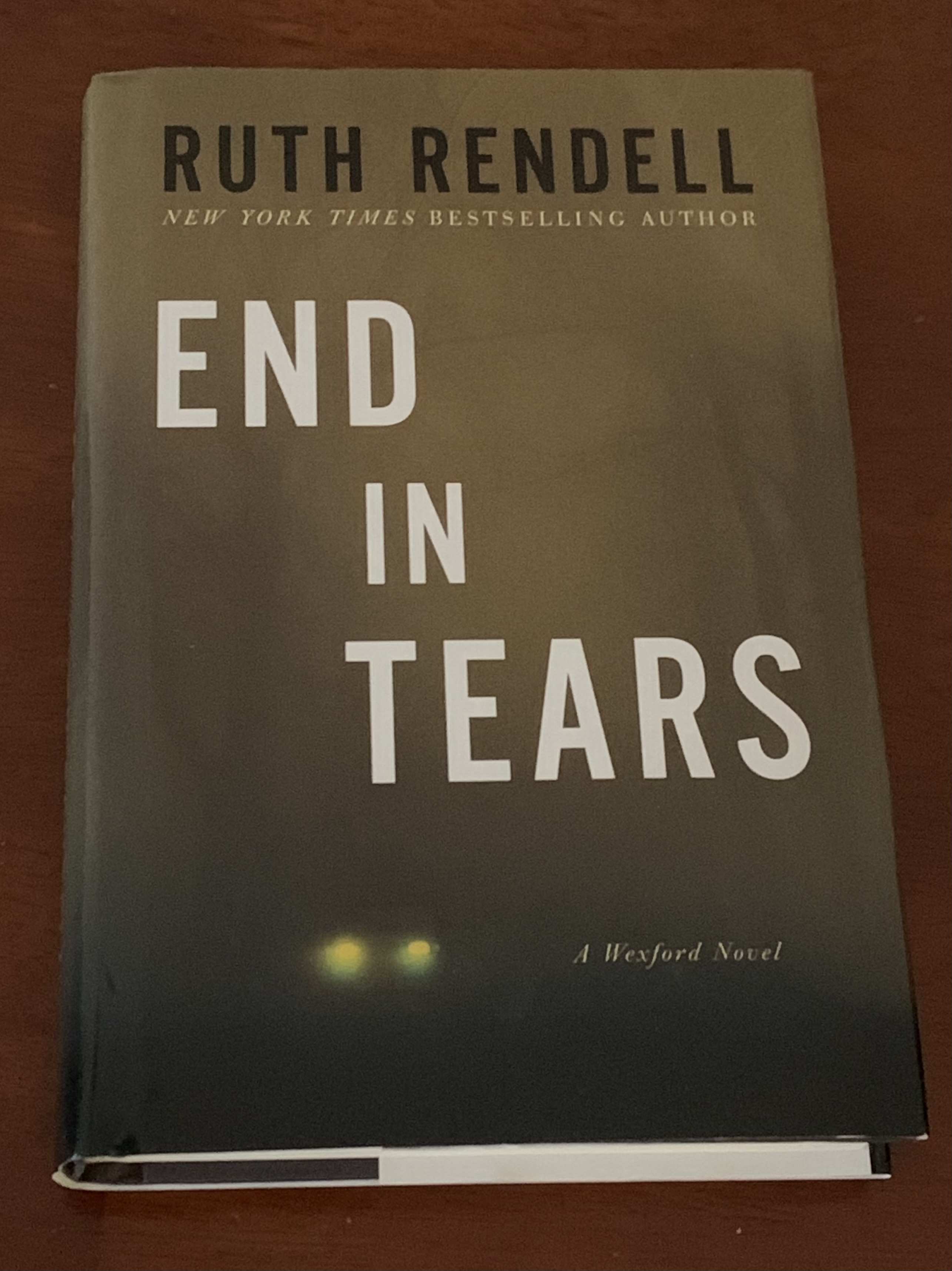
I love coming across what is probably a well-known author to a certain segment of the reading population who I’ve never encountered. In this case, I picked up one of Ruth Rendell’s books at a Half-Price Books warehouse sale. Rendell was an English author of more than 50-some books. She had extraordinary longevity from her debut book in 1964 through to her last standalone novel in 2015 at the age of 85. What a feat! A large chunk of her bibliography, 24 books in total, including the aforementioned debut book, is her Inspector Wexford series. I read the 20th in the series, 2005’s End in Tears. Obviously, having not read anything in the series prior, I didn’t know much about Wexford as a character, and honestly, I didn’t glean much from this one about his character other than his fondness for quoting Shakespeare and then his Hercule Poirot-like explanation of the whodunit of it all at the end of the book.
Wexford is a father of two, and in this novel, one of his daughters, Sylvia, who he appears to have a rocky relationship with, is ostensibly being a surrogate mother for her ex-lover’s new girlfriend. That only makes Wexford’s relationship with her rockier. But the surrogacy angle reflects the happenings within the whodunit plot, albeit, it’s a red herring. In the fictional town of Kingsmarkham, a man inexplicably drops a concrete block off a bridge onto a vehicle below intending for a different vehicle. Later, that intended victim, Amber, is brutally murdered in a nearby wood. Wexford picks up on the connection between the two events. Shortly thereafter, a second woman, Megan, goes missing and then is found also brutally murdered at a construction site. The throughline between Sylvia, Megan, and Amber is surrogacy. Megan and Amber, two young girls who previously had babies, decided to make money being surrogates for desperate parents — although it’s more likely they’re swindling them out of the money without following through on pregnancy. As it happens, and this is where the red herring comes into play, a few seedy characters are also swindling desperate mothers out of their money through some sort of scheme involving Africa. Bizarrely, as the police are going down this path, Hannah, one of the sergeants, goes undercover to entrap the schemers, but she does it without any backup! Fortunately, her would-be lover, and fellow cop, catches up to what’s going on and rescues her before she’s killed. Phew.
But again, that’s all a red herring, So, early on, what we know about Amber is that she and her stepmother, Diana, had a mutual dislike of each other, seemingly heightened by Diana being the, well, “surrogate” mother to Amber’s child, Brand. Diana doesn’t appear to dote on Brand, either, seeing him more as a burden than a gift. So, when Amber is killed, the thinking from Wexford is that Diana actually doesn’t have a motive, despite the dislike, because Amber’s death would just further foist Brand and that responsibility upon her. But as Wexford comes to realize, Diana is like the desperate women seeking surrogacy and babies by other means: she, too, wanted a child and came to love Brand. Thus, she wanted Amber out of the way, and paid a set of seedy twins money to do just that. Megan so happened to be a witness to one of the twins being near the scene of the crime, and was killed as well when she (stupidly) tried to blackmail one of the twins. The murders had nothing to do with Amber and Megan’s surrogacy swindling.
Rendell’s writing felt to me like Agatha Christie-lite, especially, I said before, with the Poirot-like explanation Wexford offered up at the end to make sense of the scheme. Which, by the way, I would love to be compared even lightly to one of the greatest mysteries writers of all time. But I wonder if I read, let’s call it, “peak Rendell,” if the writing and plotting would be stronger to me. Also, if Wexford would be more of a character. As it was, he felt like such a nonfactor until his magnificent explanation of the plot in the literal final few pages of the book. Finally, there seemed to be some sort of weather-related motif throughout the book, perhaps indicating the passage of time as Wexford tried to solve the case, from the blistering heat of August to the freak blizzard in the late fall. But it was rather overdone, in my humble opinion.
All that constructive critiquing aside, I still found myself wrapped up in the story and trying to figure out who did what and why. Diana always had the strongest motive to me, but Rendell, to her credit, effectively misdirected me and flipped the script on her motive. I’d certainly be interested in reading some earlier Wexford stories after this one.

 Milam's Musings
One thought