
Spoilers!
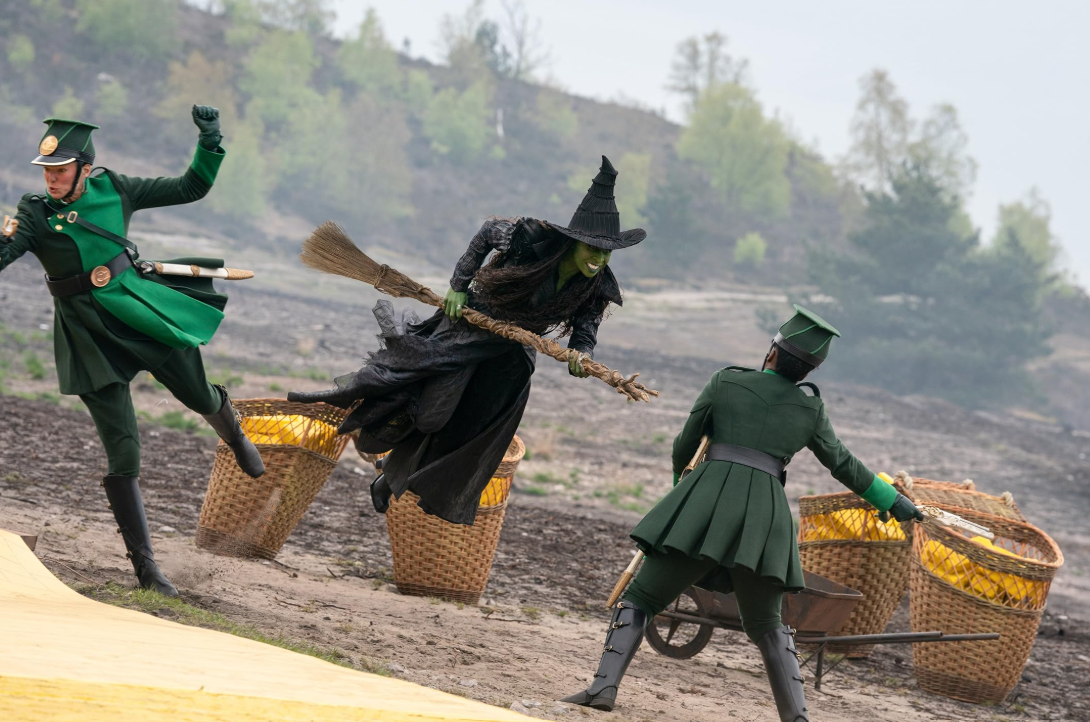
Right and wrong — the way forward — is not so black and white; it’s actually green and white, and the way forward is yellow, albeit not in the cowardly sense. Jon Chu’s follow-up to 2024’s Wicked: Part 1, 2025’s Wicked: For Good, is darker, dourer, with less levity than its predecessor, although still plenty of gravity-defying action beats, but nevertheless irresistible, immersive, and indelible entertainment. That’s because of the world-building cinematography, set pieces, and costume design, and of course, that Cynthia Erivo and Ariana Grande, as Elphaba and Glinda, respectively, continue to sing and shine in their roles. When on screen together, particularly in the closing (and my favorite!) musical number, “For Good,” their chemistry is so damn electric and captivating. While I missed some of the moments of whimsy and levity permeating the first film, Wicked: For Good was trying something different, and I think Chu and company delivered.

Where we left off from the prior film is Elphaba akin to Batman in 2008’s The Dark Knight: actually good, but becoming the villain in the eyes of Oz, which only serves to accentuate the goodness of Glinda (the equivalent for Batman was Harvey Dent). Elphaba also took a stand for animal rights, as the animals were the original villains for the denizens of Oz the Wizard (played by Jeff Goldblum) and his Goebbels-like propagandist, Madame Morrible (played by Michelle Yeoh, who continues to be marvelous in portraying her character’s Machiavellian machinations, to offer another historical analog), conjured up. Meanwhile, even though Glinda is sad about Elphaba, and certainly doesn’t want to see her killed by the flying monkeys or doused to death with bucket water, she’s more focused on her engagement and impending marriage to Fiyero (played by the smoldering and intense Jonathan Bailey). But it’s clear Fiyero’s true feelings and devotion lie with Elphaba, not Glinda. That’ll come to a head later.
Elphaba tries to convince the animals not to leave Oz, despite their persecution, as she wants to enlist their help to expose the Wizard’s lies, but the Cowardly Lion appears to argue otherwise. Additionally, Elphaba is dealing with her sister, Nessarose (played by Marissa Bode, who depicts the “broken-hearted scorned lover” so well!), who is a paraplegic and now the Governor of Munchkinland after their father died. Her righthand man, and presumed lover is Boq (played by Ethan Slater). But Boq makes it abundantly clear his affections lie with Glinda, which infuriates Nessarose. As a result, Nessarose bans the Munchkins from traveling, which brings Boq back to her. She also doesn’t want anything to do with Elphaba, who she feels abandoned her. Through trying to curry favor, I suppose, with Nessarose, Elphaba gives her flight through the classic shoes Dorothy would soon wear. After, when Nessarose tries to cast a love spell on Boq because Elphaba’s spell book is available, she instead shrinks his heart. In trying to save him, Elphaba turns him into the Tin Man. As Elphaba is christened the Wicked Witch of the West, Nessarose now sees herself as the Wicked Witch of the East for what she’s done.
What surprised me next was that Elphaba just walked right into Emerald City and confronted the Wizard. I’m not sure what she was expecting! That he would just stop his propagandizing and lies and admit everything to the people of Oz. But he does make a good point through the musical interlude, “Wonderful,” that the people of Oz don’t want to know the truth. And even if suddenly presented with it by the Wizard, they probably wouldn’t believe it. In other words, people prefer their comforting fictions to hard truths and shattering realities. In exchange for freeing the cursed flying monkeys, Elphaba actually agrees to join the Wizard and Glinda. Which also surprised me, but the bargain made sense for the sake of the monkeys, at least until Elphaba stumbles across more animals imprisoned within the Wizard’s palace. In outrage, she frees them, which also leads to them stampeding through Glinda and Fiyero’s wedding in a fantastic scene. That also “liberates” Fiyero from the facade he put up for Glinda’s benefit: after the animal melee, he flees the Emerald City with Elphaba. The look he gives Glinda here is why I said Bailey is intense; it’s a subtle intensity that he brings with his eyes and facial expression. Glinda, in her heartbreak (a reoccurring theme here, first with Nessarose and now Glinda!), offers the Wizard and Morrible the idea of luring Elphaba back to the Emerald City by making it appear as if Nessa is in trouble. The horrible Morrible takes it a step further by conjuring a tornado that causes a house to land on Nessarose, killing her, which is when Dorothy comes into play. Glinda gives a dead woman’s shoes to Dorothy and helps her follow the newly created Yellow Brick Road to the Wizard.
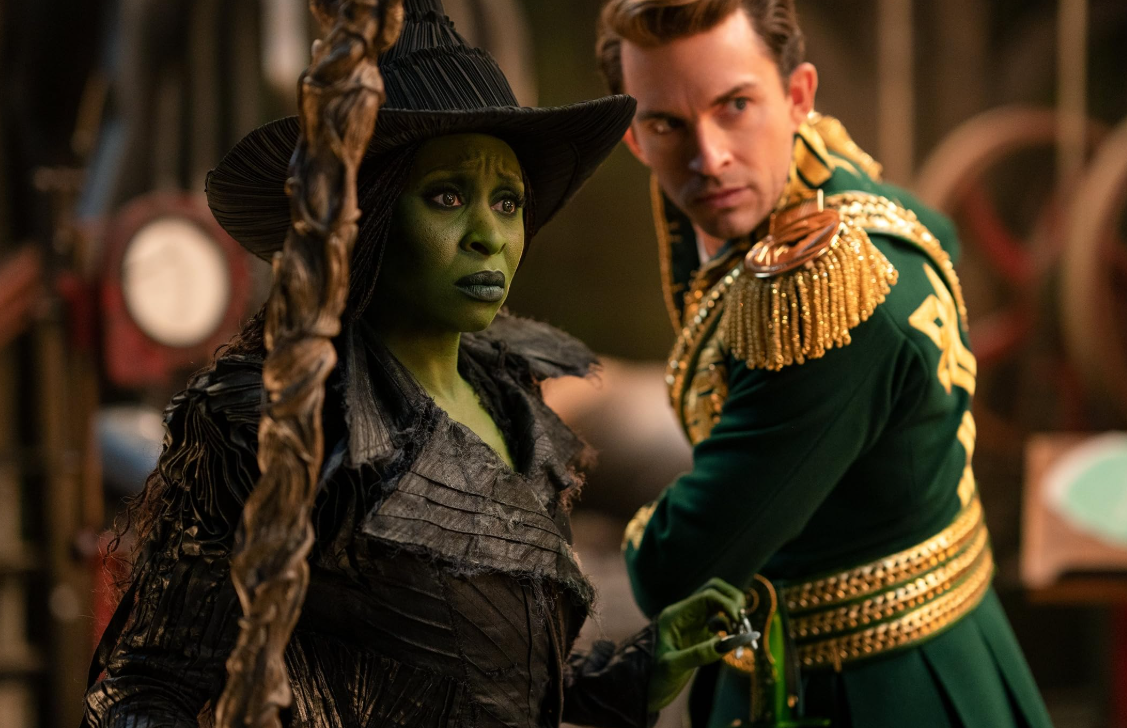
Now, at this point, I began wondering what happened to all the fun levity from the first movie?! Luckily for me, it was about to happen. Elphaba confronts Glinda about what I mentioned before — Glinda giving a dead woman’s shoes to Dorothy — and they have a hilarious brawl where Glinda is clearly outmatched, owing to her nonmagical abilities. But that’s where Fiyero comes back in to save Elphaba from being captured, resulting in his near death. One of the goosebump-inducing moments of the film is when Elphaba quickly flies back to the Kiamo Ko castle where she’s hiding out and uses the spell book to save Fiyero’s life, “No Good Deed.” To save his life, she turns Fiyero into the Scarecrow! That’s also the turning point for Elphaba, where she’s decided to embrace her villainous reputation because, as the song said, no good deed goes unpunished.
Boq, as a bitter Tin Man now, helps to rally the denizens of Oz against Elphaba. He, along with Dorothy, Fiyero, and the Cowardly Lion were directed by the Wizard to kill Elphaba and bring him her broom. But this whipping up of the mob and impending mob violence causes Glinda to reflect upon her public image as well, that she’s a caricature built upon Morrible’s lies. That lofty image is no longer worth everything being sacrificed, including quite literally her friend, Elphaba, to maintain. She goes to Kiamo Ko to warn Elphaba about the approaching mob. This was my favorite scene from the whole film, going back to my point about how damn captivating Grande and Erivo are together, especially and obviously, when they’re singing. I adore their friendship that fully blooms here through, “For Good,” the best musical number of this film’s soundtrack. Elphaba prefers the fiction mentioned at the top (her as the villain accentuating Glinda’s goodness) continue. While Glinda goes along with this, worse still is that Glinda watches as Dorothy douses Elphaba in water melting her. What a beautifully shot scene, as the confrontation was done in silhouette, where given all the context, you actually kind of hated Dorothy! (To be fair, Elphaba did imprison her.) Another neat thing was that Chu never gave us a full-on look at Dorothy, hence the aforementioned silhouette style, which was smart to do.

Everything unfolds fairly quickly after Elphaba’s death: Glinda confronts the Wizard, showing him proof that Elphaba was his daughter, causing him to flee Oz in shame; and Morrible is then apprehended by the flying monkeys on Glinda’s insistence. The latter I may need help with understanding. Morrible seemed so powerful, why wouldn’t she resist her arrest more forcefully? Nonetheless, back in Munchkin land in the scene that started the first film, Glinda expands upon her answer about being Elphaba’s friend by reestablishing animal rights in Oz. All is good again!
And the best part? Elphaba emerges from a trapdoor with the help of Fiyero. I was worried that Elphaba would literally martyr herself for her friend, Glinda, but thankfully, she did not. Elphaba and Fiyero walk off into the land beyond Oz while Glinda seems to finally become magical, thanks to the spell book Elphaba gave her.
The reason I think this movie works, even though it is markedly more dour than the first film, is because confronting a fascist regime that’s consolidated power and controls public perception is difficult and dour! And yes, it’s not black and white in the sacrifices that need to be made. Everything worked out in the end, but it certainly wasn’t as simple as following the Yellow Brick Road. Wicked: For Good is a story about heartbreak, scorned lovers and friendships, and in equal measure, rediscovering the power of those friendships, the importance of even painful truths and self-reflections, and that sometimes, it’s okay to leave the fight to others. Which is to say, Elphaba ultimately left the fight to Glinda, who by that point, was ready, able, and willing.
What a one-two punch Chu’s Wicked adaptation has been, carried by powerhouse performances, phenomenal cinematography, dazzling dance choreography, expansive set pieces, elaborate costumes and makeup work, enthralling musical numbers, and of course, what is needed above all else, a compelling story subversive of the original Wizard of Oz. Fans of the first will undoubtedly walk away enjoying this one, too.

 Milam's Musings
One thought