
Spoilers ahead!
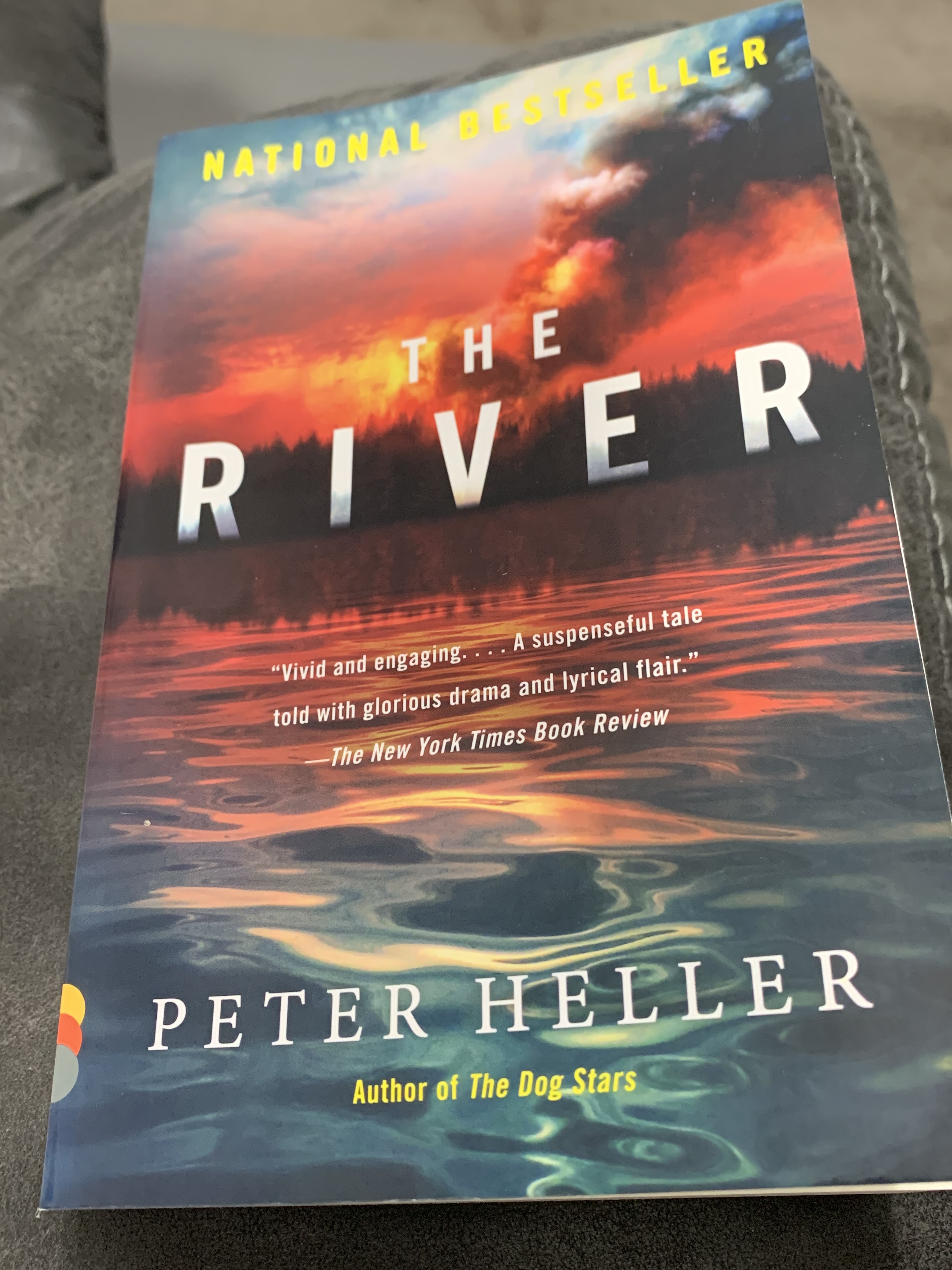
Gimme a minute. Surefooted Jack, that’s all he needs in Peter Heller’s 2019 hellacious nature thriller, The River. And that’s all it takes for everything to unravel from a quixotic paddle through the river wilderness with his best friend, Wynn, to these two best friends having an inferno roaring at their back, the threat of surviving nature otherwise (and the real pull of nature, hunger), and the most common threat humans face: each other.
Heller’s book reads like the best of nature books, writing in awe of nature’s simplicity — the seeming intelligence of the fish to evade wildfire, for example — and the joy of stripping away modernity to its minimalist roots and enjoying nature with your best friend under the stars — Wyatt is a man characterized by Jack as “puppy” believing the best of people and who enjoys being ankle deep in the water; and Jack is a man paddling away from his guilt over causing his mom’s death when he was a child (also in an “accident” of nature) and who is more attuned to the hunt, which suits them well when they face the evils of man — but also, the awe of nature’s power, the undercurrent of impending doom tracking these boys like a hunter would. Or as Heller beautifully writes at one point, “They buried their faces between the cobbles in inches of water and they felt a wind like some demonic thing, like nothing on earth, a searing gust that pummeled the canoe, they could hear the burning wood flail against it, the tick of embers, they were lying in water heads down in the ice runnels between stones and could not help but hear the passing over of hell.”
Nature is brutally awesome and simplistic in that way: both the displayer of beauty, reminding us of what is all around us, but often forgotten, including the stars Wynn waxes poetic about it (how they mirror the navigation of the river, pouring into their own ocean of galaxies), and the harbinger of death, the simple fact of it, not with any prejudice (and in fact, the inferno seems to dance around, burning some trees and not others, some tributaries and not others, Wynn’s cheek and not Jack’s), but just because. In fact, the boys (and the woman they’re later with) find themselves quite literally on the dividing line of this juxtaposition when they emerge from a near flash fire and straddle nature between its burned remnants and its still-lush green foliage.
If the fire, and the off-season impending cold (another interesting juxtaposition) weren’t enough of a concern, Wynn and Jack come across a marital “spat.” The spat seems to turn deadly when the man attempts to murder the woman. Wynn and Jack are able to rescue her and bring her back to life, of a kind, insomuch as canoeing about on the rapids and warming up by campfire and being satiated by blueberries the boys foraged for is a “life,” but it’s better than being left for dead. Wynn, being the “puppy” he is, thinks perhaps the man is innocent and that the woman was attacked by a bear or fell, and that the man’s actions are only that of a scared man, not a killer looking to finish off his wife and the boys to boot. Jack, on the other hand, is more cynical and hardened, and in some ways, morphs into a scarier version of Jack to Wynn, who doesn’t recognize his friend. At one point, Jack even points the gun at Wynn to ensure Wynn steers the canoe the way he wants. Nature has a way, Wynn mused at one point, of making men crazy.
All of this is to say, the story was about to culminate, little did I expect, in a way that would mirror the childhood story Jack experienced where his mother died and he blamed himself. In this case, Wynn, Jack, and the woman come across two drunks from earlier in the story, who somehow survived the fire. In the middle of the night, Jack catches one of the men seemingly attempting to rape the woman. They abscond with the drunk men’s boat because it has a motor, but also because Jack thinks it will dupe the man from the marriage “spat” into shooting the two drunks instead of them. Instead, the “fat man” of the drunks shoots Wynn dead (and later the man). Thus, Jack blames himself for Wynn’s dead, as he still blames himself for his mother’s.
Jack is able to escape with the woman, and Wynn’s carcass, and eventually make it out of that particular pit of hell. Nobody is ever charged with any crimes, because the Canadian Mounties determine that stealing someone’s boat justifies deadly self-defense. In the epilogue, Jack visits Wynn’s mother and sister to explain what happened. We learn that Jack tried to put the whole affair behind him by “letting go” of a canoe Wynn carved out of wood, but the damn canoe floated back to Jack, unwilling to let him go. That moment made me tear up.
Heller’s book is beautiful and has a charming anachronistic feel to it, like the pipes the boys smoke when they’re not paddling — an ode to a bygone era of journeying in nature, bare bones and all, as it were. Which, in some regard, was their downfall. Had they not, had they had a satellite phone, for example, they could’ve gotten out of there before everything went sideways, but then, we wouldn’t have a book, and we wouldn’t have these flawed, but interesting, characters to root for to survive.
The River is one of my favorite fiction reads of the year so far.

 Milam's Musings
Hi Brett,
Just finished the book and was seeking feedback on an uncharacteristic, yet pivotal, misstep by Jack. When the two Texans unexpectedly arrived where Jack, Wynn, and Maia were camping, the book made it clear that J.D. and Jack were both hyper aware of each other’s rifles and remained vigilant to this point. Jack and J.D. did not trust one another.
Later that night when Jack awoke due to J.D.’s behaviors then pulled him out of the tent and gave him a couple good whacks from the butt end of his rifle, Jack’s reaction was to quickly and silently leave unnoticed. As far as the reader knew, there was only one firearm between the two Texans and it was lying right there at Jack’s feet when he knocked out J.D.; why not pick it up!? I’m factoring in that he was exhausted, nervous, and a bit disoriented however, all this attention to J.D.’s rifle and Jack just left it there and he had accounted for it prior to pulling J.D. out of the tent.
I’m all for a main character doing something unorthodox or even making a common oversight. But this was the golden opportunity to seize the only other gun while the Fat texan was asleep and J.D. was concussed. It was right there. As you stated, if they brought a cell phone, there’d be no story however, the author didn’t even clean this up later on. It could have served as yet another remorseful log on Jack’s bon fire of life’s regrets?
If I’ve missed something in the story, please enlighten me.
Thanks, KF-
LikeLike