
Spoilers!
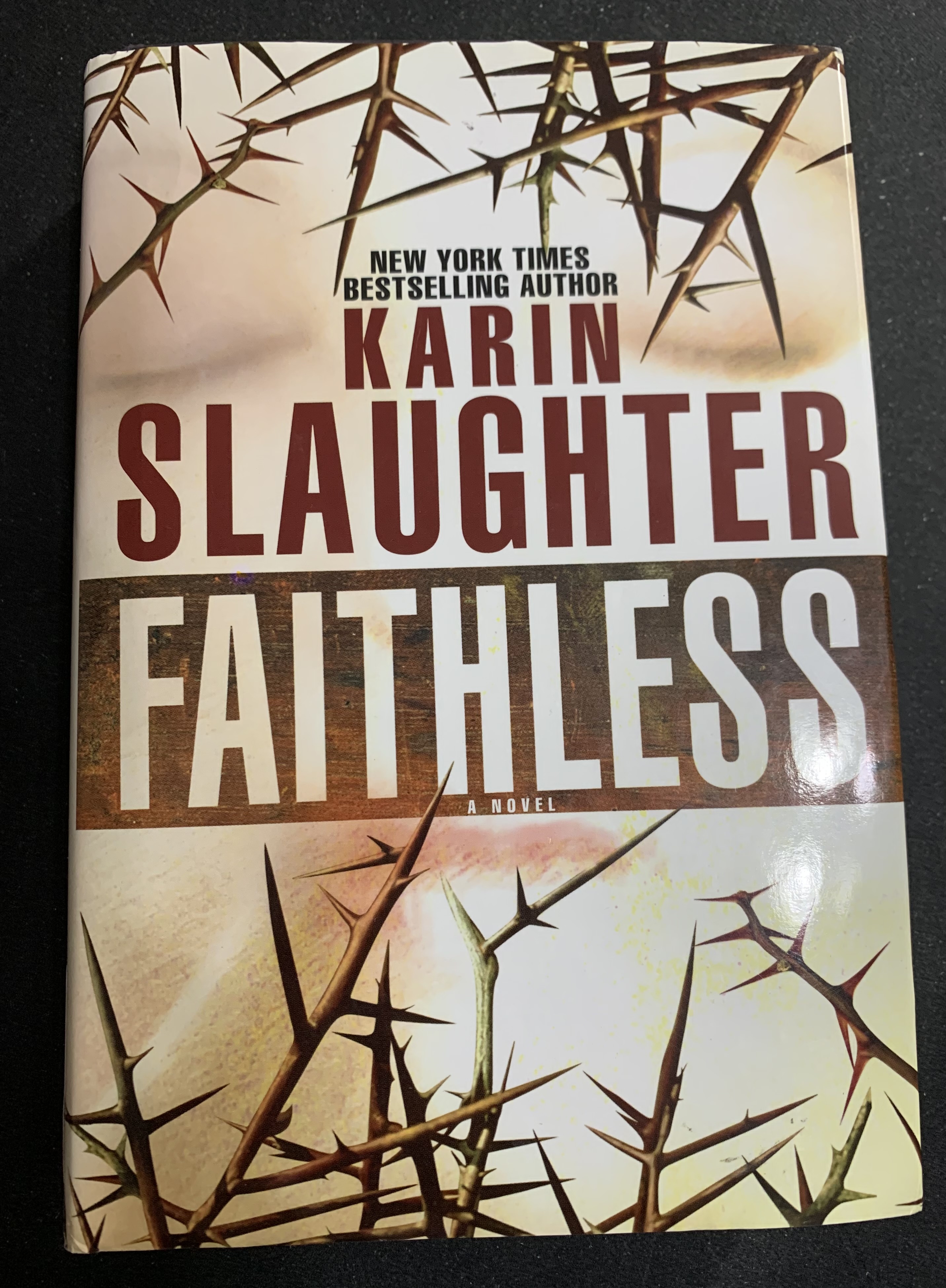
Whodunit is a great starting premise for a book, but it’s made all the better when the characters in the whodunit are well-developed so that as a reader, I care about them. I’m invested. On some level, I’m going to keep reading, even if the prose and/or characters are loosely developed because I still have an innate need to know whodunit, but I’m going to remember the book more because it made me feel something. I’ve been watching Pieces of Her on Netflix, which is an adaptation of Karin Slaughter’s 2018 novel, and it occurred to me that I’ve never read a Slaughter novel before. I rectified that the last two days with her 2005 novel, Faithless.
Faithless is the fifth novel in Slaughter’s Grant County series set in Grant County, Georgia, featuring medical examiner Sara Linton and her ex-husband, police chief Jeffrey Tolliver. At the start of this one, they are reconciling after Jeffrey had a brief affair. Also along for the ride is Lena, Tolliver’s rather … messy (his word!) detective. For starters, she has difficulty expressing emotion, especially to Tolliver, which caused her previous relationship to fizzle out. She was raped three years prior to the events of the book. And her twin sister, who was a lesbian and it was something Lena struggled with, was murdered. Oh, and if all of that backstory wasn’t bad enough, presently, Lena is being physically and emotionally abused by her loser, Nazi-sympathizing boyfriend, Ethan. In fact, our first introduction to Lena, I believe, is her at an abortion clinic in Atlanta, which only adds to her shame in addition to being with an abusive man.
Anyhow, Linton and Tolliver are on the case of a young woman who was buried alive in the woods, but worse yet, she was poisoned with cyanide. The folks at the center of the investigation are the devoutly religious members of the Holy Grown farm (red flags!), both the extensive family members and the wayward “souls” they allow onto the farm. That is, the family gives those convicted of prior drug offenses and such, second chances to work on the farm. The foreman, Cole Connolly, a former convict and soldier, is now a Bible-thumping maniac. He’s the most obvious suspect from the outset. And it turns out, he indeed was the one who buried the young girl alive. But he didn’t kill her. He only put her and other girls there to “teach them a lesson,” and then he would release them a few days later. Somebody else poisoned her.
I should note, in relation to Slaughter adding character development to these characters and making me caring about the relationships, Tolliver learns he might have Hepatitis (he doesn’t know which kind) from the affair, bringing up the ill fillings Linton had about him prior and whether she can trust him. He gets a clean bill of health later. But also, we learn that Tolliver can relate to Lena’s abuse, as his mother was abused by his father. And Linton’s mother had an emotional affair with a man (the founder of Holy Grown, as it turns out), so Linton can find some understanding with her mother, or at least a reference point for life after an affair occurs.
Lena later learns that one of the girls, Terri, who escaped the farm is not only also in an abusive relationship, but was also at the abortion clinic. The threads are everywhere and run wound-deep! Through this situation with Terri, Lena, I think, learns to find her own strength to confront, or at least, distance, herself from her abuser.
Tolliver, in talking with Lena, had a poignant insight about those who face abuse from their significant others, and in his case, he was reflecting on his own mother: At some point, living your life by merely trying to survive burns out, and you’re instead, hoping the next beating is the last — that he kills you, so at least it’ll be over. That resonates with Lena, who in many ways, thinks she deserves it and enjoys the punishment.
Later, when Tolliver and Linton find the person who poisoned the girl to death, Paul, the lawyerly brother of the Holy Grown farm operation (he was basically reaping the life insurance windfalls from the convicts after killing them with Cole’s help, and when the young girl found out, he killed her, too), holds Terri and her son hostage with Lena and Tolliver there, and Lena observes another insight into abusive situations by looking at Terri: She’s learned to read the body language of a man because doing so mean’s the difference between “keeping the peace” and violence. The person suffering abuse learns how to adeptly walk on eggshells, as it were. Eek.
Like I said, this book attracted me with its whodunit, then had me invested with Slaughter’s good character and relationship work, but it will linger with me because of its haunting meditations on abuse victims. There is nothing clear-cut about abuse and Slaughter represented that well here. The scenes, for example, when abusers are around their woman, particularly Paul with Terri in the climactic scene, are brutal and intense. Claustrophobic-feeling! Ethan with Lena, too, especially because you can’t help your mind going to: Dang, she’s a cop and this is still happening to her! Abuse, even described on the page, is difficult to read and experience.
Overall, I wish I had started reading Slaughter sooner, but the good side of that is I have plenty of books to catch up on now! I would definitely recommend Slaughter to anyone.

 Milam's Musings