
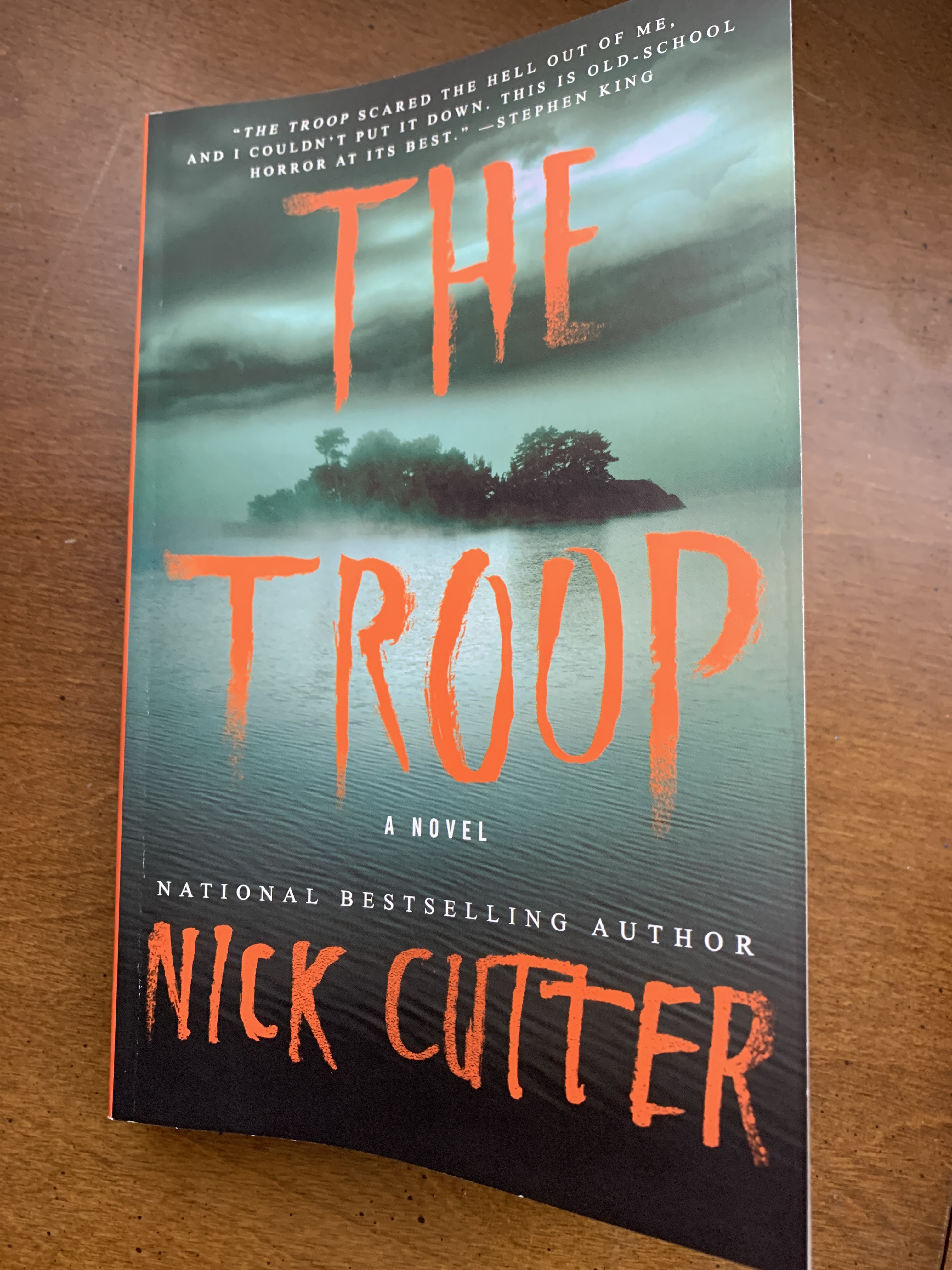
Blurbs work. When I’m on the hunt for a new horror book to read at Barnes & Noble, and I see Stephen King’s blurb on the cover of a book (and to be fair, it seems like he blurbs a lot of horror books), that’s enough for me. I skimmed the first few lines of the synopsis, and bought the book. And whaddya know, it might be my favorite horror book of the year thus far. I’m referring to Nick Cutter’s 2014 body horror book, The Troop. I’d have to really think back to recall a book that made me feel as viscerally yucked out as Cutter’s book did. That gave me the heebie-jeebies down to my bone marrow. He made me squirm! Heck, I begrudgingly took a break from reading to eat lunch, but I have to say, my appetite was a bit diminished! I adore being made to feel like worms were crawling under my skin (more on that in a moment) because isn’t that delightful? That words on a page conjured up by an author can do that to a reader? Well-done, Cutter, you sick bastard.
The premise of the book is tantalizing: Scoutmaster Tim Riggs takes Troop 52, consisting of five 14-year-old boys, to an island off the mainland of Canada known as Falstaff Island. Tim is also a doctor on the mainland, Prince Edward Island. A hungry man, a very hungry man, washes ashore in a boat, and because Tim holds to the Hippocratic Oath, he tries to render aid to the poor man, and instead, he is infected, too, with … something that also makes him a very hungry man. And chaos ensues and unfurls in unexpected ways thereafter.
Troop 52 includes Ephraim or Eef, as his friends call him, a boy with a hairline trigger for anger and a bit of a daredevil (he’s the only boy who smokes the “cancer sticks”); Kent, the biggest and strongest of the boys, so he makes himself the de facto leader, especially after Tim gets sick, and he’s also trying to impress his burly police chief father; Max, Eef’s best friend, and son of a mortician; Newton, the butt of all the jokes and a huge nerd (seriously, Cutter spent a rather funny amount of time establishing how nerdy Newton is, but it’s for good reason, as we’ll see); and Shelley, a bona fide sociopath, who enjoys killing living things just for the fun of it. As if an unknown something wasn’t bad enough …
It’s apropos that Cutter had King’s blurb on the front, because like a lot of horror writers I have to imagine, he was inspired by King and particularly with the structure of the book, by Carrie. That is, the structure of The Troop, like Carrie, is told from the present happenings on the island, and then interspersed with news clippings, a magazine story, diary entries, court interviews, scientific experiment logs, and so forth, looking back on what happened on the island. For example, I don’t remember exactly when it occurred in the book, but maybe half-way, we already know there will be a “lone survivor” because of the magazine story. I was repeating in my head, “Please don’t be Shelley. Please don’t be Shelley.” I hated Shelley.
What happened is, another sociopath, Dr. Clive Edgerton, created a genetically weaponized version of a tapeworm known as a hydatid, tested it horrifically on gorillas, and then moved to a human subject — the same human subject who washed ashore of the island where Troop 52 was stationed, aka Patient Zero. The stated aim of the testing was to create one of the holy grails in pharmaceuticals: a weight loss drug. But there was duplicity involved: Edgerton also had grant money to create a military weapon. Consider how easy it would be to sully the enemy’s water with these genetically weaponized tapeworms and wreak havoc, if you didn’t care about the Geneva Convention, ethics, or humanity.
The boys are screwed. And it does not take long for the crap to hit the fan, which is the best: Cutter wasted no time letting the crap fling about. Tim is essentially sick from the get-go after trying to render aid to the sick man. What Tim (and he enlists Max’s help) observes in trying to help the man reads like the alien bursting scene from Alien. It’s grotesque. Unlike a normal tapeworm, which already gives me the heebie-jeebies, and which can be treated fairly easily, this genetically weaponized tapeworm devours your body entirely in a matter of hours with an insatiable hunger, and it doesn’t even have to be “edible” items (sand, raw crab, algae, your own hair, the worm itself, etc.), and then weirdly, just before your finished off, it’s as if your body doesn’t realize the carnage done, and then you die. It’s a horrific death, with the worm literally feeding on the goo of your eyeball, your teeth, everything, and we glimpse this awful body horror through Patient Zero, Tim, and then even later, more horrifically (since they’re kids, but also, just more horrifically) Kent, Shelley (although we don’t feel sorry for him because he’s a sociopath who killed a kitten, killed Kent, led Eef to his death and then burned him alive, and tried to kill Max and Newton), and in an indirect way, Eef.
After Tim is sickened, even though it’s devastating to do and a mob mentality sets in to do it, the boys lock Tim in the closet. That’s smart because they don’t know what they’re dealing with, and don’t want to get sick, either. Unfortunately, a storm sets loose on the island, with lightning befalling a tree that kills Tim. At least the tree put him out of his worm misery.
Like King’s books, I love a story with teenagers at the center of the crap-hitting-the-fan, and Cutter’s teenage characters are well-drawn, with plenty of instances of them reminiscing about their lives prior to coming to the dreadful, dead island to flesh out (heh) their characters. But also, a theme permeating everything, is that these 14-year-olds (Shelley aside) are just on the cusp of their innocence decaying and dying, too. They are in the last death throes of their childhood innocence. And because of that, until and even for a good chunk into, the crap hitting the fan, they think Tim and/or other adults will figure it out. Because that’s what childhood innocence tells you: adults know how to fix things and will fix things. But that veneer is quickly shattered when these teenagers are faced with life and death situations. Especially because in this case, the adults aren’t coming. Both adults on the island are dead, and the Canadian military has quarantined the island and aren’t saving the Scouts. The military deems it a biological hazard. Nothing in, nothing out. And the saddest part of the book, even more than the bodily horror, is when the teens realize adults don’t know what they’re doing, either, except unlike children, there’s not as much keeping them accountable (the latter point is a musing Max has later in the book).
Kent dies first, owing to his bravado and penchant to lead; he drinks the Scotch that Tim drank, and thus, transfers the worms to himself. Eef dies a brutal, brutal death, but not from the worms. Rather, he dies from fear of the worms and Shelley planting the seed that he saw a worm underneath Eef’s fingernail. Of course, Shelley was screwing with him because he could. Eef was never sick. But that led to Eef systematically trying to cut the worm out of his own body by slicing and dicing his face, ear, ankle, and stomach. Then, fully broken from reality, Eef allows Shelley to douse him in gasoline and set him on fire to “burn the worm out.” Brutal, I told you! In Shelley’s efforts to finish off Kent by drowning him like he did a kitten when he was younger, he also catches the worms, but he likes it, relishing it like he’s a daddy now (to the worms, that is). He then tries to sabotage Max and Newton, who are using Newton’s nerdy big brain to survive the island, the worms, and Shelley, which is why Cutter made such a point of Newton’s nerdiness because it pays off in the end, at least for a bit.
I have to digress here to mention one of the most horrific scenes in the whole book and it didn’t have anything directly to do with the dang worms. Max and Newton, who are legitimately hungry, not worm-hungry, wrestle a sea turtle to the sand, and then Max uses his Scout knife to kill the turtle. Except, he comes to find out, killing a living being desperately clinging to life — a nice metaphor for what’s happening with the humans and the worms — is harder than it would seem. He stabs and stabs, plunging the knife into the poor turtle over and over again. The turtle is still alive, though, and every now and then, he pokes his head out of his protective shell to remind the boys of that fact. Finally, they are able to kill the sea turtle, but the act robbed them of their appetite and instead, they bury the sea turtle. That scene will haunt my brain maybe even more than the human bodily harm done to our human characters by the worms. I found it particularly profound because unlike Shelley, Max and Newton were obviously adversely affected by the act.
Eventually, though, the worms kill Shelley, too. Good riddance.
Using the boat Patient Zero used to get to the island (after two harrowing scenes of trying to retrieve the spark plugs for the boat from Shelley), Max and Newton head back to the mainland. Unfortunately and sadly, Newton is sick with the worms. In his delirium, he stands up in the boat upon approaching the military vessels, and dreadfully mentions how hungry he is, resulting in a military sniper killing him. So, Max is our “lone survivor,” but he’s not really a survivor in any sense of getting to live a real life thereafter. Everyone treats him as if he’s actually infected anyway, even though he’s not.
Between the premise of the book, the structure and pacing, the well-done characterization of the boys (they really do seem like 14-year-old boys, both on the edge of adulthood, but with lingering innocence), the horrific body horror Cutter writes, and just as importantly, the overarching themes of innocence lost and how life clings to … living, I will reiterate what I did at the start: this is likely to be my favorite horror read of the year. The body horror will stick with me, particularly that poor turtle, but I’m going to be thinking about Max’s reflections on how adults don’t know what they’re doing, either, just as much, like a little tapeworm nestled in the back of my brain. Another blurb on the book called it “disquieting,” and I find the latter to be the disquieting part because it’s far more real than a genetically modified tapeworm.
Anyway. Yuck.

 Milam's Musings
One thought