
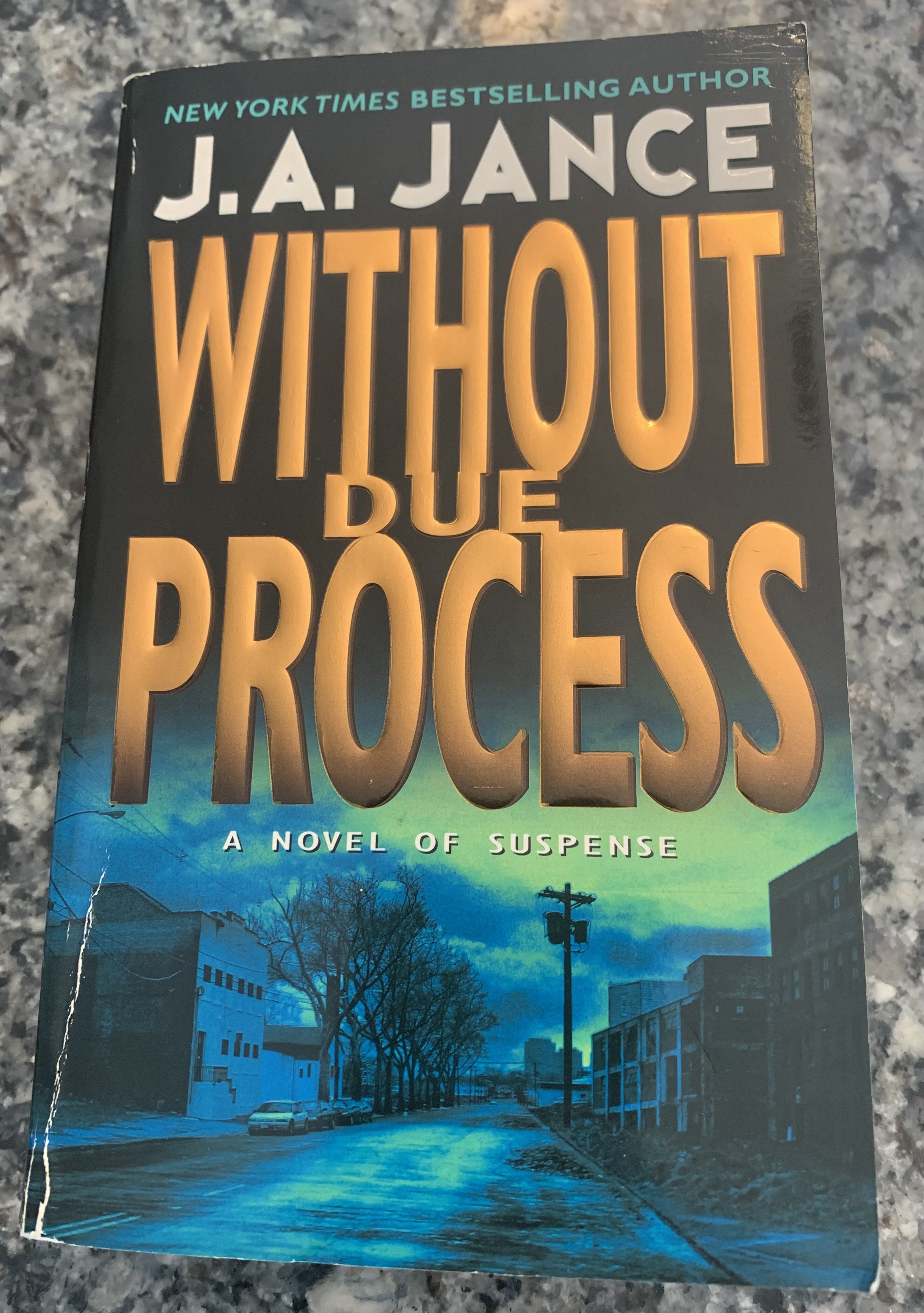
A straightforward, basic whodunit for a reader like me is akin to drinking a mug of chamomile tea. It just hits my spot and goes down nicely. Soothes my need-to-know-whodunit soul. I’m continuing my streak of reading books by women authors I’ve heard of, but not yet read. The last two days, I read J.A. Jance’s 1992 novel, Without Due Process. I could have sworn I had read another novel of hers, but I guess not. Anyhow, this novel is the 10th in her J.P. Beaumont series, following Beau, a homicide detective with the Seattle Police Department (Seattle is one of Jance’s homebases). Today I learned, J.A. Jance, or Judith Ann, went by J.A. because the publisher said a female author writing a male detective would be a “liability.” Yuck. Well, J.A. Jance has a had a very long and successful career despite sexism in the publishing industry. And she can absolutely write a male detective series.
As I said, Without Due Process, is pretty straightforward, but it’s basicness is its strong suit, in fact. The story starts off with a horrific mass murder: “Gentle Ben” Weston, his wife, two of his kids, one of his kid’s friends, and the family dog, were all brutally murdered in the middle of the night. Ben is a police officer with the Seattle Police Department working in the gang unit. Or as the department euphemistically calls it, Coordinated Criminal Investigations. Of course, that’s a red flag in my book. If a department has a gang unit, there’s a good chance the gang unit is itself operating like a gang, and that seems to have been the case with this one in Jance’s book. Corrupt cops were getting protection money from the three warring gangs in Seattle. And when Ben caught on to that fact, they killed him for it. Just as dangerously, Ben’s 5-year-old son, Ben Weston Jr., survived by hiding in a closet and is now a sought after as a target because he’s a witness.
Scuttlebutt back at the department is that Ben was also corrupt, but as point-of-fact, he was working on a detailed gang database, and as I mentioned, getting close to nailing the corrupt cops. In addition to that, he had created his own, as he called it, Underground Railroad, taking troubled kids from gangs to college and footing the bill for their schooling. He was one of the good ones.
Eventually, Beau and some choice members of the department, including the Captain of Internal Investigations, are able to unravel the whodunit: A former Marine who is a mechanic for the department did the actual killing (and then was either purposefully killed or accidentally overdosed); a Patrol officer there the night of the murder, guarding the house after-the-fact incidentally; and a cop who kept lurking around Beau trying to supposedly sell him life insurance. What a rib that is! And contrary to the title and the sense (as Jance addresses) that cops will go beyond due process to avenge the loss of one of their own, no extrajudicial action occurs in the book. Which I liked!
What I love about Jance’s book here, and the reason I called it straightforward as a compliment, is because there weren’t a lot of overdone twists and turns and unnecessary plot complexities. It was a straightforward story of a good cop gunned down by his fellow bad cops, and a few good cops trying to figure it out. I appreciated a straightforward story like that told exceedingly well and fast-paced.
I also appreciated that Jance put in some race relation issues between the cops and the African American community, i.e., the latter didn’t trust the former and for good reason. So, when an entire African American family gets wiped out, a high-profile one at that, tensions are understandably high. I thought Jance handled that subplot deftly.
Finally, given the book came out in 1992, I found the jokes about Beau not understanding a fax machine or wishing his colleague’s vehicle had a cellular phone so they could respond to a beeper, a fun and funny throwback to a different time.
I look forward to reading more of Jance’s work. I’m intrigued by her Joanna Brady series set in Jance’s other homebase of Arizona. This one, though, made me want to visit Seattle, oddly enough given how on-edge the top officials in her book were with whether folks would still want to visit Seattle due to the gang issues. I still do, thank you very much.

 Milam's Musings