
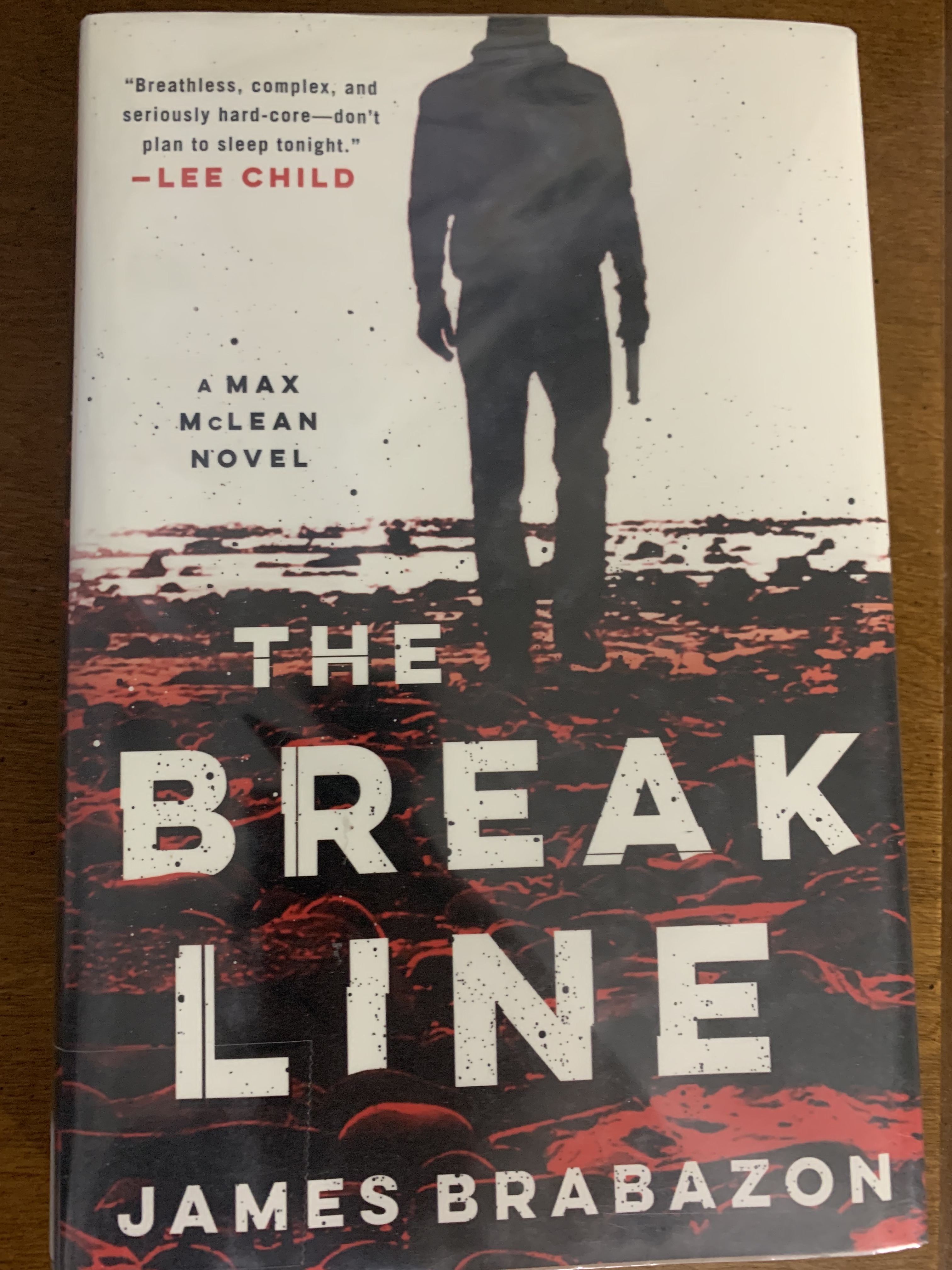
Unknown unknowns seem to be the currency of the assassin trade, but for Max McLean in James Brabazon’s 2018 novel, The Break Line, it’s not enough. Given the book was blurbed by Lee Child, features a silhouetted man with a gun on the cover, and has a generic action-book title, you’d be forgiven for thinking Brabazon’s novel was going to be the usual assassin book. This is anything but, and I was pleasantly surprised by that fact.
Essentially, McLean, a special forces assassin for the British government, is tasked with going to Sierra Leone and killing a rebel leader presumably backed by the Russians. And as Brabazon subtly tells us, the Americans will be no help in this operation because the higher ups in Washington aren’t interested in deterring Russia (it was written in 2018, mind you!). The stated concern is that if the rebels overrun Sierra Leone, then it’s a domino effect where the rebels would then move into Liberia and Guinea next, destabilizing the entire West African region.
But McLean is facing something altogether different. The first inclination of that is that a fellow special ops assassin, Sonny Boy, who is known for a being a concrete tree of a man and unflappable, went mad after what he saw in the jungles of Sierra Leone. He went so mad, that when McLean came to talk to him about it, Sonny tried to kill him, and so, Max had to kill him in self-defense. Or at least, when he left Sonny Boy, he was clinging to life. Then, later, once in the jungle himself, McLean is taken by the Sierra Leone Army to a decimated village — decimated by something they deem unnatural, and others refer to as dyinyinga, a demonic spirit of folklore among the people of Sierra Leone — where bodies have been quite literally ripped apart by hands and human teeth.
McLean finds tunnels (old Chinese mining caves) beneath the villages, where essentially the Russians have set up an entire forward operating base, replete with medical testing, and that medical testing is on human subjects. The mad scientist behind it all turns out to be McLean’s long-thought-to-be-dead father, who apparently is working for the Russians. He spews mad ravings about finding the original vector for Ebola and creating a vaccine for it, but what he ended up actually creating was zombie-like creatures out of those infected with the original vector virus for Ebola (at least in this 2014 article, it seems clear we don’t quite know where the virus originates or how it then transfers to humans). In other words, McLean’s dad weaponized a pure version of Ebola to make an army of superhumans virtually unstoppable. The worst-case scenario is thousands of these creatures overtaking countries, continents, and the world. Those darn Russians. If that wasn’t bad enough, McLean was set-up by a rogue member of the British secret intelligence who was working to craft a deal with the Russians and the Americans (I’m not entirely sure what the deal was, but McLean survived and learned about it, of course).
The latter stages of the novel get a bit spiritual and esoteric with the mad ravings and rituals of McLean’s father, but McLean is able to survive both because the vaccine was made from his DNA (meaning, his father’s) and thus, he’s able to control the “Sleepers,” as the creatures are called, long enough to survive, and he’s rescued by two people from earlier in the novel who were helping him get into the jungle in the first place.
I thought Brabazon’s novel was smartly written, and the little ruminations about life interspersed with the strategizing, killings, ravaging, and surviving, were actually quite interesting. In fact, one came from McLean’s father’s mad ravings: “Men are vanquished by what is within them, not by what is brought to bear against them. Fear, Max. Fear is the weapon. Not fear of the enemy, but fear of oneself.” The emphasis was in the original quote. And indeed, I think if one wanted to reach for the metaphor, the “Sleepers” are a metaphor for how governments the world over train up (and then disappear off the books) assassins, aka weaponize human beings in the same way, albeit not to the same deranged, fictionalized degree, McLean’s father weaponized men with the Ebola virus. Similarly, too, the only way to end either one is a bullet to the head. For example, when McLean has to kill a rogue CIA agent, the CIA agent is still trying to kill McLean despite bleeding out to his death.
If you like assassin novels with a flourish of jungle fever and some zombie-like fun, then Brabazon’s novel is for you, a lesser-known gem of the action-thriller genre of books if there ever was one.

 Milam's Musings