
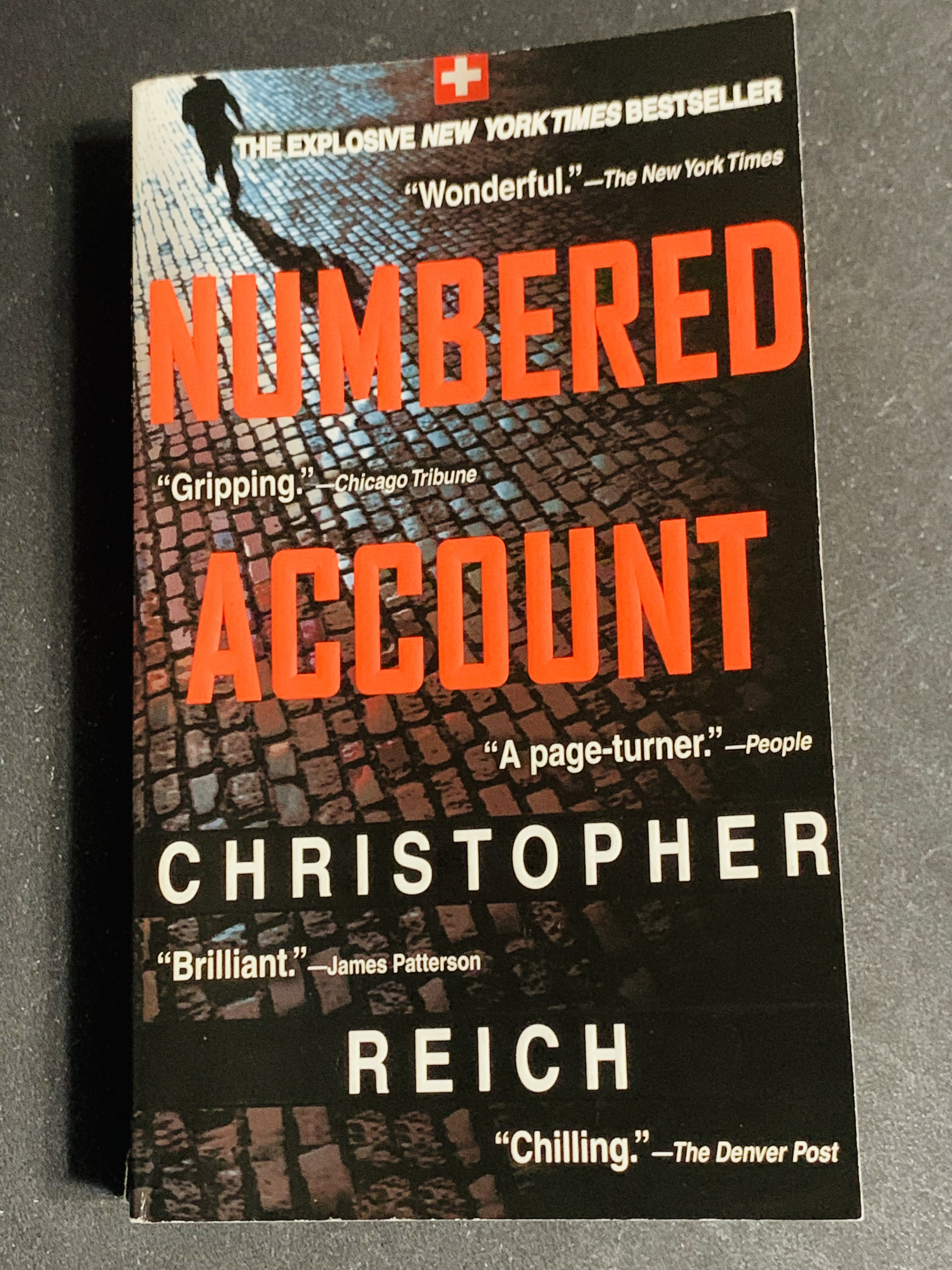
A 750-page book about banking intrigue and conspiratorial plotting — banking! — and Swiss banking at that, shouldn’t have been as enthralling as it was, but my brain was properly titillated by Christopher Reich’s 1998 book, Numbered Account. I’m not much of a finance guy on a personal level by any means, and on an intellectual level, I’m interested in economics, but not so much finance. Some of the banking and finance lexicon and maneuverings in Reich’s book went over my head for that reason, especially because he authentically worked in a Swiss bank, but that only gave the book even more legitimately, and there’s a direct relationship between an increase in legitimacy and an increase in my titillation at the unfolding plot and bank intrigue. I don’t like to look into a book until I’ve written my review (I’m adding this addendum after having done so), but today I learned, a “numbered account” is primarily a Swiss bank feature, where an account holder’s account is known through their number rather than their specific identity.
In Reich’s novel, our protagonist, Nick Neumann, departs for Switzerland to work at the United Swiss Bank, leaving behind not only a glitzy fast-tracked career on Wall Street, but his fiancée, breaking off the engagement, obviously. (She rightly didn’t want to upend their life and future to go half-way across the world!) Nick is adamant about getting to the bottom of his father’s murder 20 years prior, though. His father, Alex Neumann, not only worked at United Swiss Bank, but Nick strongly suspects the bank had something to do with his murder. Therefore, if Nick can secure a job at the bank, then he can sleuth around and find out the mystery behind the murder, so his thinking goes.
Unfortunately for Nick, a lot of forces he doesn’t even know about yet are working against him, primarily a Turkish drug lord and terrorist, Ali Mevlevi, who made his fortunes in heroin trafficking across Europe — and does business with the United Swiss Bank, the caricature of the seedy types laundering their money to the Swiss to avoid the law — but whose main goal, as an Islamist now, is to set off a tactical nuclear weapon on a settlement in Israel, forecasted to kill 15,000 men, women, and children instantly. In other words, he’s using his heroin money to buy up weapons of mass destruction, and to control bankers to continue doing his seedy business. To that point, he “owns” Wolfgang Kaiser, the longtime chairman of United Swiss Bank, and once longtime childhood friend of Alex Neumann.
However, and I suppose this owes to the time period in which it was written, if I’m being charitable, what Mevlevi has on Kaiser is that Mevlevi is bribing him with compromising photos of Kaiser with a “transvestite.” Even aside from the issues of that term and the cliché story element of being “tricked” by a trans person, I don’t think it’s enough of a blackmail pressure point! But maybe that’s just my moral sensibility. Certainly, I don’t see it as enough of a blackmail pressure point for Kaiser to be under the thumb of Mevlevi for 20 years doing all kinds of awful things, including killing one of his own underlings. I also didn’t think that murder made much sense. Kaiser is the respected chairman of a powerful and well-known Swiss bank. He’s not going to get his own hands dirty! Nonetheless …
Nick eventually figures all of this out, although there was a stumbling block along the way. That being the personnel vice president at the bank, Sylvia Schon. Maybe a third of the way into the book, Kaiser makes an off-handed remark to Sylvia that she should keep a particularly close eye or whatever the phrasing was on Nick. I took that as an directive-through-insinuation to have sex with Nick to stay close to what he was up to. Then, suddenly, Nick and Sylvia are on an item after Nick makes a move on her and Sylvia acquiesces. Nah! My brain went right back to Kaiser’s line, and I figured Sylvia was dirty all along because she was way too loyal to the “bank” and thus, Kaiser. I was right. She was in league with Kaiser and was feeding all the dirt about what Nick was up to right back to Kaiser.
Surprisingly early on in the book (relatively speaking, with a couple hundred pages still left), Nick confronts Mevlevi about his suspicions after Mevlevi kills a henchman in front of Nick and then Nick out of instinct catches the murder weapon, a gun, in his hands, making himself culpable. What I didn’t believe next was that Nick, a former United States Marine (and the story behind his dishonorable discharge from the Marines was an interesting subplot itself, where basically Nick beat the crap out of a CIA military contractor who left his unit out to dry in the Philippines, resulting in one dead and others injured, including Nick himself), holding the gun in his hand, wouldn’t realize it wasn’t loaded. Instead, he shoots Mevlevi, but there were no more bullets. Empty. Come on, Nick! Or even if he couldn’t tell the weight difference since it wasn’t his gun and he wouldn’t necessarily be familiar with it, I feel like a Marine would check if the gun was loaded before attempting to fire on someone.
Those issues — the flimsy blackmail backstory, Kaiser himself killing one of his underlings, and Nick shooting a gun a Marine should know better to not fire without checking if it’s loaded — aside, again, I found Reich’s book a quintessential page-turner. I was intrigued by the bank shenanigans, the subplot of attacking Israel, and of course, Nick’s characterization, both his Marine background and his quest to uncover what happened to his dad. I found it poignant that Nick, even once he realized who was responsible for his dad’s death (Mevlevi and Kaiser), he didn’t feel the sense of … competition he perhaps expected to experience. Vengeance and revenge aren’t as fulfilling as they appear to be from the outset. I also appreciated that a character early on in the book, who was originally handling Mevlevi’s “numbered account,” Peter Sprecher, who then left to work a the bank that was attempting to buy out the United Swiss Bank, went from a curmudgeonly arrogant bloke to Nick’s one true friend he could count on. So much so that Peter was instrumental in bringing down Mevlevi at the climax of the novel. That little arc for a minor character was nice, as was the vindication for Sterling Thorne, the Drug Enforcement Administration agent in-country with the cooperation of the Swiss to bring Mevlevi down, who was pushed off the case and rebuked initially by Nick. He was also instrumental in not only thwarting Mevlevi’s drug operations, but through his connections at the CIA, stopping the two-pronged attack on Israel (a front-facing infantry-like attack, and then the tactical nuclear weapon attack).
So, yeah, if you’re into banking and finance, you’ll definitely get a kick out of this book with the fun fictional accoutrements thrown in. As someone who isn’t normally into banking and finance, I sure as heck still did get the “kick” out of it, which I think, again, owes a lot to the legitimacy Reich brought to the table with his background in banking and finance. That was particularly pronounced in the dialogue between characters. I found it, for the most part, believable and thus, captivating to read (I only hedge because some of the romantic dialogue did make me cringe!). Overall, well-done, Mr. Reich.

 Milam's Musings