
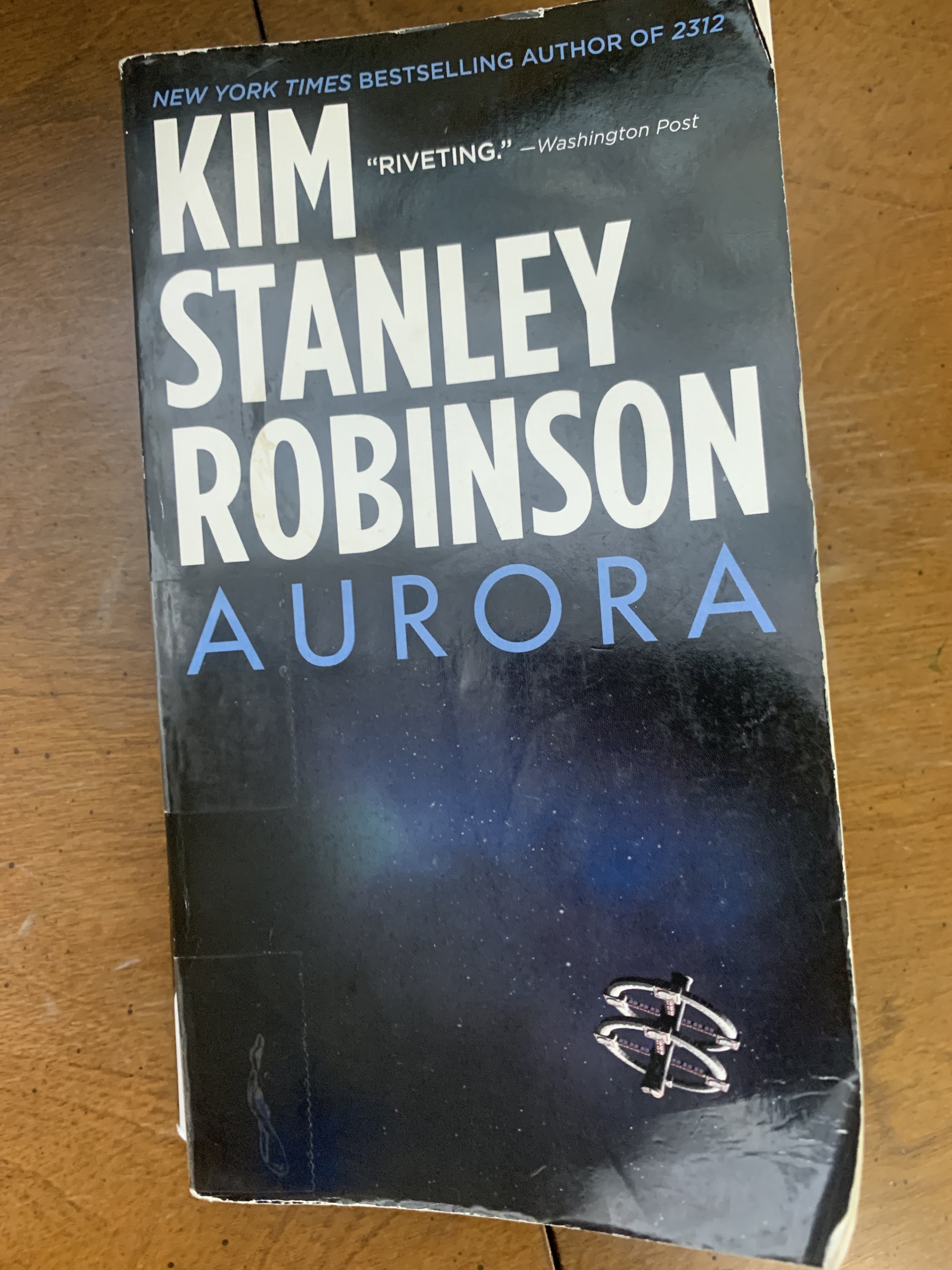
Starfarers at heart, literally down to our DNA perhaps, humans seek outward when what’s inward was there all along, and it’s own sort of “starfaring,” albeit directionally different. Kim Stanley Robinson grapples with this impulse, this teeter-tottering, if you will (an analogy he uses in the book), both on a near-future scientific level, with how logic and language operate at the metaphysical level (often nonsensically!), and at the deeply human (and resulting artificial intelligent) psychological level, in his 2015 book, Aurora.
In Aurora, set in the year 2545, six generations of “starfarers” have been approaching Tau Ceti after being propelled from Saturn to potentially terraform an Earth analog planet or moon, and Tau Ceti itself is an analog, as far as that goes, to our sun. Consider that: starting a mission you know you won’t live to see the end of, or even that your grandchildren will live to see the end of, but you do it anyway. In fact, 20 million people volunteered to be one of the select 2,000 humans to go on the journey. Then, imagine, your entire existence, everything you’ve ever known, being confined to a ship. A miraculous ship, no doubt, mirroring Earth-like towns and cities, only that it’s propelling at a percentage of the speed of light, faster than any human-created projectile. Still, a ship. It’s a ship operated by an artificial intelligence that, thanks to Devi, the ship’s “captain” for lack of a better word (the tribulations of language to approximate meaning!) on the ship and its engineer and A.I. programmer, encourages the A.I. to “narrate” the story, which creates funny moments of language difficulties and trying to analogize what this trip is like. But more importantly, over time, the A.I., which calls itself “Ship” or “we,” comes to love its cargo, i.e., the humans (and other living beings) and does nearly unimaginable computations and calculations to ensure their survival.
Eventually, the humans do reach Tau Ceti and its moon, Aurora, but not before Devi dies, though, and is unable to see the fruits of her labors. Aurora is something of a paradox: being an analog for Earth in that it has the constituent parts suitable to sustaining and reproducing life means its also inhospitable to life forms, like humans, who aren’t used to its bacteria. As such, some sort of microscopic virus or pathogen kills the first of the starfarers to go down to the planet to begin terraforming it.
This results in the first open strife since Year 68 on the ship. Discord and indeed, civil war, over how to proceed now that Aurora is biologically dangerous. Ultimately, the factions break down between those who are “stayers,” who want to try other Earth analogs since they’re already out beyond our solar system, and those who are “backers,” who want to go “back” to Earth, where they know, as humans, they will be “welcomed” by the bacteria, as it were. But it’s a funny notion because nobody aboard that ship has ever been on or seen Earth other than through 12-year delayed reports! They are generations removed from the humans who were born on, and knew, Earth. They’re seeking to go back to a home they’ve never known. The compromise, enabled by the Ship or A.I. finally interceding itself (themselves?), is that the stayers will stay to terraform Iris (another moon of another star) and the backers will head back to Earth. We never do learn the fate of the “stayers.”
As for the backers, including Freya, Devi’s daughter who has taken up the mantle as the ship’s captain like her mother before her, they face a new issue beyond governing structures and free will, albeit not actually new. Famine strikes because reproducing and maintaining agricultural crops on a ship are difficult, and because bacteria is growing on the ship after all this time disrupting everything. And because humans create that teeter-totter problem of disequilibrium. Without us and our self-consciousness impeding matters, life, which wants to live, as Robinson points out, will generally return to some form of homeostasis. But humans, well, we’re more complicated. The solution: hyperhibernation, where the ships inhabitants will undergo hibernation for the century and a half it takes to get back to our solar system, with the help of the A.I., which loves the humans now, as the caretaker.
In other words, more than three centuries of roundtrip traveling on a ship that didn’t end up accomplishing its originally-stated goal. That’s a lot of traveling! But the problem the A.I. encounters is that the inhabitants of Saturn who built the lasers that propelled the ship in the first place, removed the lasers that will help the ship deaccelerate, a rather big issue when your ship is moving at even a fraction of a percentage of light speed. Essentially, after the inhabitants of Saturn get the lasers going again (“too little too late,” as the A.I. gripes), the solution is to pinball through our solar system for 12 years using the “drag” caused by the reverse gravitational pull of the Sun, and the gas giants Jupiter, Saturn, and Neptune, to slow down enough to drop-off the surviving humans of the ship back on to Earth. Having done this, the Ship then flies into the sun.
Once back on Earth, the humans aboard the ship, who have never seen or experienced Earth before, are both in awe and terrified of its enormity and beauty and power. They analog Earth to a giant ship in its own right. And in the end, Freya enjoys the simple beauty of the Earth’s power through the tide, that is perhaps responsible for life itself, bringing in crashing wave after wave.
I’ve never read a Robinson book before, but what a joy my first “dip” into his imaginative ocean Aurora was. Robinson is breath-takingly authentic inasmuch as I understood the breadth and depth of the science on display, interspersed with meta-comedy through the A.I. “character” musing about humans and our complexities, ultimately coming to the conclusion that we need meaning, and meaning is love, and to that point, Robinson’s book is also beautifully poetic and contemplative.
For example, at one point, the A.I. comes to understand that the seemingly simple directive given to it by Devi to narrate their story is not so simple, stating, “Some actions, some feelings, one might venture, simply do not have ways to be effectively compressed, discretized, quantified, operationalized, proceduralized, and gamified; and that lack, that absence, makes them unalgorithmic.” Italics are his emphasis. Indeed, what is “beyond algorithm” is the human experience! The A.I. can computate and model, but human variables are too myriad to “fit” in any meaningful way, and certainly then, it is inconceivable to approach anything like narrative as distilled from what is “beyond algorithm,” but of course, we do try, which is the fun messiness of said human experience and the weirdness of our language.
Another interesting concept to the human experience I liked from Robinson was his idea of how a reconciliation process necessarily needs a “structured forgetting,” but that there is a paradox within it. In other words, when strife manifest between humans, at some point, to be able to go on being social animals with those humans, we necessarily need a “structured forgetting,” but this attempt at enabling us to move on peacefully, eventually, breaks down because we forgot what led to the strife in the first place! In the case of the book, nobody aboard the ship knew that a second ship was sent to Tau Ceti and that violence ensued after that second ship was obliterated for causes unknown. The “structured forgetting” that followed allowed for peace to return to the ship, but eventually, in the narrative of Freya’s time, led to civil war, which also needed its own solution, in this case a divorce, or as Robinson cleverly put it, a “successful failure.”
However, the best remark in the book comes toward the end in shared poems between Freya’s father and friend, that gets to the heart of whether humans reach beyond the stars or back in upon themselves, and indeed, the Earth, like terraforming the Earth in response to cataclysmic climate change: “… no ship exists to take you from yourself.” That’s the crux of the matter, and which Freya and the people try to explain upon “returning” to Earth, where the people are seeking to send more ships out beyond the solar system. Yes, we can figure out the biological and physics computations, and all that it takes to, as a matter of science, mathematics, and logic, send human beings across great distances. But what we can’t account for is that we are still sending human beings across great distances! You can’t algorithm it! That’s Robinson’s point, as I understand it.
So, I don’t know, maybe it’s better to be like Freya and ride the waves here on Earth rather than the ones out there where you’ll get swept up in the same rip currents that have plagued humans since the savannas.
If you like smart and poetic science fiction, I highly recommend Robinson’s book, Aurora. The themes he tried to distill into a narrative are going to be floating around in my brain for a while to come.

 Milam's Musings