
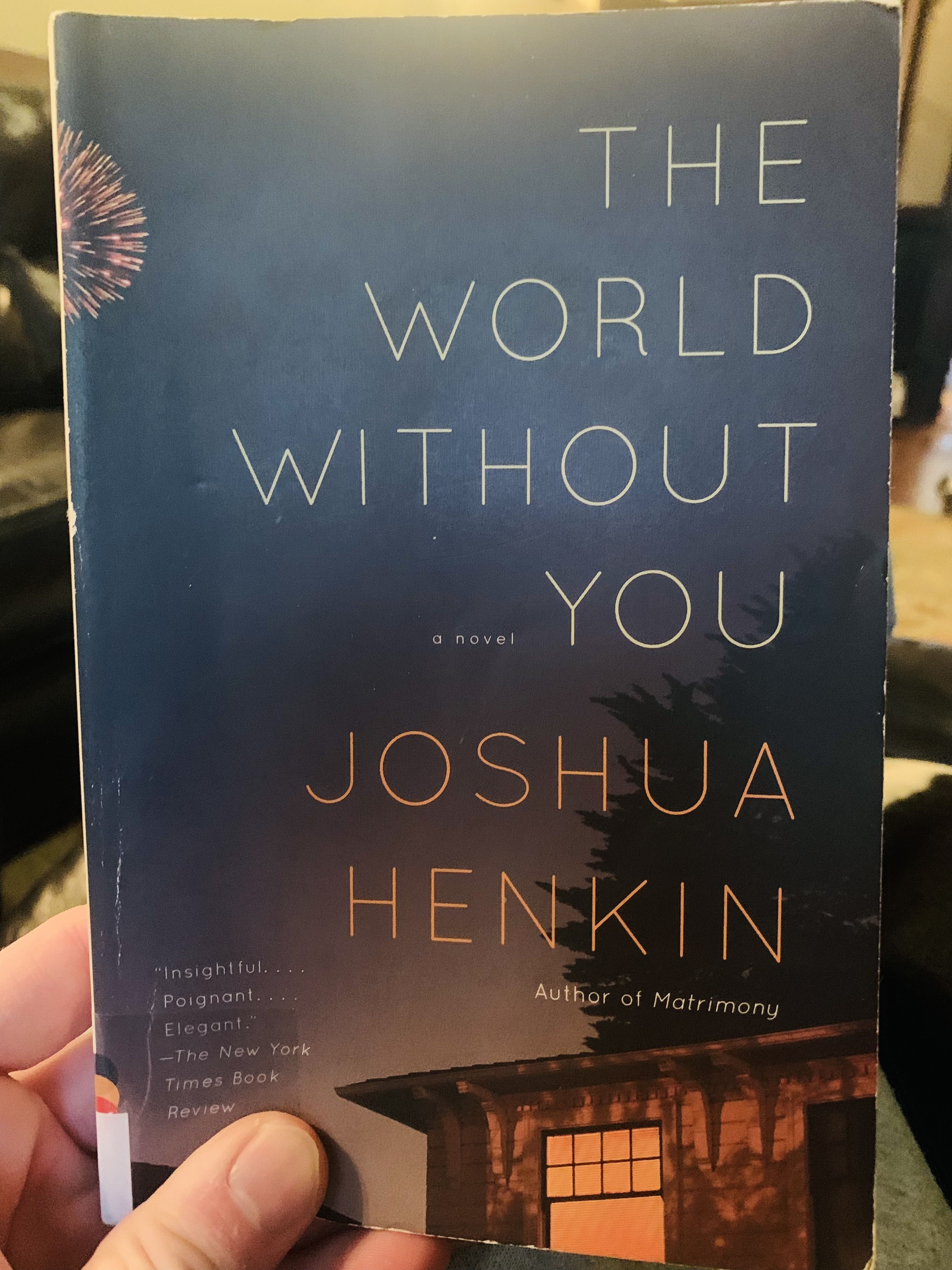
Grief has a way of excavating old wounds, reminding people of what’s long been buried and thought lost, forgotten. In Joshua Henkin’s 2012 novel, The World Without You, a family tries to navigate what happens when those old wounds surface, bringing with them uncomfortable truths, secrets, and the realization that even grief isn’t the material needed to repair fissured familial bonds.
On July 4th, 2005, the Frankel family are coming to their summer home in the Berkshires for a memorial service for their son, brother, husband, brother-in-law, and uncle, Leo, who died the previous year after being captured during the war in Iraq, where he was reporting on the war as a journalist. The family is both coming there for the memorial service, and one senses, as a memorial to the family unit they once were, and once both memorials are finished, they can go back to their established lives.
Marilyn and David, married for 42 years and the father of Leo and three girls, are planning on getting a divorce. That’s the dark cloud hanging over the memorial to come — I suppose bedding up with the dark cloud of Leo’s death itself, which is fingered as the catalyst for the pending divorce. Their oldest daughter, Clarissa, has been trying without success to get pregnant, and her husband, Nathaniel, who is on the shortlist for a Nobel Prize in neuroscience, is tired of “trying,” as it were. This is left unresolved at the end. Their middle child, Lily, seems perpetually angry and also, wanted to soldier on to this memorial without her boyfriend, Malcolm, who surprises her by coming anyhow. The youngest of the clan (but still older than Leo), Noelle, went from something of a nymphomaniac as a youth to being a ultra-Orthodox Jew in Israel with four boys and a husband, Amram, who, spoiler alert, I can’t stand (the way he treats Noelle is frustrating). Then, there’s Thisbe and her and Leo’s son, and Thisbe is holding in a secret only Lily knows, which is that she has a new boyfriend, who she met only four months after Leo’s death and (and this is a secret that actually never gets out), she was planning on separating from Theo prior to his murder. Lest we forget Gretchen, the 94-year-old matriarch of the family (David’s mother), who is filthy rich and sort of lords it over everyone. In fact, she gifted $200,000 to Thisbe for her and Leo’s child, but Thisbe returns it to David who promptly tears it in half.
As you can imagine, when you get all of these elements together, plus the fact that Marilyn and Noelle don’t get along, Lily and Noelle don’t get along, and there’s, ya know, the overall pall hanging over everything anyway, and Henkin’s book makes for one of those riveting family dramas buoyed, as it only needs to be, by penetrating dialogue and the rawness of living. I’m talking about the kind of well-written dialogue that is able to be distinguishable among all these characters and personalities, keep the book flowing at a fast clip, make me think about the deep undercurrents between the lines, and importantly and most impressively of all, make me uncomfortable at times. It’s good to be made to feel that way because these characters are having tough, difficult conversations about life, each other, and their futures.
And true to the family drama he’s written, Henkin doesn’t wrap everything up in a neat bow at the end. I mean, there is a sweet moment at the end with Marilyn and David seemingly reconciling to some extent and her teaching him how to ride a bicycle, but everything is teetering, complex, nuanced. Precarious and precious. As life tends to be. The lesson I take from the book is what I started the review with: sometimes we think a life-altering occurrence, such as a death, will bring people closer together, and instead, often times, it has the opposite effect because grief strips away all pretense and cover. Alas, sometimes what’s leftover can be made into a new kind of relationship. The three sisters are going to try to forge one upon that altar at least.
If you dig family drama books, I think you’ll like this one. It reminded me of both the film and the play by Tennessee Williams, Cat on a Hot Tin Roof. I think that gives you somewhat of an idea of the wheelhouse Henkin’s book is operating in.

 Milam's Musings