
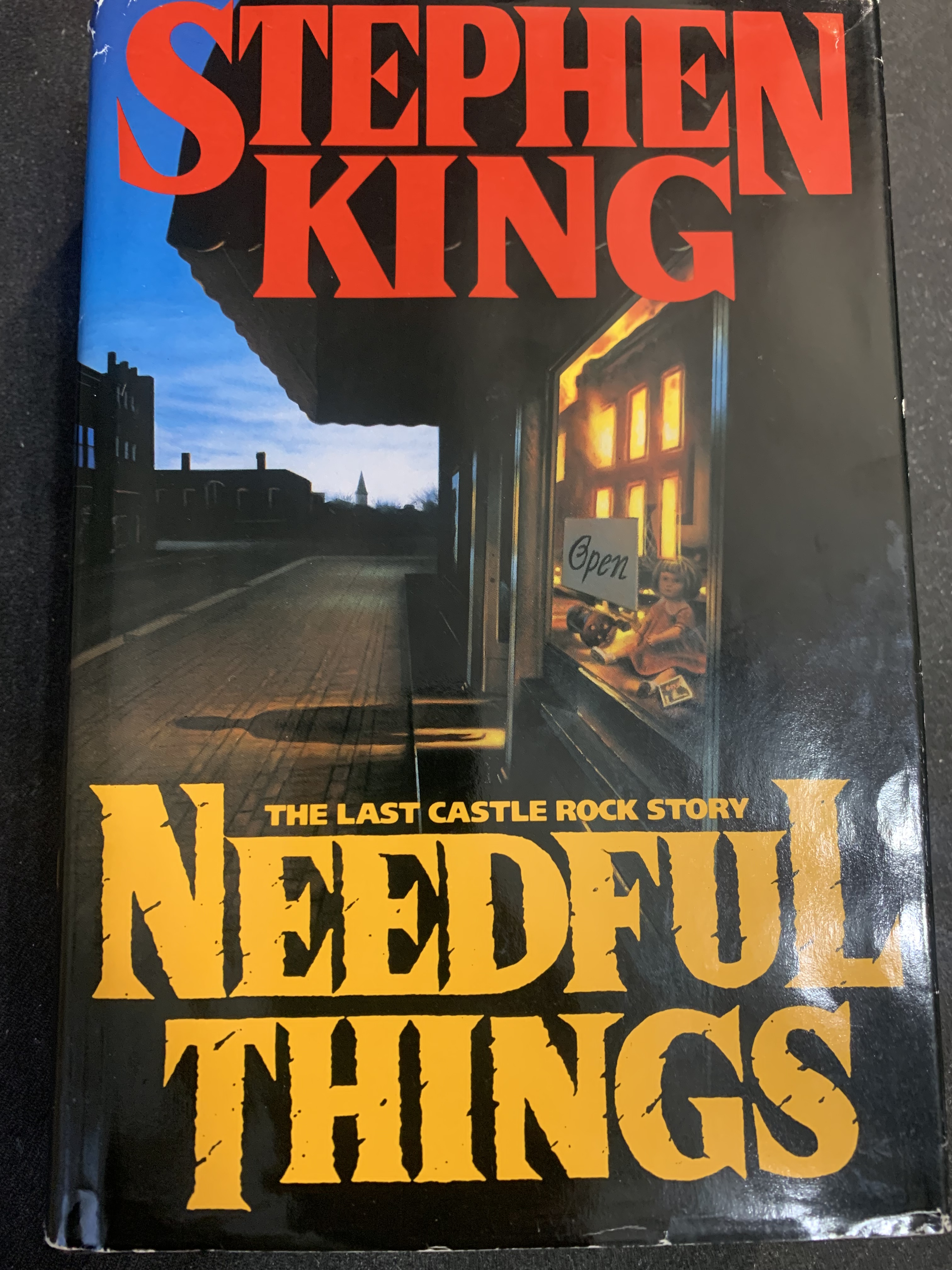
As we’re approaching fall, you fall-lovers (like me) might appreciate this analogy: falling back into reading Stephen King is like putting on that familiar, comfortable sweater again. His style, with the parenthetical line breaks, italicized madness, movie, music and other cultural references, ensemble casts in a small town, shocking violence, and supernatural horror afoot with that quintessential crap-hitting-the-fan moment, all just fit so nicely once you start up with him. In this case, I read what is billed as “The Last Castle Rock Story,” 1991’s, Needful Things. Castle Rock, a small town in Maine, of course, being the site of many of King’s novels: Cujo, The Dead Zone, The Dark Half, and others. And I’m pretty sure it’s not actually the last Castle Rock story. Nonetheless, what transpires in the book sure feels like it could have been the last Castle Rock story.
A new store opens in the little town of Castle Rock called, you guessed it, Needful Things. Since the proprietor seems to be an out-of-towner, people are particularly curious, especially because “Needful Things” doesn’t necessarily hint at what the store will be selling or offering as a service. Like with many King books, we’re introduced to an assortment of townsfolk, all with complicated pasts and presents, and already-simmering feuds and buttons-not-to-be-pushed, such as Buster Keeton, the town selectman who has been embezzling funds from the town to enable his gambling addiction (and who abuses his wife), or Polly Chalmers, considered an “eccentric woman” by the town because she left with a child and then came back without a child, or Nettie Cobb, Polly’s friend and employee, who was released from an insane asylum after killing her husband in self-defense. Another character is Brian Rusk, an 11-year-old boy, who is the first to go into Needful Things and receive at an outrageously discounted price, an apparent priceless, pristine Sandy Koufax baseball card. All the proprietor, Leland Gaunt, wants from Brian, aside from his piddling pocket change, is for him to play a trick on a mean old Polish woman, Wilma Jerzyck.
There, indeed, is the rub: Gaunt, an old man with quite literally hypnotizing, ever-changing-color eyes, seems to have the precise item a customer who enters his shop most … needs, and he doesn’t care much for the money aspect; rather, he wants you to play a trick on another townsperson, some sort of prank he’s promised is rather harmless in the grand scheme of things, particularly the thing you most need. Because weighed against the latter, it’s not too bad, right? The hypnosis effect leads people to believe the item they acquire is the most consequential and important item they’ve ever received, and as such, they become severely protective over it and paranoid about it, to the extent of being willing to do murderous harm to anyone who should even think about stealing it. The most horrific part aside from the violence? The items in question are a mirage. The customers are only seeing what they want, and need, to see. Rusk’s Koufax card, for example, is a battered, worthless baseball card of some other far less-famous Dodgers pitcher. All of the items are worthless and those who are not under Gaunt’s spell can see as much (more on that in a moment).
Naturally, these tricks start out rather small, but escalate once the ugly tapestry of Gaunt’s plan unfurls throughout the book. Gaunt is playing the townspeople against each other and pressing those already preconceived hot buttons, like playing Wilma and Nettie against each other after they’d already had an imbittered feud over Nettie’s yapping dog. He has Brian throw mud on Wilma’s sheets, which Wilma naturally suspects was the doing of Nettie. And he has a different person, Hugh Priest, kill Nettie’s dog (ugh). This leads Nettie and Wilma to duel it out in the streets of Castle Rock with a knife and a meat cleaver until both are dead, slumped over each other’s bloody corpses.
This is when our protagonist, Sheriff Alan Pangborn, really begins to take notice of what the heck is going on in his town. He’s one of the few yet to go into Needful Things and meet Gaunt. In other words, he’s still sane. He also has his own past that solemnly tickles at the base of his neck: His wife and younger son were killed in a fiery car crash either in an accident or because of a seizure brought upon by the wife’s tumor Alan feels like he should have noticed beforehand. Alan’s with Polly now, though, and Polly has terrible arthritis. I have to say, out of every horror thing that occurs in the book, Polly’s arthritis might be a top three skin-crawler for me in the way King describes the pain she goes through. Awful. As you could have guessed, Gaunt has a cure for that, too, which is some weird amulet that cures her of her arthritis and turns her against Alan. (The amulet is not magical, though, and is just a nasty spider.)
This is the one particular part I was confused about, though. People unaffected by Gaunt, like Brian’s younger brother, Sean, can see the cherished items are actually trash, but Alan himself (and others) could see that Polly’s hands were getting better after she started wearing the amulet! Or even with Buster, who is gifted a Winning Horse game, which again is trash, he uses to win at gambling at the real race track … how did he really win based on trash? Perception? Or in Polly’s case, did the magic actually work for her because she was important enough to bring down Gaunt’s perceived biggest threat to his plan, Alan?
In any event, obviously Gaunt is a supernatural force of some kind, but I think King gave us a nice hint a little over half-way through the book when he talks about smoke coming out of Gaunt’s nose and mouth. He’s from hell! So, a demon or Satan himself.
All of these tricks Gaunt’s orchestrated forming a deviously violent intricate web come to a head with about 250 pages still left in the book in one of the wildest stretches I can recall reading in a King book reminiscent of that section in The Stand. Just utter chaos starts happening everywhere in Castle Rock and Alan and his little team of deputies are clearly overwhelmed by it all. It was such fun madness to read, and as I said, the best part was, holy moly, we still have 250 pages left! As with most King books, you’re thinking, a.) how can the town recover from this? and b.) how can mere mortals possibly combat this? That’s the joy of King, though. The remaining pages involved more mayhem, including Gaunt’s sheeple setting up bombs to blow up various town buildings, and a West Side Story-like, but far more violent, show-down between Catholics and Baptists in the streets of Castle Rock.
I was a bit frustrated that Alan fell under Gaunt’s spell when he goes into Needful Things for the first time with like 20 pages left in the book because Gaunt shows him what he most “needs”: the crash involving his wife and child to see how it happened. Luckily, Polly is able to break out of Gaunt’s hypnosis effect, which is quite literally akin to the devil on your shoulder whispering to you, thanks to the help of her Aunt, a sort of angel-on-the-shoulder force. Alan then steals Gaunt’s bag of souls, the thing Gaunt most needs, and is able to vanquish Gaunt, at least from Castle Rock (we later see him pop up in a different town).
The reason I said I’m frustrated with Alan falling under Gaunt’s spell, even if you could see King’s story going in that direction and it was smart of King for that to be Alan’s need, I wanted at least one townsperson — and I expected that townsperson to be Alan — to overcome with their own free will the demon, or Satan without any outside help, like Polly or how Polly had help from her dead Aunt.
Still, Needful Things quickly ranks as one of my favorite Stephen King books. This one feels like a “gem” in the sense of, I don’t hear it spoken about among his best books, but I think it’s fair to say it’s up there! It’s also notable because it’s the first book King wrote after breaking his alcohol and cocaine addiction (and he writes extensively, and I would surmise, realistically, about a character who has cocaine addiction in the book). Aside from the usual hallmarks of King’s style I mentioned at the top, I thought Needful Things was a well-told and well-wove story the way Gaunt’s “tricks” came together to play the townspeople off of each other and kept building and building into the crescendo of madness at the end, but also, the brilliant turn that, of course, the items were actually trash. The sad fact of it is, even if the items were real, they still weren’t that great, at least to my eyes, but I think that’s the point: Many of these townspeople had such little going for them, that even this was something.
And Needful Things also ranks as one of King’s best books based solely on the fact that it contains one of the most horrifying scenes I can recall from him, and as a dog-lover, I’m not even talking about the gross dog-killing scene. I’m talking about Brian Rusk at the end of his sanity, not knowing what else to do anymore, using a shotgun to kill himself in his parents’ garage with his little brother watching. King even describes how Brian uses his toe to slide over the trigger in order to shoot himself. Again, in front of his brother. Just thinking about how traumatized that little brother would be seeing that. But it’s also what breaks the case wide open for Alan to solidify that all hellacious roads lead back to Gaunt. What also makes the suicide horrifying is the follow-through that Brian’s mother could not care less because she’s under Gaunt’s spell still, and after talking with the police, she goes back upstairs to pleasure herself while wearing what she thinks are sunglasses worn by Elvis. Bleak, bleak stuff from King.
If you love King, but haven’t had a chance to read Needful Things, I highly recommend it. I don’t see how a King-lover wouldn’t like it, and if your new to King, there’s enough of those King hallmarks to get a sense of his writing style and why he’s considered the King of Horror.

 Milam's Musings