
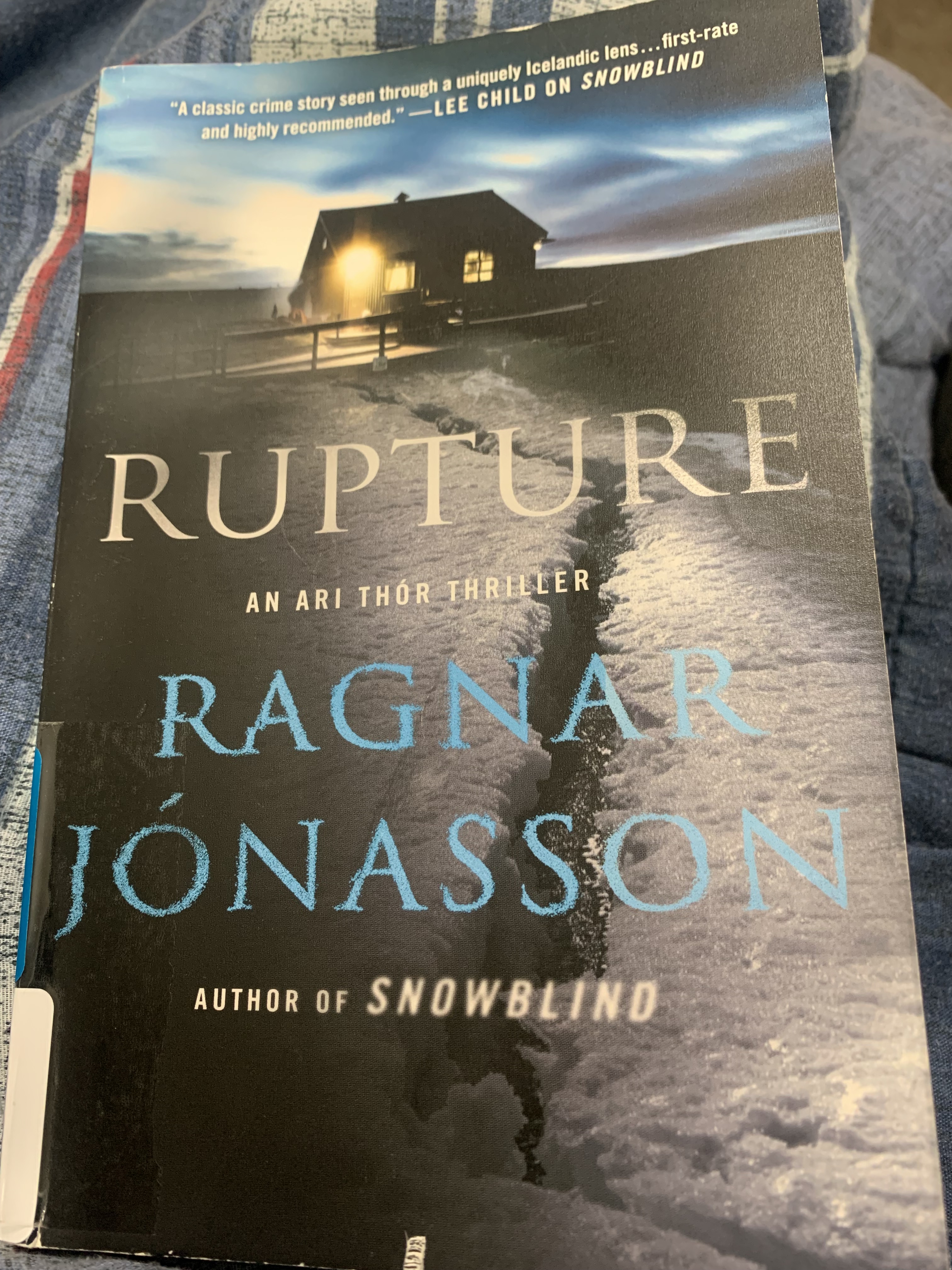
Procreation is both the engine that drives humanity forward, and yet, also that which creates consternation, violence, and even death. In the hands of Ragnar Jónasson, with his 2012 book (translated and released into English in 2016), Rupture, procreation takes on exactly that eponymous quality among families and would-be families. This is the fourth book in Jónasson’s Dark Iceland series featuring the police detective protagonist, Ari Thór. These books are billed as “Nordic noir,” and after realizing the author has translated numerous Agatha Christie books into Icelandic, I not only agree with the “Nordic noir” label, but I can certainly see the homage, if you will, to Christie.
Jónasson’s book here is slow-burn novel, using the first third of the book to set the table with an ensemble cast of characters, including characters, like the prime minister of Iceland, you’re wondering how they’re going to all come together in the end. That, and the conspiracy that binds them, is what makes the book Christie-esque, but even more Christie-esque is how Thór brings together the conspiracy around a different, albeit parallel story. I found the way Jónasson pulled both storylines together while operating separately within the plot, and had them be thematically mirrored, to be brilliant.
The theme? As I said, babies and all that we imbue them with. Thór has a woman claiming he might be the father of her baby after a drunken night, and she’s getting a DNA test done. Róbert, who has a seedy past, is the step-father to his girlfriend’s new baby, and he’s trying to start fresh. Another man lost his baby in awful, unsolved assault, and then two agonizing years later, his wife and mother to the baby, and now seeks revenge. Another kid, a drug-user and budding musician, is the son of Iceland’s would-be prime minister, and old friend to the current prime minister, is written off by his mother. For all intents and purposes, he’s dead to her.
All of the aforementioned (except for Thór’s situation) come to a head when Róbert’s past catches up with him, and the mentally unstable man who lost his wife and baby kidnap’s Róbert’s girlfriend’s baby and kills the drug-user/budding musician, thinking both are culpable for the deadly assault. The way the would-be and current prime minsters factor in is that the current prime minister’s team leaked the suspicions around the assault, causing the former to drop out of the race. Uh-oh.
Thór isn’t dealing with that story. Instead, he’s helping another man uncover the 50-year mystery of who killed his aunt and who is the mystery man in a photograph, both the killing (or suicide?) and photograph were taken at Hedinsfjörður, an abandoned fjord in the northern most part of Iceland. The man was the baby of the photo. We later learn, thanks to Thór’s Christie-esque protagonist exposition of the conspiracy, that the man’s father and mother couldn’t procreate, so, the father had sex with the mother’s sister, had a baby (him! so his aunt is really his mother), and the wife couldn’t deal with it, and poisoned the sister. It was kept under wraps as a suicide, though, owing to the fact of them being out in the middle of nowhere, which was intentional on the husband/father’s part.
And we have one more sort of “baby-related” story. Ísrún is an almost equal in stature protagonist — in fact, I almost thought the book could have been her book. She’s a television reporter working both stories: the prime minister/mentally unstable angle, and helping Thór with his unsolved case. Her “baby” relation, loosely, is that she might not have a future in which to procreate, if she so chose to do so, because she has a potentially genetic terminal illness, and she was previously raped and doesn’t want to have sex. We later learn she doesn’t actually have the illness and is okay. And Jónasson ties up Thór’s story because his drunken night night of sex did not lead to his baby.
Like I said, Jónasson’s book was a bit of a slow burn, and I think would have been better in its original Icelandic (translation is just hard!), so both those factors meant it took me a second to get into the book, but once Jónasson’s Nordic noir was rolling, I was hooked! I had to see how all the pieces fit together, and once Thór started his lengthy exposition at the end explaining the photograph and the death in Hedinsfjörður, I was utterly captivated and hanging on his every word.
Well-done, Jónasson, I look forward to reading more of your work! The Iceland setting is just too dang perfect for crime books.

 Milam's Musings