
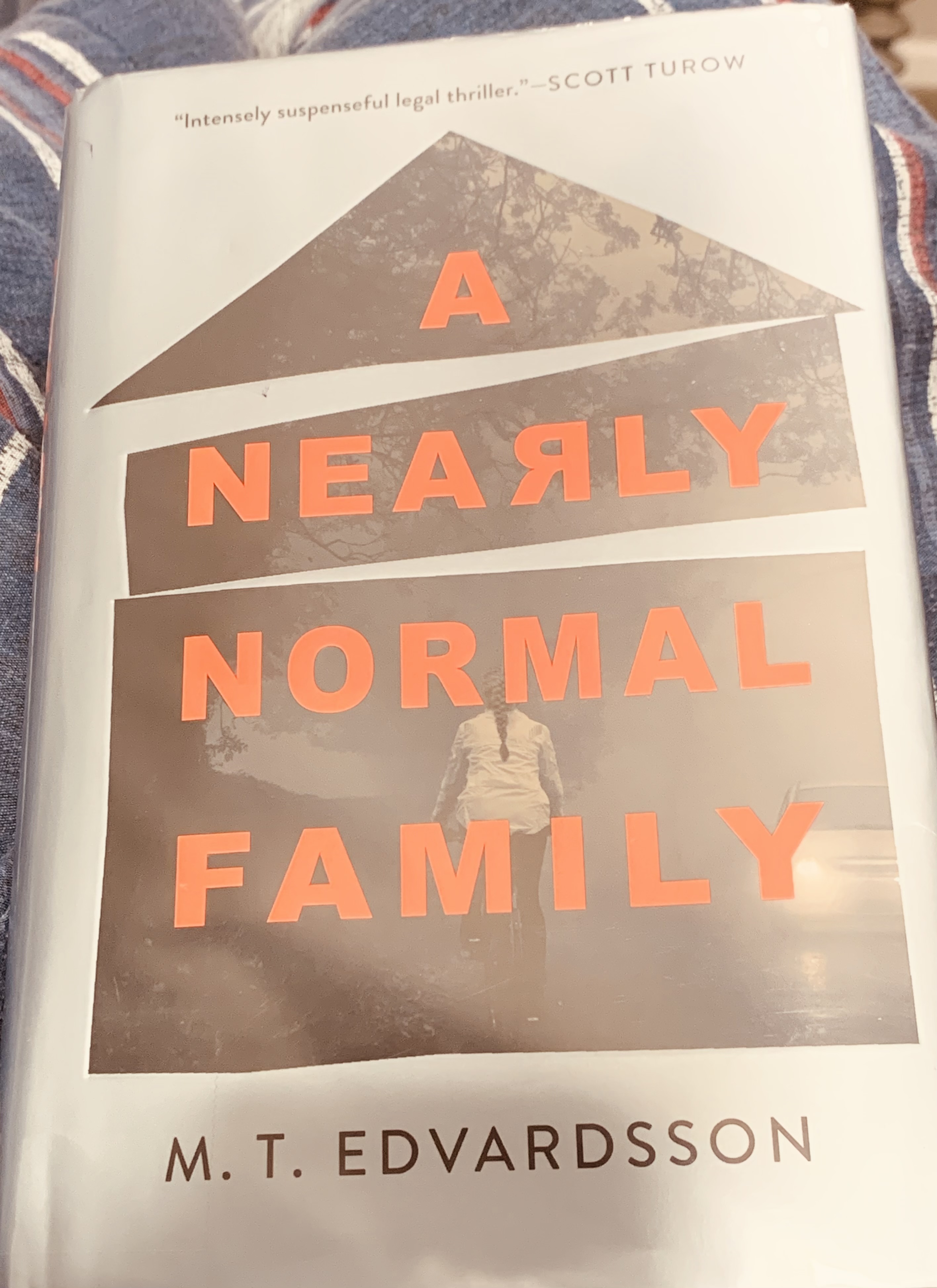
It’s unlikely we really know anyone to the fullest extent possible, even family members. At least, Swedish author M.T. Edvardsson pushes the limits of what is knowable in his 2019 novel, A Nearly Normal Family. When I read a new author, I naturally grab for a familiar author they remind me of, and Edvardsson’s book, where a normal family is besieged by the unthinkable, had echoes of Harlan Coben, but I dare I say, Edvardsson scratched a little deeper into the moral fiber among family members.
Stella, 18, has a pastor for a father, Adam, and a criminal defense attorney for a mother, Ulrika, and a best friend, Amina. The first third of the book is told through Adam’s perspective, where Stella is arrested and charged with murdering a man, Chris, twice her age. To use that word again, Adam is besieged by the twin pulls of his commitment to God, and by extension, telling the truth, and his paternal desire to protect his daughter, no matter the ethical cost. Adam ends up lying to be Stella’s alibi for the night of the murder, and he doesn’t tell the police about a stained blouse he found in the laundry nor that he found Stella’s phone at the house. In hindsight now, learning about the situation through Ulrika’s perspective, it’s funny that Adam was hiding those facts from Ulrika to “protect her” when in reality, she was hiding much more from him. More on that momentarily.
Through this section, we also get flashbacks to earlier times in Adam and Stella’s often times rocky relationship, as she rebelled and he tried in vain to maintain control. In one instance I’ll circle back to, Stella, at 14, was raped by an older man, Robin, at a Christian camp getaway, interrupted by Adam himself. By Adam’s telling, it was his wife and her criminal defense attorney experience that begged him off of calling the police and reporting the rape, so as to not put their daughter through a trial.
The middle of the book then switches to Stella’s perspective through some of the same earlier moments in her relationship with her dad, and her friendship with Amina, as they party and mingle with boys. We learn that, contrary to what Adam and especially Ulrika feel (she even states it at one point, much to her eternal shame) about sometimes wanting the perfect, easy-going Amina over their own daughter, Amina isn’t doing well. She’s faltering under the constant pressure to be perfect. Ulrika also learns later than Amina’s mom, again contrary to her perception, does not have the ideal life, either. Stella also visits with a psychiatrist while in prison who gets Stella, slowly, to open up. This section of the book is so formative to the character of Stella because we learn that she is a teenager through and through: making stupid choices, acting out, and achingly uncertain about her future, and indeed, both a budding adult who still yearns for her parents’ affection like the child she actually still is and who can’t stand their overbearingness. So it goes. Finally, we learn about Stella’s “summer fling” with Chris, and that he had an ex-girlfriend who seemingly flung wild accusations of rape and abuse at him. This ex tries to warn Stella and Amina, but they don’t listen and they don’t believe her.
Ulrika’s perspective is next, and I was eagerly awaiting it because a.) it was clear she had an affair with her boss, adding to the whole, not really knowing someone because Adam was under the impression his marriage was going swimmingly, and b.) she seemed to know more about Stella and Amina’s situation than Adam and more than Stella realized. Perspective, it’s an interesting phenomenon. People in the same household can view events in hindsight differently, and experience interpersonal relationships differently. For example, Adam thought Amina was close to him almost like a second father figure, whereas, in reality, she was closer to Ulrika and in fact, probably was a bit terrified of Adam given his overbearing stature and status as a pastor. Similarly, back to Robin raping Stella, by Ulrika’s telling, it was Adam, not her, who didn’t want to go to the police, which fits with Stella’s perspective (although she didn’t explicitly talk about this, I don’t believe) of her father that he cared more about keeping everything private and away from prying public eyes.
I have to give Edvardsson credit because through three different perspectives up until quite literally the epilogue, I still wasn’t entirely sure how the story was going to shake out. I had a suspicion that because Amina was cracking under the pressure, she might have wanted and sought a “fling” with Chris, too, betraying her best friend in the process, much to her own eternal shame. That’s sort of what happened, only it went further than Amina anticipated because Chris violently raped her. When Stella heard about this, she’s the one who stabbed Chris to death. But Ulrika, knowing all of this, orchestrated it so that Amina’s rape didn’t come out until the trial, thus setting up the reasonable doubt that two people with potential motives were at the scene of Chris’s death, and thus, neither could be convicted. That’s how Swedish law works, apparently. I’m probably not explaining it as well as Edvardsson did.
But in other words, Ulrika found a way to save both Amina and her daughter, Stella, even if Stella had to wait it out, somewhat in the dark, in prison longer, which was agonizing for someone like Stella whose worst fear in life, it seems, is to be bored. Imagine the solitude of prison, then! For the record, the way the scenario is presented, with Chris raping Amina, and then for all intents and purposes, kidnapping her by not allowing her to leave his vehicle, and then her escaping with him chasing her, Stella’s actions could be seen as self-defense and defense of Amina. Nonetheless.
Edvardsson’s book is a very clever one, with lines throughout from the perspectives of Adam, Stella, and Ulrika, respectively, that made me think about life, morals, what we’re all willing to do for those we love, and again, how well we really know others, especially those we love. I love a page-turner that makes me slow down a second to think. Great characterization of each that made me sympathize with all of them for different reasons: Adam was trying to be a good father, but unlike the God he worships, he’s not infallible and stumbles often, often greatly; Stella was a misunderstood by others, including her parents, and just needed to be unfettered, but that desire clearly had its drawbacks, too, most pointedly because of predators like Robin and Chris; and Ulrika, who never felt adequate as a mother and then felt shame at not knowing how to “handle” Stella or her marriage, for that matter. But through the course of the murder trial, they realized that when you strip away all the insecure feelings, what’s left standing is love. Complicated love, ugly love even, but love. Nobody’s love is “normal” and certainly, nobody’s family is “normal.” All of the fibers connecting families together get frayed one way or another along the way. It’s more a matter of how you respond to the fraying when it happens.
If my Coben connection makes sense to you, then I think you’ll quite enjoy Edvardsson’s thorough page-turner, A Nearly Normal Family.

 Milam's Musings