
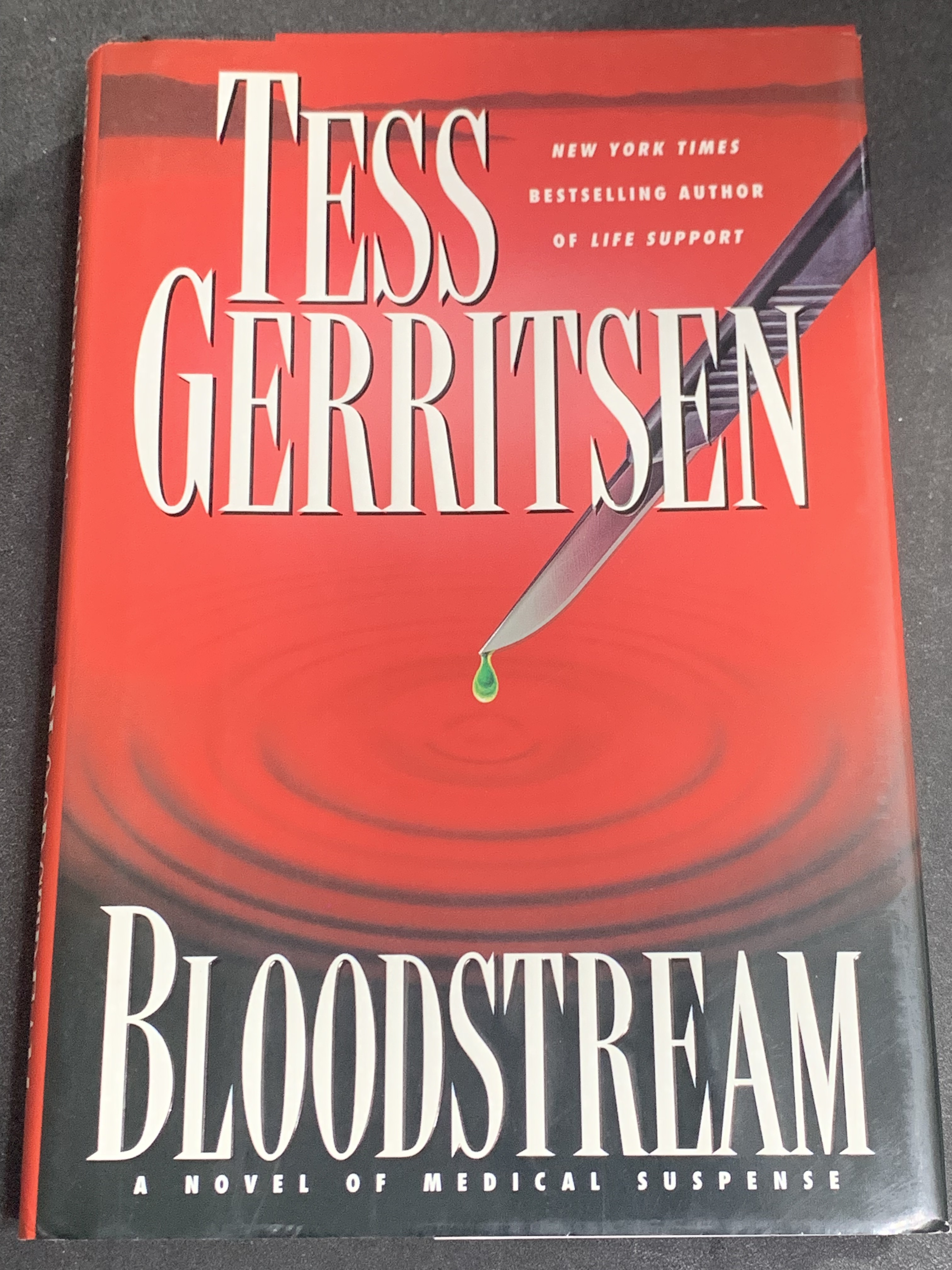
I wasn’t expecting one of the last books I read in 2023 to be one of my favorite reads of the year, but here I am, with Tess Gerritsen’s 1998 book, Bloodstream. Gerritsen is perhaps best known for the Rizzoli and Isles series, which went on to be a television series, and I believe one of those books, 2006’s The Mephisto Club, is my only other previous Gerritsen read. (In fact, after I read that years ago, I emailed her my appreciation, and she responded and in such a way that it wasn’t one of those automated replies!) Anyhow, Gerritsen actually has a medical background, and before she was doing the Rizzoli and Isles series, she was doing standalone “novels of medical suspense,” like Bloodstream.
Bloodstream is set in the fictional town of Tranquility, Maine, and the reason it became one of the sneaky favorite reads of mine this year is because from the get-go until the final page, it was nonstop action and intrigue. This little town is besieged by inexplicable teenage violence: violent fights at school (that seems redundant, but it’s worth emphasizing the difference between a scrap at school versus trying to kill each other in a fight occurring in the book), children attacking their parents, and even a school shooting where a teacher is killed. And it’s not the first time this spate of violence has occurred, with the book opening with such violence in 1946. Caught in the middle of all of this are Dr. Claire Elliot and her son, Noah, and the police chief, Lincoln. Claire’s husband died two years previous and Noah’s been getting in trouble, so, Claire moved her medical practice and Noah from Baltimore to Tranquility, thinking a smaller town would be helpful. Welp.
Medical books are so much fun because the “whodunit” isn’t a flesh and blood killer, but it is a flesh and blood killer (heh) in terms of a medical mystery. In this case, Claire eventually learns that there is some sort of bacterium affecting these children (mostly boys) causing them to be abnormally aggressive and violence. Naturally, not only is the male doctor at the hospital skeptical of her because he’s chauvinistic, but the town itself is skeptical of her because she’s the outsider, especially when she recommends closing the suspected source of the bacterium, Locust Lake, which happens to be the draw of tourists dollars to the town.
But, of course, even medical suspense books need a human culprit trying to capitalize on the dangerous medical malady. A pharmaceutical company hopes to harness the bacterium for sell to the Department of Defense, and the man they sent to Tranquility starts killing people to procure it, and even frames Claire and her son for wrong deeds to get her out of the way. I didn’t see the twist coming of who that person was, one of the journalists who comes to the town after the school shooting who turns out to only be posing as a journalist. But it was one of those twists where in hindsight, I said, “Huh, that actually makes sense.” So, well-done, Gerritsen!
By the way, the source of the bacterium ends up being one of the violent boys in 1946 who is a carrier of it and has been “shedding” it into his septic tank, which then goes into the lake where the boys of the town (and tourists) swim. The implications of how many people could be affected throughout the United States when you consider tourism is pretty staggering, but only hinted at here.
Like I said, from the opening preface with the 1946 violence through to the violence that plagues the small town of Tranquility, to Claire and Lincoln facing violence themselves to stop it all, Bloodstream is a “novel of medical suspense” that never lets up. It was like having a blood pressure cuff on my arm the entire read, if you will. Fans of Gerritsen’s later books will enjoy going back to this one, and those who haven’t read her are sure to get the heebie-jeebies about the bacterium.

 Milam's Musings