
Spoilers ahead!
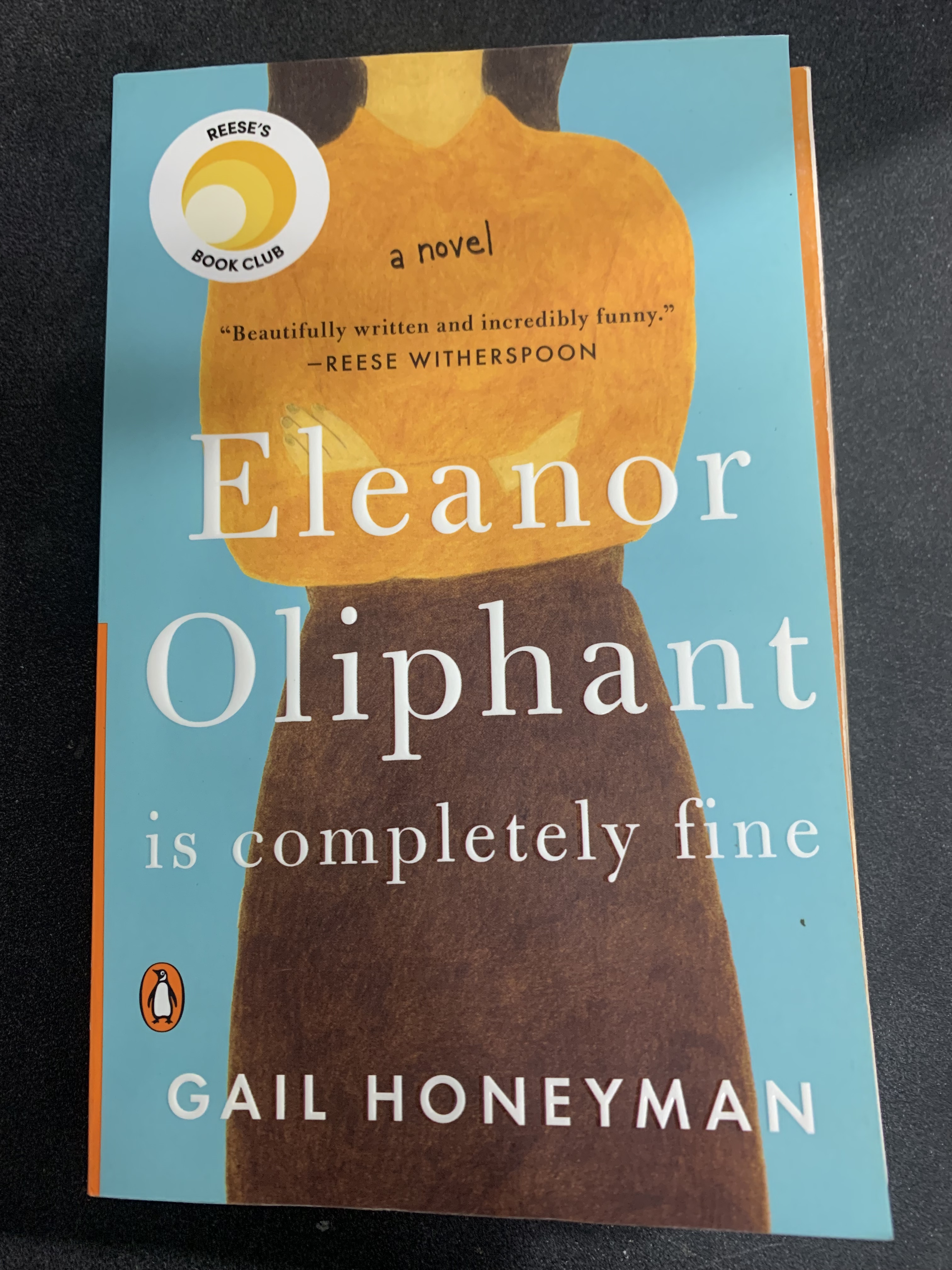
Loneliness’s origin story is not always created in the fire of tragedy — trauma causes people to pull back from relationships and even a sense of desiring happiness; after all, loneliness isn’t just a function of socializing with others, but being content within your own headspace and spatial space, in my humble opinion — but for Eleanor Oliphant, her loneliness, which she didn’t quite have a name for yet, was created quite literally from the embers of a fire. Gail Honeyman’s debut 2017 novel, Eleanor Oliphant is Completely Fine is one of those rare books that lands the dichotomy of being deeply poignant and dark, while also genuinely gut-busting funny.
Eleanor, 30, has her routine and the life she’s built around dark parameters we don’t yet understand: she goes to work as an accountant at a graphic design company, talks to her Mummy on Wednesdays for 15 minutes, partakes in some pizza and wine on Fridays, enjoys doing the crossword puzzle (she’s a proficient wordsmith), throws back some vodka on Saturday, and then she starts it all up again. Unless she’s paying to have a service done at her house, like the meter read, she doesn’t entertain guests, doesn’t talk to anyone, and may even go the entire weekend without hearing her own voice. Such is the existence she knows. We also know early on that prior to starting her job, she was violently raped and beaten by her one-time boyfriend. You know she’s faced serious trauma because she doesn’t seem to see that “episode” in her life as itself a great tragedy.
Then, Raymond comes in to her life as the new IT guy at work. He’s a shambling type, with a seeming unpolished veneer to him, and he enjoys smoking, much to Eleanor’s chagrin. And yet. He’s the first person who not only begins to break through Eleanor’s tightly wound trauma bubble, but he allows Eleanor the space, freedom, and comfort to be … happy, to realize there is more that’s possible within the world. As Raymond remarks, the “world is your oyster.” In so doing, of course, that also entails the opposite, wherein Eleanor is finally able to assess and name what she’s been feeling: loneliness. After all, without knowing what it means to have a friend and do things with that friend, she didn’t know what she was missing and ergo, that she was bereft of something good. Eleanor and Raymond keep finding ways to hang out, whether that’s a regularly scheduled lunch during the work week or being Good Samaritans to a random passerby and getting ensconced in his life with hospital visits, parties, and then a funeral.
The funny parts are that Eleanor is so prim and proper, and doesn’t have any sense of social norms or cues, that it creates for funny fish-out-of-water moments, like when she’s asked for her name to be written on the coffee cup at a cafe, she’s aghast at the privacy invasion. Or when Raymond gets her a SpongeBob balloon and she wonders if it’s supposed to resemble cheese, not having the first clue what SpongeBob is. Or when Eleanor acquiesces and goes to counseling, she’s determined to not mention her Mummy (the source of her trauma) and the first thing she does, without prompting, is mention her Mummy. Her disposition is so funny, and situations throughout darkly hilarious. I found myself laughing often throughout Honeyman’s book at moments of funny levity and dark humor. That’s quite the feat to offer both and it work.
Eleanor’s mother is a nasty, brutish woman who belittles Eleanor. She’s also the one responsible for the scars on Eleanor’s face, as she tried to burn Eleanor and her younger sister alive in their home. Eleanor escaped, though, but repressed those memories. Worse yet, her mother died in that fire, too (something I started to suspect about mid-way through the book), but Eleanor still believes she’s talking to her mother every Wednesday and hearing her negativity. In fact, so strong is this tether to her mother that through her mother’s prodding, Eleanor crushes on a local musician, only to be crushed by the reality of how inane the crush was that she tries to kill herself. Raymond saves her (which then results in that funny SpongeBob get-well soon balloon incident) and is the one who encourages her to get into counseling.
Also, Eleanor’s mother claims that Eleanor was the product of rape and that’s why Eleanor doesn’t know her father. At first, I figured that was true to add to Eleanor’s trauma, but then I realized Eleanor’s Mummy is not a trustworthy narrator. And besides, not that it’s impossible, but the fact that Eleanor has a younger sister belies the rape narrative, too. In other words, I bet if we had longer with Eleanor, she would realize that, too, and start searching for her only blood relative.
I like being in Eleanor’s head, including the dark moments, like when she was suicidal because it was relatable. Honeyman offers this visceral image, “I drank it with the focused, single-minded determination of a murderer, but my thoughts just could not, would not be drowned — like ugly, bloated corpses, they continued to float to the surface in all their pale, gas-filled ugliness.” Or later, when reflecting on surviving her suicide attempt, she says, “I simply don’t know how to make things better. I could not solve the puzzle of me.” Again, very relatable! That’s how it used to be for me, too. But, I also found comfort in Eleanor’s brain, despite the trauma, because she’s so disarming, utterly charming in her way, and funny. I loved being with Eleanor throughout this novel. More impressively, I’m not sure I’ve read a better relationship between a man and a woman in a modern book than that of Eleanor and Raymond. In anyone else’s hands, their friendship, which I believe Raymond would like to be more, clearly, would have led to a Lifetime-like kiss at the end. Instead, in Honeyman’s hands, it’s such a sweet, tender relationship, and Raymond isn’t perfect, but he is present, which is exactly what Eleanor needed. Eleanor finds Raymond to be like, no pun intended, “golden honey dripping from a spoon.”
We’re only a week into 2024, but when I look back on the year, I think I’ll be hard-pressed to find another book that affected me like Eleanor Oliphant is Completely Fine. Beautiful, dark, darkly humorous, and tender without being overwrought. It’s quite the remarkable achievement from Honeyman, and I look forward to reading more of her work in the future.

 Milam's Musings