
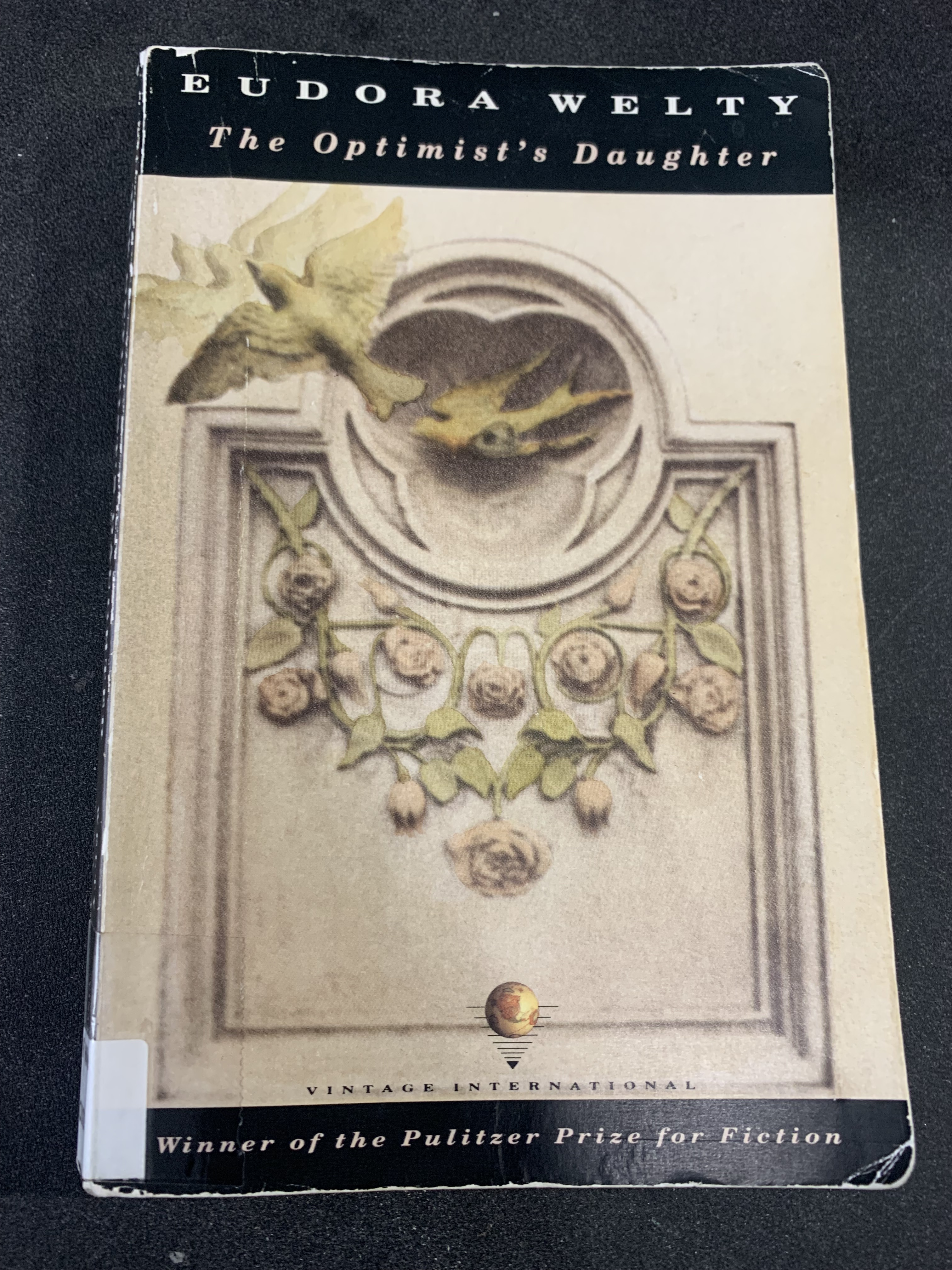
Another word for grief is memory, and memory is the fluttering bird swooping down from the chimney, finding itself ensconced in your room, not willing to be swooped back out to a freedom of a kind. Until it is. Such is the metaphor at work in Eudora Welty’s 1969 Pulitzer Prize-winning book, The Optimist’s Daughter. When it comes to death and dying, and the resulting grief, there is optimism to be found, eventually.
Welty’s book, a small but hefty 180 pages, won’t be for everyone. Not just because it deals with these weighty themes — Laurel, whose already lost her mother and is a widow, owing to WWII taking her husband, and then must deal with the death of her father and the erratic behavior of his new wife, Fay, who is around the same age as she is — but also because it’s written in the 1960s, within that milieu and with a slower style. That said, I enjoyed it because it read to me like a stage play. I could picture each of the four sections: the father dying at the hospital, the funeral service back at the home and the women chatting derisively about Fay, Laurel scouring the home for reminiscence of her mother’s presence and her father’s steady, if sometimes maddening, optimism, and the final confrontation between Laurel and Fay over a breadboard, of all things, an object stand-in for their dispute (a great line, too, when Laurel raises it over her head, as if to hit Fay with it, and Welty writes, “She supported it, above her head, but for a moment it seemed to be what supported her, a raft in the waters, to keep her from slipping down deep, where the others had gone before her.”). And I love a good stage play presentation, largely because it brings forth, as Welty does, authentic dialogue and picturesque scenes, but still has the novel’s unique ability for introspection and reflection.
I think what Laurel comes to understand is that grief is a matter of memory sifting, as she did in the big old house she grew up in before departing back to Chicago, and finding those memories she wants to hang on to, and those memories, like a wayward bird come down the chimney, she wants to be free of — unburden herself of — and not hold onto anymore. She’s capable of this memory-sifting and thus, healing alongside her grief, while Fay is the antithesis of this, shrill and selfishly defiant (everything is all about her; even when her husband dies, she makes it about how could he do this to me).
It’s also interesting to note that both of her parents had failing vision or vision issues prior to their death, which reflects the line between optimism and pessimism, where I see Laurel’s late mother embodying the latter with the way she needled her husband, and the father the former. Although, I may be wrong about that on reflection, because Laurel’s mother was a gardener, and isn’t that inherently optimistic? Maybe they both were then.
If you’re looking for something different, at a much different speed and sensibility, then I would recommend Welty’s book, The Optimist’s Daughter.

 Milam's Musings