
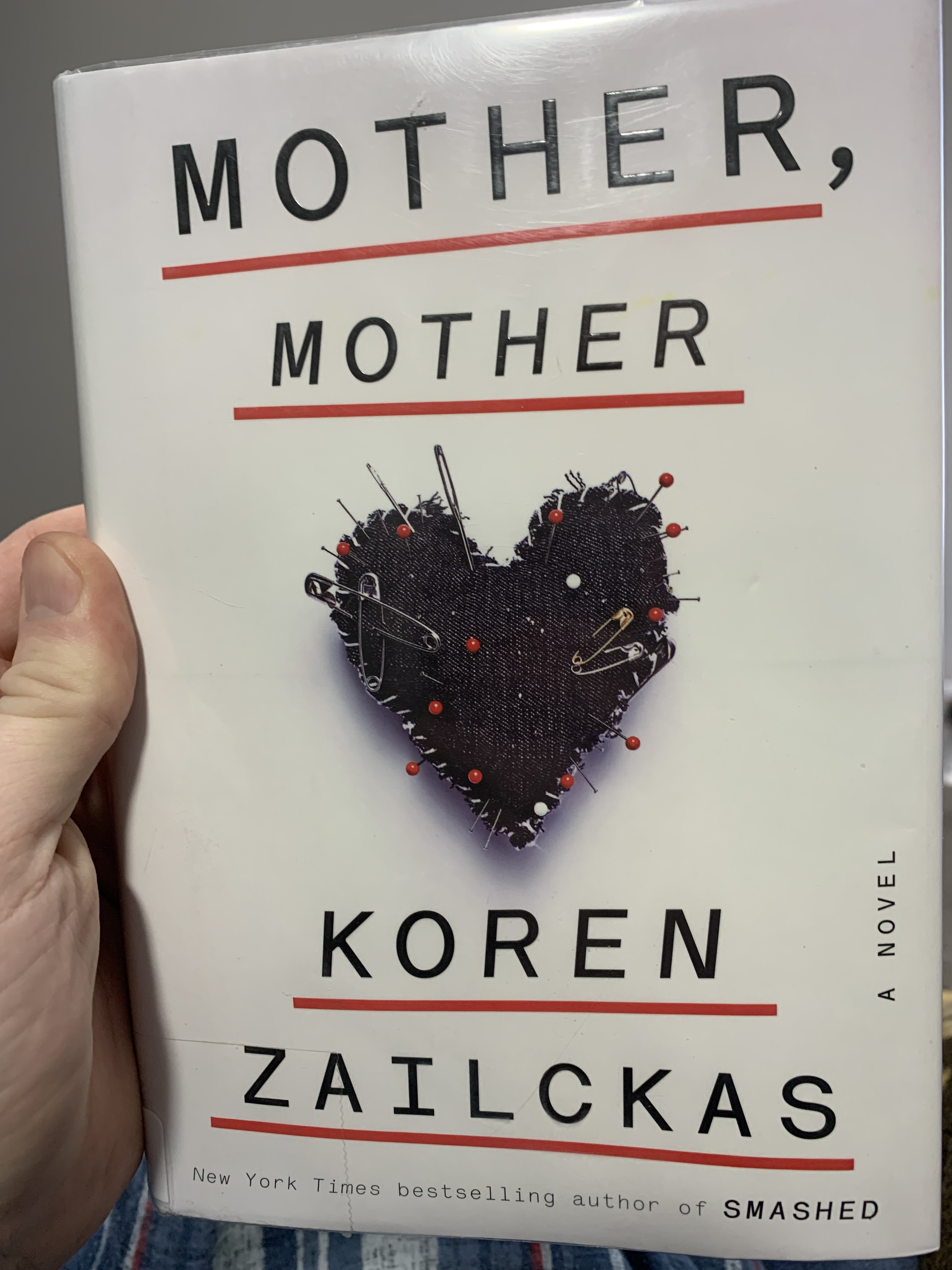
A flower planted will follow any number of evolutionary and environmental factors to ensure its growth, but an improper watering-hand can stunt its development (per my understanding of gardening!). And yes, flowers tend to grow better socially, if you will, than in insolation. This is my elongated way by analogy of introducing my latest read, Koren Zailckas’ 2013 book, Mother, Mother, about the ways in which families can be like a garden taken over completely by a weed, similar to the introductory quote of the book from George Bernard Shaw, “A family is a tyranny ruled over by its weakest member.
In the Hurst family, the tyrant is the narcissistic Josephine Hurst, the matriarch, who has two daughters, Rose and Violet (hence, my flower analogy), and a younger son, Will. Her husband, Douglas, is an alcoholic, with probably some dependency issues, wherein he’s passive, even apathetic, to the point of enabling Josephine’s largely emotional abuse and control over the family. Rose was her first “project” to make her into a child actress and famous star. Instead, Rose eventually rebelled and, as we’re led to believe early on, runs away from home with her boyfriend after having an abortion (an abortion Josephine, ever the manipulator, both pressured her daughter into and then berated her for having). Violet has rebelled in her own way with an almost incremental suicide, where she’s embracing a radical notion of Buddhist fasting until she withers away. She takes some LSD, which causes the precipitating event of the book: Violet has a confrontation of some sort with her parents, with Will as the collateral damage, quite literally, when he’s hurt. Josephine blames Violet, and Violet is institutionalized in a psychiatric hospital.
Will is homeschooled and thus, fully under Josephine’s thumb. Brainwashed is the word that comes to mind, but it feels weird to apply it to a 12-year-old who has never known better and is at the mercy of such a predator. So much so, I was certain that his diagnoses of sporadic epileptic seizures and Asperger’s Syndrome, a form of Autism, were somehow fabricated by her in order to justify homeschooling Will and thus, keeping him under her control. I was later proven correct when Douglas’s budding sobriety made him finally begin to question everything.
Likewise, I started suspecting, given the way Josephine was depicted, that obviously she was an unreliable narrator about the events of the night Will was hurt and Violet institutionalized — that Josephine hurt him to scapegoat Violet, and she nor Douglas were none the wiser because they were both afflicted with drugs and alcohol — and more significantly, that Rose never ran away. Rather, she was killed by Josephine. It’s later revealed that Rose committed suicide in the family’s garage, and Josephine, horrified at the outside world knowing the truth, buried Rose’s body in the backyard and faked that she’d “run away.” But I think it’s worth wondering if that’s merely Josephine’s version of events. How do we know Rose killed herself? The suicide note could have been faked by Josephine, who later wrote in Rose’s script to send letters to Violet at the psychiatric hospital to trick her. So, there’s precedent for that.
Along the way, Will has moments of doubt about his mother’s love toward him. That she’s more tyrant than nurturer. And that his dad is doing right by him rather than being an aloof alcoholic. But in the end, the abuse and trauma he’s suffered at the hands of Josephine rears its head, and Will covers for his mother by lying for her, or tearing up “Rose’s” credit cards. Sadly, as the book progressed a number of years toward the end, Will becomes like her: manipulative, narcissistic, and broken.
Josephine’s charade fully falls apart when she attempts to kill Violet on the ruse that Violet was to meet Rose and go live with her, and is interrupted by Violet’s best friend and her mother, an actual mother-like figure to Violet. Because of Will’s scheming and weirdness in the law, Josephine largely gets off easy, even though she attempted to murder her child, and clearly in a premeditated way. Nonetheless, Zailckas offers a beautiful meditation on recovering from trauma, particularly trauma stemming from familial abuse, in the closing chapter from Violet’s perspective as Violet tries to wonder what life will be like now, and look like in the future. Stemming from her epiphany at the psychiatry hospital, Violet realizes she wants to live and that eventually, she can learn to live separate from the tyrannical, demeaning voice of her mother.
Zailckas’ writing of the Josephine character, the somewhat redemptive, if stumbling arc for Douglas, the insights Violet gathered, and the tragedy of Will (and Rose), all felt so authentic, real, richly drawn, and intense. There were times throughout the novel, I felt the presence of Josephine in my chest, catching my breath. Such is the power, I think, of the abuser. They become omnipresent and omniscient, and you wonder how anyone under their control will extricate themselves without dying or being irrevocably harmed. Josephine was one of the most loathsome characters in that regard I’ve read, whether it was the ways she purposefully would gaslight Will (claiming he called her “cunt” at one point to mess with his emotions) or how she kept pushing alcohol on the recovering Douglas, she was always scheming and manipulating. Those were just the smaller, awful items, too! She was even far worse to Rose and Violet, directly responsible I think for Rose’s suicide (if it was that) and Violet’s passive suicide attempt, for lack of a better word.
This is not an “easy” read because of its emotional abuse plot, but it’s worth reading, and I think you’ll walk away as impressed as I was by Zailckas’ character development, dialogue, story, and reflections on trauma, abuse, and for that matter, positive motherhood, too.

 Milam's Musings