
Spoilers!
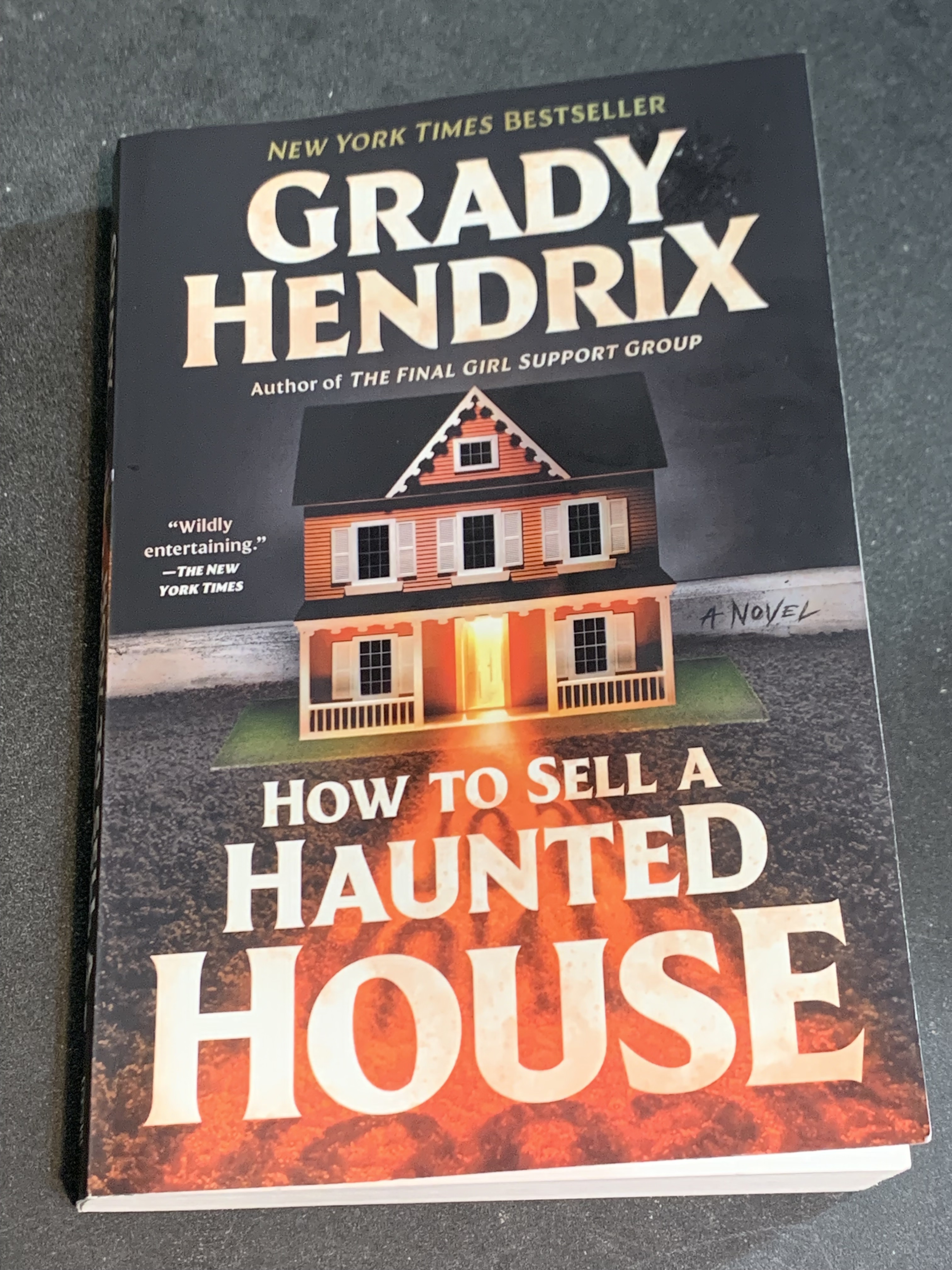
As I was reading Grady Hendrix’s 2023 book, How to Sell a Haunted House, my inclination was that Hendrix’s metaphor at work was that the “haunted” aspect of the family home was grief. But then, as I kept reading, while I think that metaphor works, too, the more apt one is the puppet as grief. Just as the demarcation between where the human ends and the puppet begins is shrouded in darkness, so, too, is the demarcation between where the human before grief ends and the human after grief begins. Of course, the real truth of Hendrix’s book and the truth about grief is that assuming there is a demarcation line at all, between puppet and human, or human and grief, is itself a misnomer: they’re one in the same, hence the darkness in the former, making for a creepy horror book, and the tragedy of the latter, making for an insightful meditation on loss, mourning, and trying to move on.
Sister and brother Louise and Mark are not friends. As they like to say, just because they shared a bathroom for 15 years doesn’t make them friends. They’re estranged because of a shared bond they didn’t know they have (more on that in a moment), but on the surface, because of their perceived mistreatment by the other. Mark was such a jerk in the first 100 or so pages of the book, grief or not. The way he was treating Louise was not right. But later, you understand at least why he’s so bitter toward her.
Their family was ordinary in the weird sense of most ordinary families: they kept secrets and absolutely avoided talk of death. But avoiding talk of death only brings the dead alive. That’s the case with their mother’s younger brother, Freddie, who died when he was 5-years-old, and the family never talked about him again. He came back as a ghost in a sentient, malevolent puppet named Pupkin.
After Louise and Mark’s parents die in an accident (or more likely, were indirectly killed by Pupkin), Louise and Mark must sell the haunted house that is their family home, replete with Pupkin and the other creepy dolls and puppets, and soon find out the malevolence awaiting them, and more importantly, the aforementioned bond they didn’t know they had. Their macabre bond is that both had experiences when younger with Pupkin. Louise’s experience was Pupkin through her trying to kill Mark (the jealous older sibling of the baby sibling), and Mark as a college student getting in a cult-like orgy of violence and mayhem via Pupkin.
Hendrix’s plot made grief visceral and physical, far more physical than I expected, as Louise and Mark are put through the wringer by grief (Pupkin). Louise is battered and bruised by Mark’s imaginary dog, Spider, who has six legs, attacked viciously by Pupkin with a hammer, and then a golem of all the puppets. Mark is possessed by Pupkin, as it were, into being the one to hammer Louise, and then he’s “saved” by her when she uses a saw to sever his hand off, thus removing Pupkin’s grip on Mark.
I saw the main two plot points coming: that Freddie didn’t die by lockjaw, as the family lore had it, and that when Louise returned home, her daughter, Poppy, would be “possessed” by Pupkin, too, as she dealt with the collateral death of her grandparents and the absence thereafter of her mother. (Louise thought she and Mark had effectively “killed” Pupkin at the family home, but there was still so much book left, surely more was to come!) That section of the book was disturbing, as Poppy became lifeless like a puppet, marionetted by Pupkin’s bidding.
Of course, the book still had its Hendrix’s charm, fun, and humor, though, primarily in Aunt Gail and Barb, two, uh, exterminators of demons. Granted, Barb realizes Pupkin isn’t a demon, but the ghost of Freddie and that’s a completely different kettle of fish.
Grief has a way of bringing to the surface familial secrets, unvarnished and raw. The truth of Louise and Mark’s family, particularly with their mother, the puppeteer, is that they kept everything buried through avoidance (quite literally with Freddie’s body in the backyard) until it couldn’t be buried any longer. Their mother was more comfortable talking to a puppet at the end of her hand — herself — rather than her children. As such, they became maladjusted in their own ways; Louise by avoiding any sort of emotion, and Mark by falling into a rabbit hole of despair trying to find where he fit in, as if he was still under the icy pond Louise (Pupkin) tried to kill him, always drowning.
Puppets are creepy because they are a mirror of us, or more precisely, an extension of us, and in the hands of Hendrix, it’s made all the more apparent that sometimes that extension of us needs to be sawed off into a bloody stump, or at least, confronted and acknowledged.
Fans of his 2020 book, The Southern Book Club’s Guide to Slaying Vampires, one of my favorite reads last year, will not encounter a similar book here. This one’s far darker because it’s about grief, but if you like Hendrix’s style, then you’ll still find much to latch onto here, if you also “enjoy” pondering grief in the best skin-crawling way.

 Milam's Musings
One thought