
Spoiler alert: We’re all going to die.
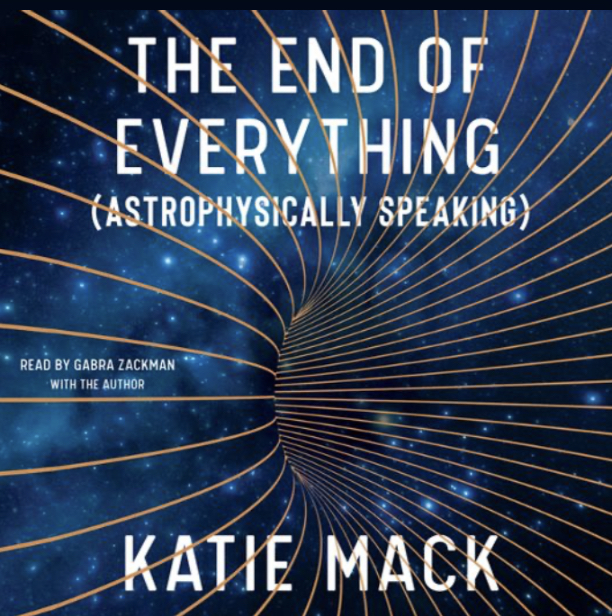
The end of everything … kind sucks, right? Astrophysically speaking, but that is everything, quite literally. Katie Mack’s 2020 novel, The End of Everything: (Astrophysically Speaking), is part fascinating and part cosmically horrifying, part serene beauty and part heat death “this is totally fine!” horror. While also part pop science (in terms of being understandable for a general audience, I mean), and part far over my head, astrophysically speaking. The doing, the living — the miraculousness of being here at all to think about being here at all, cosmically speaking — is a remarkable fact that the ending need not dissuade us of such remarkableness. At least, that’s how my brain, thinking about its own demise and the demise of everything through Mack’s book, interpreted the “end of everything.”
Even though I’ve never been someone who grasps science and math in the way someone like Mack obviously does, I’ve nevertheless long been fascinated by how utterly weird and fascinating it is to be alive, conscious, and exist within a universe, a universe that is so profoundly mysterious, unknowable, yet, also, to some extent, knowable by relatively minor blips as us humans. Incidentally, it seems, figuring how the universe ends, or the myriad ways it may end, helps to understand how it began through extrapolation and working backward, and it might help us better understand pesky matters like the seeming feebleness of gravity, time and space itself, and whether other dimensions and/or universes exist. Little things like that.
Still, even though I’ll be dead star dust sucked back into the void long before our sun dies out or vacuum decay occurs or the entire universe ends in some other way, there is something wistfully sad about the end of everything. At the obvious micro level of our own self-centered self-consciousness, dying is already an existential crisis, and whether any of our own individual contributions to the world mattered. But what if the collective consciousness of the human race was blipped out? No legacy. No anything. But that goes back to the importance of enjoying the doing and the process and the journey, but still, wistful.
Anything to do with the cosmos is hard to wrap my head around, both the infinitely large and the infinitesimal, and the speed at which everything occurred and/or is occurring, and the delay in which we can even observe it all to make those aforementioned extrapolations about the origins of the universe. For example, I love gazing at the moon, as poetically cliche as it is, and yet, when I’m looking at it, the moon is one minute in the past. If I brave a gander at the sun, it’s eight minutes in the past. The night stars, if they happen to be viewable to my naked eye? A few years to thousands of years in the past due to light speed delay. Which is why we can extrapolate backward to the origins because when we gaze at the past of other galaxies, we make the fundamental physics assumption that the universe is the same everywhere (I think the implication being that nothing about science would make sense in how we understand it if the universe was not the same everywhere). This is also why, by the way, we can’t see “ourselves” thousands of years ago, i.e., our galaxy or quite literally, the human race from thousands of years ago because there is no older light emitting to see and extrapolate backward.
Mack also explains the Big Bang, and again, the grandiose activities occurring within infinitesimally tight windows of time: in 10 to the negative 34 seconds, the universe expanded 1 to the 26th power in size to about the size of a beach ball. Now, a beach ball doesn’t sound that big, cosmically, but when you consider the size it was prior to the beach ball and how fast it then reached beach ball size, it’s unbelievable. Again, how does one wrap their heads around forces in the cosmos acting in this way? What I have trouble understanding is what the Big Bang expanded out of or into, as it were. Or another way of putting it, I suppose, what were the constituent parts that created the Big Bang within at the time of great expansion? Then, as we’ve now learned, the universe is infinite in size … and expanding, which “infinite” is a concept that’s difficult to even approach an understanding of for our brains, but that something infinite can get more infinite is bewildering. But even if the universe were finite, that, too, would be difficult to understand because I’m not sure what the universe would run into to stop its expansion.
Despite all of our knowledge down to the infinitesimal about the Big Bang, apparently we can’t go shorter in time than Planck time, which would encompass the earliest events after the Big Bang. To put it another way, in regular vernacular, we joke about the quickness of a nanosecond, but a nanosecond is a decimal point followed by 8 zeroes before getting to 1. Planck time is 43 zeroes. And yet, so much is happening apparently within those 43 zeroes, a hundred of a millionth of a trillionth of a diameter of a proton, for goodness’ sake! The cosmos are weird.
The other item I gravitated toward (hehe) in Mack’s book was the idea of entropy, or the idea that universe tends toward disorder. In human terms, on our scale, it’s neat to think of how when we try to create order somewhere, we create disorder elsewhere, i.e., unintended consequences. But I digress.
Finally, I’d be remiss if I didn’t mention the Boltzmann brain thought experiment Mack mentions. I’d never heard of this before, but apparently the thought experiment is that it might be more likely for a single brain to spontaneously form in a void, complete with a memory of having existed in our universe, rather than for the entire universe to come about in the way cosmologists think it actually did. You see where this thought experiment can lead us, right? It lends credence to our consciousness living on even after the death of this universe. Tantalizing, huh?
My Boltzmann brain hurts, but I thoroughly enjoyed listening to Mack’s book about the end of everything, astrophysically speaking.

 Milam's Musings