
Spoilers!
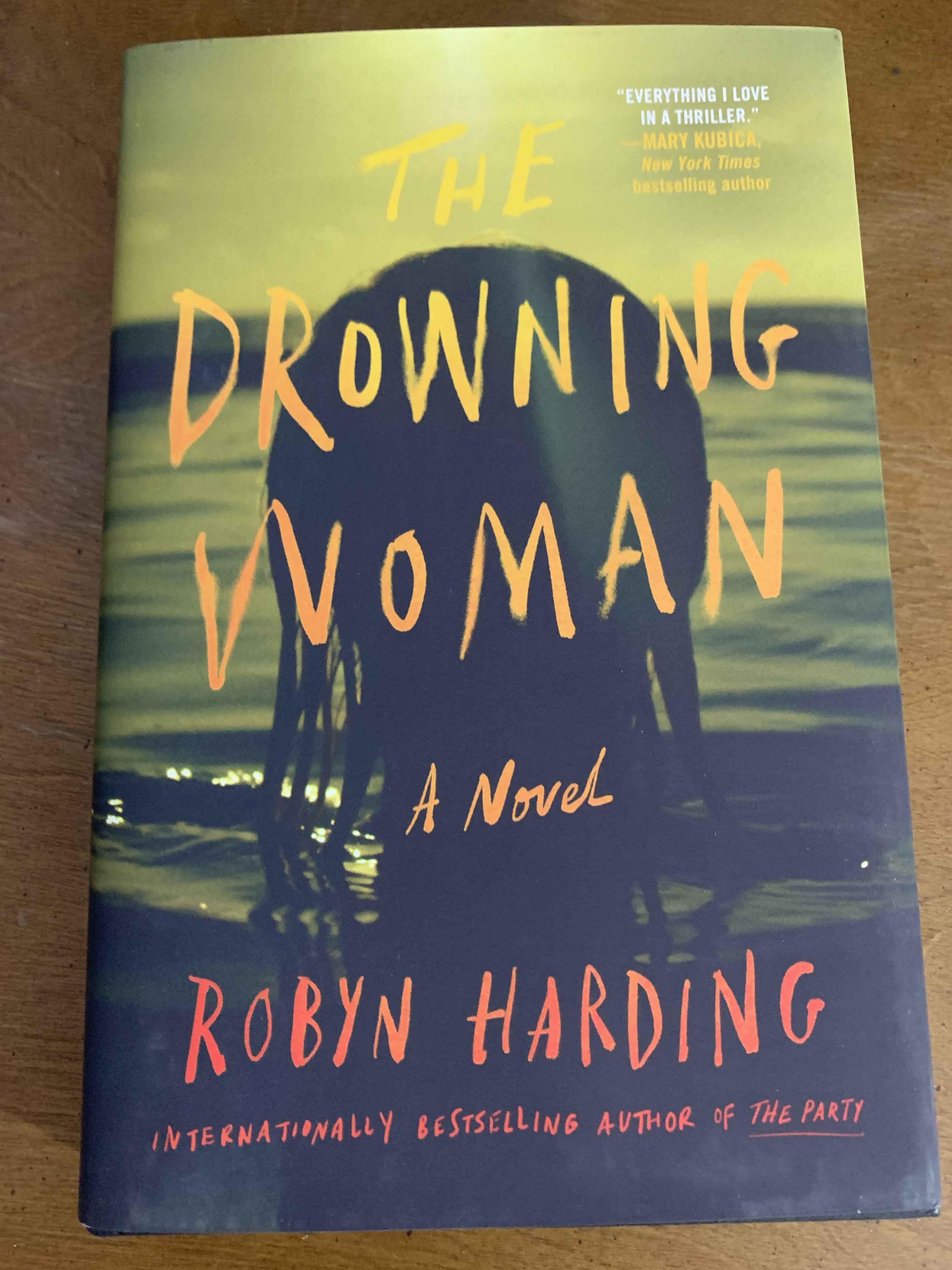
In an abusive situation, I imagine it must be a lot like perpetually drowning — water seeping into your lungs, with the primal desperation to survive, but unable to break the surface for air until the sweet taste of oxygen is there, tantalizingly brief, and then you’re back under, hardly a reprieve at all — and perhaps the worst indignity of the experience being the inability to call out for help in any meaningful way (drowning victims are so focused on putting air into their lungs, they aren’t actually making much noise or effectively signaling) Worse still is if the abuser is powerful and wealthy, paying off the lifeguards to look the other way, to keep my analogy going. Like the shadowy, amphorous figure on the dust jacket of Robyn Harding’s 2023 book, The Drowning Woman, the “drowning woman” could be any woman and “abuse” could be a stand-in for actual abuse, or a more pernicious, unseen abuse at the societal level, like a woman experiencing the little cuts of abuse manifest from experiencing homelessness.
I love a title that can apply to either protagonist of a story. In this case, Hazel, the woman facing psychological, emotional, and physical abuse from her powerful criminal defense attorney husband, Benjamin, and Lee, a former restaurant owner, who lost everything during the pandemic and is experiencing homelessness. Both women converge in their “drowning” on a beach in Seattle. What I’m particularly grateful for is that, as Harding acknowledges in her Acknowledgements, she learned what the experience of homelessness was like from a friend, and those little indignities and condescending judgments that arise, in addition to the unceasing fear and concern. She beautifully conveyed the sentiment that anyone at any time could experience homelessness if the right confluence of events occurs. Yet, we judge. What is a great touch, though, is even in her situation, Lee judges Hazel! In the aforementioned beach moment, she’s saves Hazel from what appears to be a suicidal attempt at drowning herself. After being rescued, Hazel explains to Lee she’s in a Total Power Exchange contract with her husband, which apparently goes beyond typical BDSM into a “master/slave” relationship, with one party exerting total control over a relationship. I’d never heard of this before. Nonetheless, Lee is aghast upon learning Hazel hasn’t just divorced or left him. And it goes without saying Hazel, who is living an affluent lifestyle, notwithstanding her abusive situation, is judging Lee’s homelessness, like peeing in the bushes, her unkemptness, and so forth.
Lee does have a job, and it’s through the job she meets Jesse, a personal trainer at a gym, who begins doting on her. They go out on dates and back to his rundown apartment for sex, but she hopes she’s keeping it under wraps she doesn’t have her own “home” to go back to.
Now, what I also love about what Harding did with The Drowning Woman is flipping the script in a smart and clever way. I was reading along, jotting a few weird tidbits down in my Notes app — I can’t believe Hazel gave Lee a trinket as her thanks to Lee for saving her life, or Jesse as a giant red flag because he didn’t even care about asking for Lee’s number, as examples — when Harding expertly answered those tidbits with said script-flipping. As it turns out, Hazel and Jesse were the ones originally together, plotting to kill Benjamin for his money and to ostensibly help Hazel out of her situation. They lucked into the happenstance of Lee — the drowning attempt was only supposed to appear accidental/suicidal, and Lee was going to save her — and through that, used the “homeless woman” as the scapegoat in their plot to kill Benjamin.
So, of course, now I’m wondering if Benjamin was abusing Hazel in the first place, and I’m mad at her for being so callous with Lee. But, naturally, Harding cleverly flips the script on me yet again because in fact, it was Benjamin and Jesse (not his real name; he’s a violent felon, who Benjamin defended previously) working together to murder Hazel. When Lee ostensibly came to “rescue” Hazel in the boat, he was actually going to kill her for $50,000. My one nitpick of the story is I’m still not clear on why Benjamin wanted her killed. It’s conveyed by him and generally throughout the book that he’s protective of his public image, but nothing Hazel did up to that point, including plotting to kill him, would have contradicted his public image.
Thankfully, both of our protagonists, our “drowning women,” are smarter than either Benjamin or Jesse realize. Hazel double-crosses Jesse, who she realizes is violent and lied about sleeping with Lee. In so doing, she ends up helping Lee escape to Panama with money and a new identity. Likewise, in her quest for answers, Lee discovers Jesse recorded his murder-for-hire discussions with Benjamin and gives them to the police. Also using Benjamin’s money, Hazel flees in the end — after Benjamin first is cleared in the murder-for-hire plot for questionable evidenced (the audio), and then charged once Jesse’s body washes up; yes, Benjamin had his guard kill him, meaning, in effect, Jesse was double-crossed twice! — and somehow discovers where Lee is, and they reconcile happily ever after.
My one hope for the ending was Lee, who wanted to start a restaurant again, and Hazel, whose dream was to have a bakery, would bring their dreams together after fleeing these terrible men. A high-end restaurant-bakery! They’re at least close to it.
I felt insatiable while reading Harding’s book; I couldn’t read it fast enough to figure out what the heck was going on every time she pulled the carpet out from under me. And again, it wasn’t in an unearned or cheap way; she earned her twists and turns. I was fully invested in Hazel and Lee’s outcomes, and for that matter, Benjamin getting his comeuppance.
While this was my first Harding book, it certainly won’t be my last!

 Milam's Musings