
Spoilers!
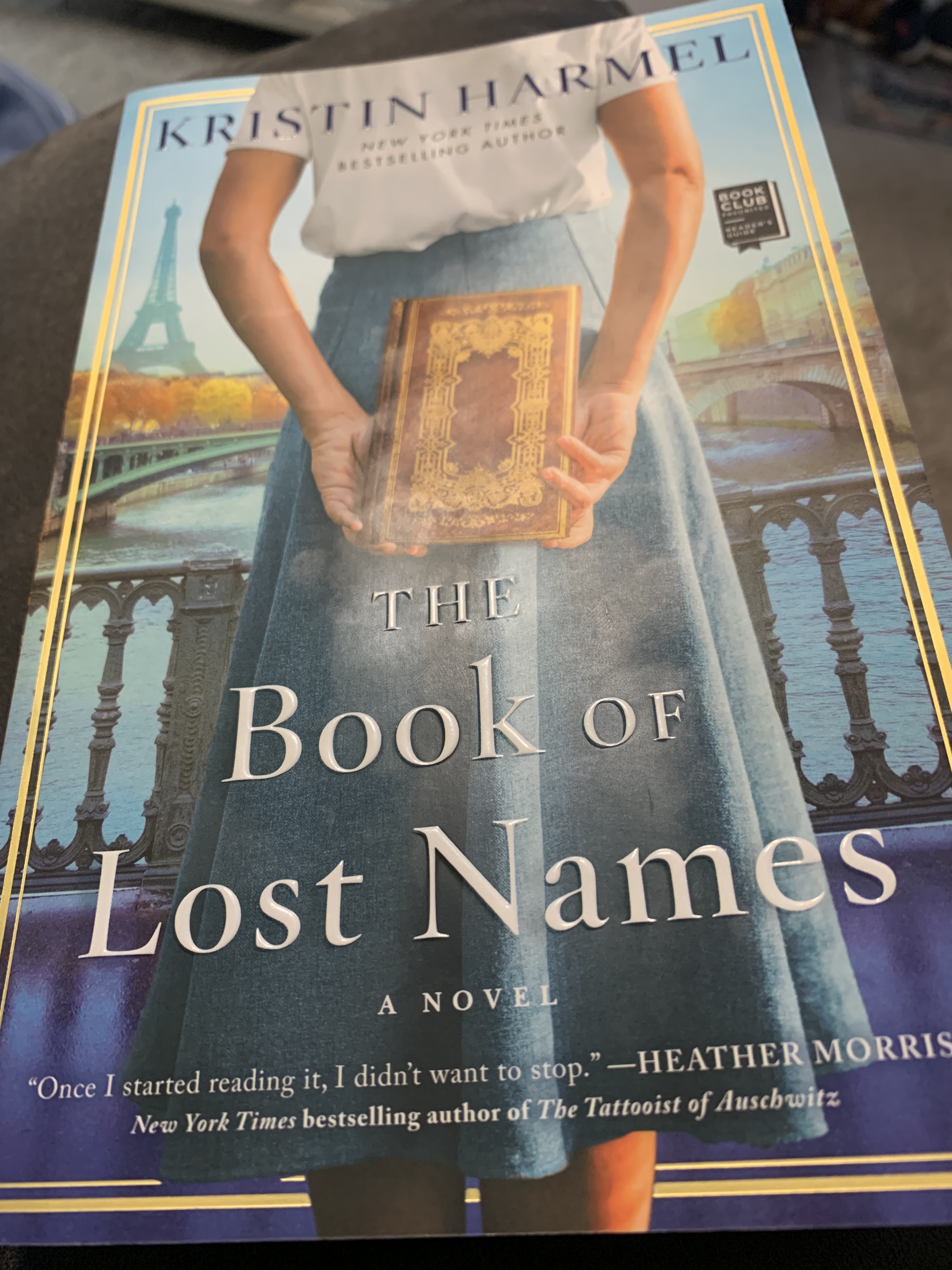
One of the most human activities is to tell stories; we’ve been telling stories as long as we’ve been able to have any effective form of communication with one another. That is why people love books and the magic of books, too. Additionally, the stories we tell ourselves about ourselves are just as important, if not more so, than the stories we tell others. For a variety of reasons, those who experienced something as life-altering, with life-and-death stakes, such as WWII and the Holocaust, need not only conceal their story with others, but often with themselves as well. Kristin Harmel’s 2020 book, The Book of Lost Names, uses real-life, deeply researched events from history to chronicle a story about the stories we tell, and don’t tell, about love and loss.
Eva loves books, and even well into her 80s, she’s still a devoted, spry librarian, who belies the ageist characterizations of her colleagues, and her son, Ben, for that matter. When she sees a 2005 New York Times article with Epitres et Evangiles pictured, she must fly to Berlin immediately, returning to Europe for the first time in 66-some years. Harmel’s book then transports us back to the turbulent early 1940s, when Eva lives at home with her Tatuś (daddy) and Mamusia (mommy) in Paris. Naturally, she’s pursuing a career in English literature. Her parents are Jews from Poland, who immigrated to Paris 20 years previously, and have a made a successful life for themselves. That is until Hitler and the Nazis invaded Poland and are on the march in Europe, bringing with them their harassment, discrimination, imprisonment, and extermination of Jews. Like many Jews of the time, Tatuś and Mamusia (more so her) are incredulous at the notion that the Germans will try to round up Polish Jews like them living in Paris, or their daughter, who was born in France. And unfortunately, that is exactly what happens, with Tatuś being taken away by the French police actually, and eventually sent to Auschwitz.
Understandably, Mamusia was distraught at losing her husband, but a fascinating dynamic quickly emerged: It was 23-year-old Eva who became the “mother-like” figure, directing Mamusia on what to do and planning their escape from Paris before it was too late. All the while, Mamusia is not only complaining about leaving Paris, but is blaming her own daughter for Tatuś being taken. She thinks her daughter should have intervened! I tried to be empathetic with Mamusia and her plight, but as the book goes on, she gets even more unlikable with the way she treats Eva and continues to blame her for everything.
Originally, Mamusia and Eva were going to abscond to neutral Switzerland. While waiting for travel to Switzerland, they stay in a small fictional mountainous town in France. There, they meet members of the Resistance, the ones fighting back against the Germans by undermining them, and by forging documents to send more people, particularly Jewish children, to Switzerland. That’s where Eva comes in handy (see what I did there?), as she has artistic talent. She hastily forged her family’s identities to flee Paris. When the Resistance learns of this, and how good she is at it, they want to use Eva to help forge documents and save thousands of Jewish children. In other words, she doesn’t go to Switzerland because now something bigger than herself or her plight commands her attention and efforts, which of course, Mamusia complains about. Nevertheless, the two Resistance figures Eva most works with are Père Clément, a Catholic priest who has a fantastic library within the church (where the aforementioned Epitres et Evangiles is) and it is there where the forging occurs, and Rémy, a fellow forger and soon to be the man of Eva’s dreams. Understandably, Eva is concerned that the children, who are often orphans, will forget their real names while they are under assumed identities; so, she wants to record them somehow, which itself is dangerous if those real names fell into the wrong hands. Rémy comes up with the solution of using the Epitres et Evangiles book and encoding all of the names within the book. Brilliant! Hence, then, the “book of lost names.”
Later on, the Resistance is betrayed by a fellow Resistance fighter and Jew, and many of them are killed, including Mamusia; and on the other hand, a Nazi with regrets helped the Resistance and actually saved Eva’s life at the end of the book. To Mamusia’s credit, she didn’t give up Eva, and instead, said her daughter was brave. I just wish Mamusia had told Eva that! Instead, thanks to Mamusia, Eva had all kinds of guilt, despite doing something heroic. I digress. So, after the betrayal, Eva is a prized “get” by the Germans, owing to her forging skills, so, she ought to finally make it to Switzerland. Instead, she stays behind with Rémy, they make love, and promise to marry each other once the war is over. They get separated, as he returns to the Resistance, and after the war, Rémy is presumed dead. More regret ensues for Eva. At least, her father, Tatuś survives the concentration camp, albeit he dies shortly thereafter from cancer. Not long after that, Eva gives up her dream that perhaps Rémy isn’t dead and he will show up at the library to meet her and they will indeed marry. She goes on to marry an American and move to America.
At the end of the book, Eva is reunited with Epitres et Evangiles, and as it turns out, Rémy, who actually wasn’t dead, and was living in New Mexico all this time. They tearfully kiss and promise to marry now. Oh, and Eva finally tells Ben about her life.
One of the most tragic aspects of Harmel’s book, and I’m not sure she even intended it to be so tragic (in a book filled with other tragedies) is that Eva essentially lived for 66 years without telling her own story. Imagine that, someone so enamored with the stories created by others, and yet, was unwilling to share her own, even with her son. (And when she finally does, she does it over the phone, mind you!) She became a “lost name” to herself and to her family. To the world! I find that incredibly sad, and I wonder how many other heroic individuals who sacrificed so much for others during WWII are lost to history because they never told anyone their story.
Now, my one critique of Harmel’s book is that Eva is rightly concerned with the children being lost to history, and thus, she and Rémy create the Book of Lost Names. This is the whole project. Yet, when Eva is ostensibly escaping France to be free and safe in Switzerland, she doesn’t take the book with her! What was the original plan?! Later, she’s not able to take the book with her because the Nazis are within the church, and then they loot the book, which is how it ended up in Germany for Eva to reclaim in 2005. But I was astonished! In fact, the Book of Lost Names became more about Eva and Rémy exchanging coded love notes to each other than it did about the children’s names. Put another way, what if Eva had tried sooner to find the looted book and tell the children saved from the Holocaust their real names? I was gobsmacked by the trajectory of the Book of Lost Names, given it is the namesake of Harmel’s book and the whole point of Eva’s part of the Resistance. Still, there is no denying how sweet and lovely Eva and Rémy’s improbable romance is, particularly finding each other all those years later, and of course, we were rooting for them to survive their ordeals and be together.
Harmel’s story had me at WWII, and then she further sucked me in with a historical aspect of WWII I wasn’t familiar with. Eva and Rémy were heroic characters, with many minor, heroic characters assisting them. I do wish she had played out the “book of lost names” concept further, such as Eva reuniting with one of the “lost children” at the end, but my gripe doesn’t take away from my enthrallment at the book. If you like books that blend real-life history with fictional, lovely storytelling, then The Book of Lost Names ought to join your bookshelf.

 Milam's Musings