
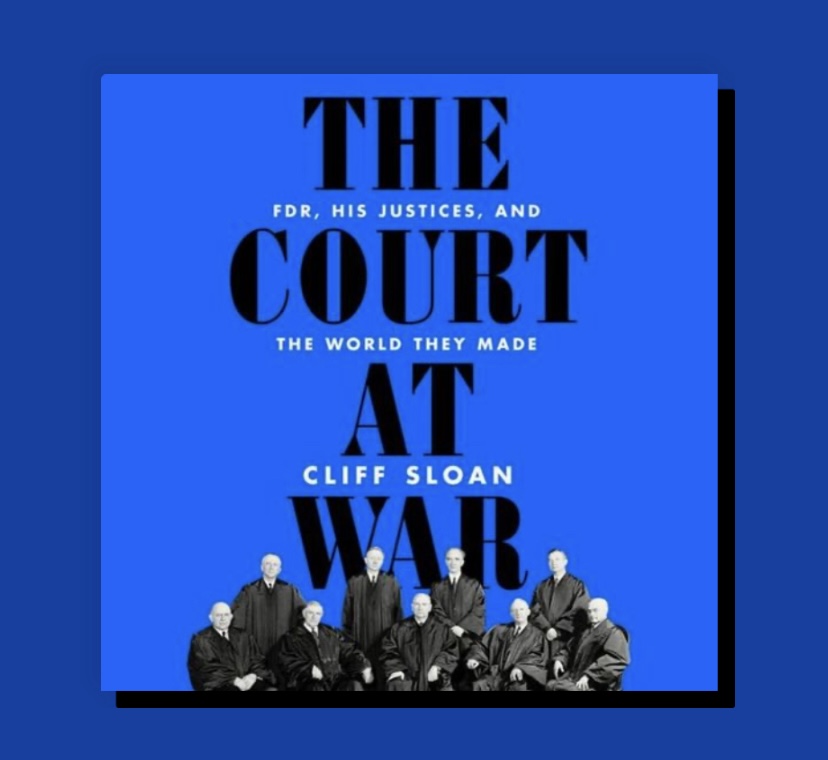
Sometimes, I think we are currently living in unprecedented times — and to be sure, some items, like a former president of the United States being indicted, is truly unprecedented — and then other times, I dive into history and realize how often certain concerns permeate the body politic and recirculate through each generation that follows. One of those concerns is the independence of the judiciary, and specifically, the independence of the Supreme Court of the United States as a co-equal branch of government (although, I like to remind folks that the branches in theory aren’t co-equal since Congress can impeach presidents and justices). Perhaps every generation thinks of itself as experiencing unprecedented times, and again, in some ways, it’s true, but surely, no time is as unprecedented as the WWII period, which may seem weird to say about the second world war, but the scope, devastation, and impact on domestic life and policies is without match in all of human history. Cliff Sloan explores this impact on the Supreme Court in his 2023 book, The Court at War: FDR, His Justices, and the World They Made. Sloan is an attorney, former American diplomat, and law professor at Georgetown University. The Court at War is a sweeping look at the ways in which WWII and the fight for civil rights arrived at the Court’s magisterial doorstep, and how the Justices responded, often in what seem like contradictory, flawed ways, both for the good of future jurisprudence and the historically awful.
One of those initial unprecedented moves from President FDR — himself an unprecedented president, elected to his third term a month before Pearl Harbor and America’s entry into WWII — was to pack the Supreme Court. The reason was simple: The Court was too conservative in his estimation, and kept ruling against his New Deal legislation. FDR’s Court-packing efforts received bipartisan pushback and he abandoned the idea. (Interestingly, nowadays, Court-packing has more traction than it has since at least 1869.) But in practice, FDR received his wish, anyhow. Over the course of his presidency leading into WWII, he appointed seven of the nine justices, and elevated an eighth to Chief Justice. That’s the most since Washington, and obviously, hasn’t been matched or surpassed since, although Eisenhower and Nixon were close. This was due to various justices retiring or dying. And it was short-lived, because within five years of the war’s end, Truman replaced four of the justices. As the subheading of Sloan’s book indicates, these justices were FDR’s, and to put it more pointedly, they were largely obsequious to him. While not his appointed Justice, an unprecedented move for the time was FDR’s appointment of Justice Owen Roberts to head the commission whose sole purpose was to investigate the facts related to the Pearl Harbor attack. Not surprisingly, the Roberts Commission was not only completed rather hastily (only a month after the attack) and with key information missing, but the report didn’t shine any negative light on the executive branch and FDR. One of FDR’s appointees, Justice James Byrnes, helped with the first War Powers Act, which gave FDR and the executive branch new, far-reaching authority, albeit such power would ostensibly end six months after the end of the war. Byrnes would then resign the Supreme Court to become FDR’s Director of Economic Stabilization to manage the economy during the war. He was even called the “assistant president.” Finally, Justice William O. Douglas was considered for FDR’s 1944 ticket. Interesting to imagine a President Douglas closing out the war and deciding over the use of nuclear weapons rather than Truman. FDR’s first nomination, by the way, was Justice Hugo Black, who had ties to the KKK, but he didn’t resign over the news and it eventually simmered down, naturally.
But let’s get to the cases. I love getting into the weeds on cases, and why certain Justices go one way or another with them, often contrary to what our preconceived notions are, and I like the behind-the-scenes as the Justices argue amongst themselves.
One of the first major decisions from the Court, decided only a week or so before Pearl Harbor was Edwards v. California, which is actually a fascinating decision. It essentially deemed California’s “Okie Laws” unconstitutional; a law which was enacted to prevent poor people from moving to California at the height of the Great Depression. In 1942, one of the most appalling cases of the era was Ex parte Quirin, which upheld the jurisdiction of the U.S. military tribunal over the trial of eight German saboteurs (which has been used to justify trial by military commission of unlawful combatants during the Global War on Terror). Justice Frank Murphy recused himself, and I thought Justices Byrnes and Felix Frankfurter ought to have as well. Nonetheless, I did think it was intriguing that Lieutenant Colonel Kenneth Royal argued against the military tribunal FDR created, and in effect, if the justices had ruled in his favor to send the case to civilian court, went against his own job interests. The Justices not only came to the decision quickly, only two days after oral arguments, but FDR even told one of the justices he would ignore the Court’s ruling if they opposed him. The Court opened the doors to six of the men being executed, but not rendering their Opinion justifying it until after the fact. How does that make any sense? If I could summate the views of the Justices, they essentially deferred to the wisdom of FDR and the military during a time of war on this case. That’s not exactly a comforting orientation for a co-equal, independent judiciary.
I have this in my notes, but I’m not sure if it’s one of Sloan’s own quotes or he himself was quoting a contemporaneous quote, but it’s apt, all the same: “The Court had become part of an executive juggernaut.” In other words, FDR, especially once the war began, was going to get deferential treatment in almost all matters of how he exercised his power.
Back to the cases. Of course, I’m being harsh on the Justices, and for good reason, but as I said at the top, they did buck the federal government at times to give us landmark cases that built the foundation for good case law, such as Schneiderman v. United States, when they rejected the government’s bid to denaturalize William Schneiderman, a self-avowed communist. Or the 1943 case, West Virginia State Board of Education v. Barnette, where the Justices upheld the right of the Barnette children to not salute the flag or say the Pledge of Allegiance (they had been repeatedly expelled from school for doing so, and anti-Jehovah’s Witness sentiment was fervent). Of course, I should note, this decision overturned the Court’s 1940 Gobitis decision that said public schools could require students to salute the American flag and recite the Pledge of Allegiance to much consternation from 170 newspapers that opposed the decision and concerns that the U.S. was imitating Hitler. With the 1943 decision, however, comes the most poetic sentence of the entire wartime era, and what many consider one of the greatest lines ever put in a Supreme Court Opinion from Justice Robert Jackson: “If there is any fixed star in our constitutional constellation, it is that no official, high or petty, can prescribe what shall be orthodox in politics, nationalism, religion, or other matters of opinion or force citizens to confess by word or act their faith therein.” Phew, yeah, that’s good. On the other hand, Justice Frankfurter is perhaps the most perplexing justice during this time. Not only did he previously play a role in the founding of the American Civil Liberties Union, but much to the chagrin of the other justices, even evoked his minority status as Jew in his dissent in the Barnette case while dissenting, mind you. Skinner v. Oklahoma is another landmark and unanimous decision that held compulsory sterilization of criminals to be unconstitutional. The Justices used a person’s right to privacy provided under the 14th Amendment as a basis. Sloan argues that not only was this decision the foundation for the Roe decision, but that Roe’s overturn is a slippery slope to arguments favoring the forced sterilization Skinner countered. In other words, the basis for overturning Roe could lead one to overturning Skinner, too. Another positive decision was Smith v. Allwright, which Sloan argues set the table for Brown v. Board of Education and the civil rights movement. He contrasts the Allwright case with the current Court’s lack of interest in judicially-enforced voting rights.
However, you cannot discuss the Court during WWII without discussing one of the most shameful Court decisions in our nation’s history, which goes back to the deference given to FDR and the military during the war: Korematsu, which was a challenge to Executive Order 9066, approving the relocation of Japanese-Americans into internment camps. What’s so interesting to think about is that we consider California such a staunchly blue state now, of course, but a.) I already mentioned the unconstitutional “Okie Laws,” and b.) California and other West Coast states was where much of the fear and ire about Japanese-Americans stemmed from. In echoes of today, some of the animus against Japanese-Americans was economic: native farmers in California didn’t like the Japanese-Americans encroaching on their turf. A lot of racism was baked into this decision long before WWII or Pearl Harbor, and coming out of Pearl Harbor, it didn’t help that there was misinformation from the Navy Secretary about “fifth column elements,” i.e., the threat from within by Japanese-Americans. One appalling statement was put out by the American Legion in California stating something to the effect of, “If they’re really patriotic, they’ll welcome the opportunity to be put in camps.” Patriotic duty was to sacrifice for the WWII cause, even if it meant camps. John McCloy, Assistant Secretary of War from 1941 to 1945, in response to Attorney General Francis Biddle’s statement that the Justice Department would have nothing to do with any such plans (he would later acquiesce, naturally), said, “The Constitution is just a scrap of paper to me.” His context was when measured against the safety of Americans, but it is precisely at the time when we face danger that we need to be most vigilant about that “scrap of paper,” lest things like the internment of innocent Americans is allowed to happen. Notably, though, Justice Frank Murphy was the first Justice to use the word “racism” in a Supreme Court opinion in his scathing dissent. This was yet another area where I was disappointed in ACLU-founding Justice Frankfurter, however. I’d be remiss if in my disappointment, I didn’t also mention how Frankfurter seemingly did nothing with reports of the Holocaust. He didn’t believe Jan Karski, a Polish resistance fighter, who reported on what he saw of the death camps. Shameful, to say the least.
This is an aside, but I also find it sickening and maddening that many of those involved in the brief in support interning Japanese-Americans went on to have exalted careers in the government. No recriminations or accountability of the powerful. One example: Charles Fahy, the Solicitor General of the U.S., who argued the case, later served as a circuit judge and then on the U.S. Court of Appeal for the District of Columbia Circuit for 30 years. Fahy acted dishonorably and unethically by withholding crucial information about the facts of the case.
Sloan’s book is thorough, with many throughlines to today’s Court and the arguments therein, and I think, ultimately, a warning about the need for the Court to be as independent from the executive branch and the president as possible. The lessons from the War Court are many, but the strongest takeaway I have is that deference to the president, especially when the stakes are as high as they are during war when the executive seeks more power over citizens, leads to faulty, flailing jurisprudence, which is another way of saying that it leads to the trampling of the rights of American citizens.

 Milam's Musings
One thought