
Spoilers!
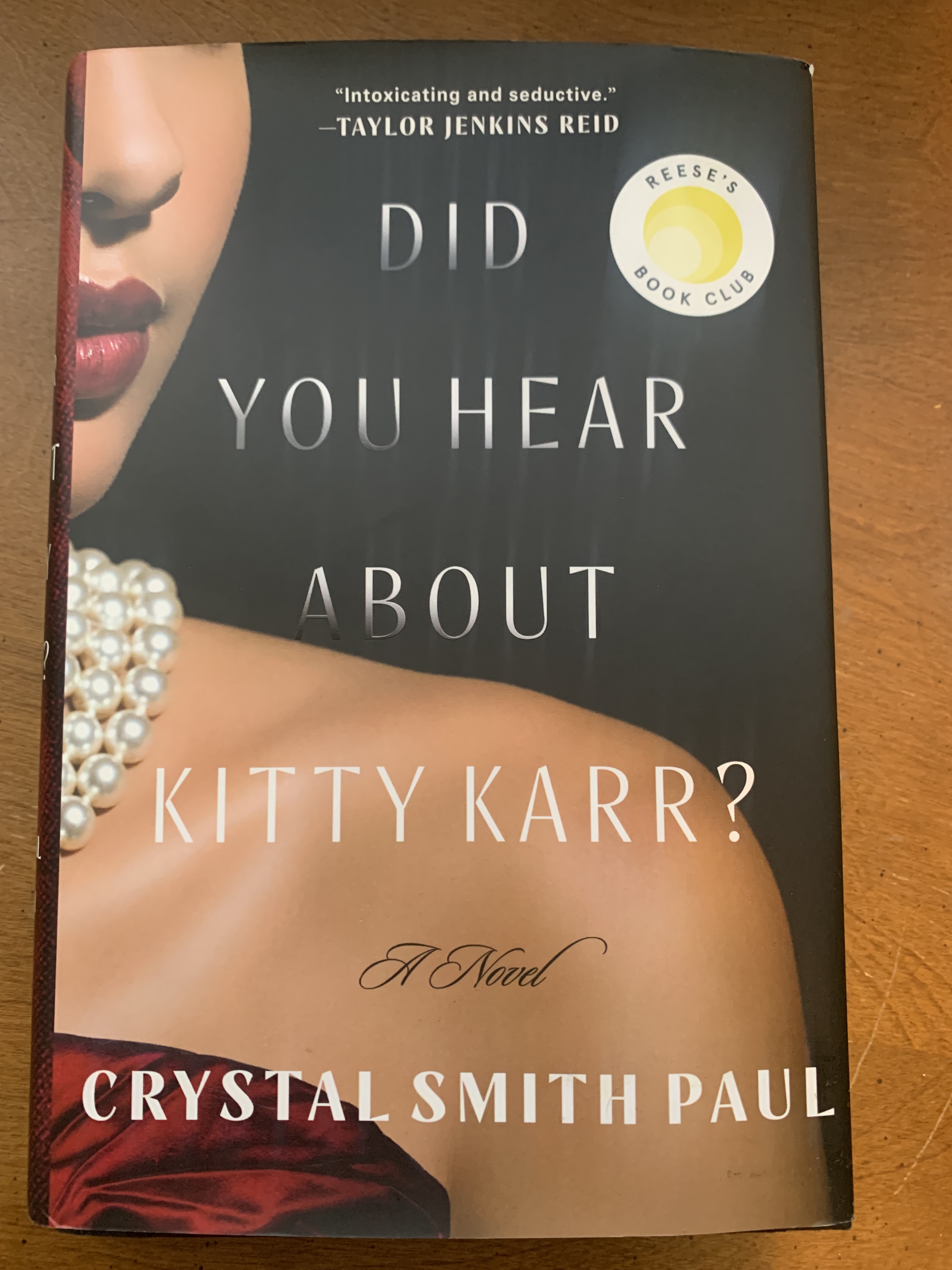
In a world purposefully, maliciously closed off to you, perhaps the path to take is to Trojan horse your way in, purporting to be the very picture of privilege that erected the walls against you in the first place. In Crystal Smith Paul’s 2023 book, Did You Hear About Kitty Karr?, she paints a tour-de-force of shame, pride, perseverance, and historical injustice that is hard to ignore.
Kitty Karr, a famous, albeit reclusive, 1950s and 1960s Hollywood actress, dies and bequeaths her considerable wealth to her next door neighbor, Elise, also a famous Hollywood star, in 2017. This is inexplicable to outsiders; why would Kitty Karr, a white woman, give her money to Elise, a Black woman, and for all seeming intents and purposes, not a blood relative? Paul’s book answers that question stretching back to the 1950s and 1960s era in Hollywood with Kitty, and indeed, her time before the glitz and glamour of Los Angeles and Tinseltown.
At first, I was wondering how Hazel, a Black maid for a rich tobacco family in North Carolina, with her daughter, Mary Magdalene, are going to factor into the story of Kitty Karr and Elise, but that was purposeful and seductive on Paul’s part. Mary is able to “pass” as white, owing to the crime of her creation: the white man, Teddy, heir to the tobacco fortune, raped Hazel resulting in Mary. Her ability to pass becomes Hazel’s dream for her daughter where passing is a ticket out of poverty, discrimination, and a dead-end future in North Carolina. Unbeknownst to Mary, Hazel’s been saving up for Mary’s entire life to send her off to Los Angeles.
A formative moment for Mary, one in which she realizes her mother’s true station in the world as a Black woman — I’d be remiss if I didn’t emphasize the “woman” part, too, as Paul’s book is just as much a discussion about gender dynamics as it is race, even within Black spaces because of how the degradation of the race affected men, which then affected their wives and children — was on a visit to the mall to go shopping for clothes. This moment showed the imbalance created by Jim Crow and the cultural norms around it. Mary spills a drink on a white woman, and the white woman demands Hazel (who she thinks is actually Mary’s maid, not mother because of the “passing”) to clean it up. Other shoppers pass by, “immune to a Negro woman down on all fours.” After the ordeal, Mary reflects, “Had she not been her mother’s daughter, it wouldn’t have hurt so much to see her crawl.” Oof. This is also precisely why Hazel wants to get Mary out of the South. Not that the North is necessarily better in many respects, or the West, as it were, but at least there, her “passing” could bring riches and success not feasible in the South.
When she gets to Los Angeles, Mary rekindles her friendship with another Black girl who is passing as white. Her name is now Emma, and she declares they are sisters, and that Mary’s name will now be none other than Kitty Karr. Emma works with white women at the Telescope film studio as phone operators and gets “Kitty” a job there. Through this job, she meets the new heir to the studio throne, Nathan. Through this budding relationship, she helps write scripts and eventually becomes the famous, Oscar-winning, white actress. But that’s only because she gave up her daughter with Nathan because she couldn’t pass. That daughter was Sarah, Elise’s mother, who was raised primarily by Nellie, the Black midwife who delivered her. Sarah, obviously, had mixed feelings that her mother gave her up. In addition to her soaring success capitalizing on the privilege of being white, Kitty also leveraged her connections through a network of other passing women who formed a front for charities called Blair House, where they instead re-directed the funds garnered from rich, white men to the NAACP and other causes. Somewhat in a throughline, at the end of the book, Elise decides to donate Kitty’s money to a reparations program for Black Americans.
I found it fitting that Paul’s book had a blurb from Taylor Jenkins Reid on it. She’s the author of Daisy Jones & The Six, one of my favorite reads of the year, and I feel like if there is an analog to that book, it’s this. But instead of music, it’s Hollywood, and add in a bit of Lessons in Chemistry barriers (gender and race), and that’s the vibe I had with Paul’s book. Reid is the one who called Paul’s book “seductive,” and it’s true. At first, I kept wondering where the book was going, but once Kitty, aka Mary, came to Los Angeles, the book picked up steam, and was riveting. However, I would like to know what happened to Emma, Kitty’s “sister,” and to Nathan, who we learned died some 30-years prior to Kitty, and why Kitty ultimately quit acting and became something of a recluse. I think Paul gives us enough to fill in those blanks — Kitty had everything she needed living next door to her daughter and granddaughters — but it still would have been nice to know for certain. Nonetheless, Paul’s book also read like almost a clandestine spy book because of how the “passing” women could so easily take advantage of the white power structure precisely because they could pass, because whites ignored the Black people around them, and also because in a place like Los Angeles, many of the whites at least understood the profitability of catering to Blacks, if nothing else.
Obviously, when Mary is sent to Los Angeles and then realizes what Hazel did, she’s upset because it means she has to leave her “Black life” entirely behind, including her mother. But she also realizes that “within her grief was a degree of relief.”
“… being Negro was akin to being a jack-in-the-box. Sometimes the lid opened, and you were able to shine, but eventually, you ended up back inside the darkness of limitation until someone got the notion to open the box again.”
Because of that “darkness of limitation,” it’s hard to fault Kitty’s actions, whether the way she treated Richard, her Black fiancé, or Sarah, or that she “died white,” like Emma intended, because she was navigating the reality of the world she was presented, and despite what could have been those limitations, she was able to provide for generations of her Black family, and at least, if Elise’s plan works, scores more Black families ruptured and limited by the crime of slavery, Jim Crow, and so on.
As I mentioned, I can certainly say Paul’s book was like a Trojan horse for me, starting off somewhat peculiar and then becoming a book I didn’t want to finish, owing to the the allure of 1950s and 1960s Hollywood, particularly the sheer force of will Kitty exerted, and the maddening fact of the discrimination endured. In a sense, I suppose, you could say the “cream always rises to the top,” when it’s a world where only the cream is allowed to rise.

 Milam's Musings