
Spoilers!
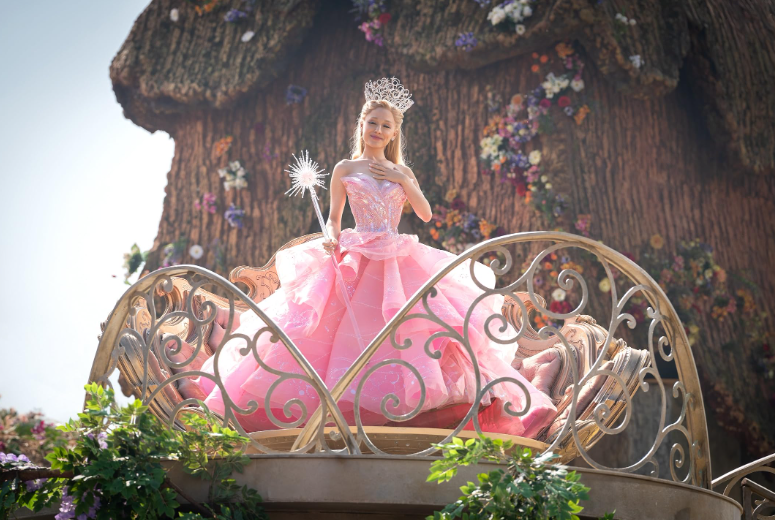
In the land of the wicked, be good. In the land of the vain, be modest and unassuming. In the Land of Oz, be the Witch. Be the one who says, “No.” In the 2024 film adaptation of the broadway musical of the same name, Wicked: Part I, Cynthia Erivo, who plays the Witch known as Elphaba, and Ariana Grande, who plays Galinda (Ga-linda!) are spellbinding and charming in a movie teeming with it. What’s great is I went into Wicked knowing nothing about it. I’ve never read the 1995 book by Gregory Maguire the stage musical is loosely based on, and I’ve never seen the musical. So, as I’m watching, it made Galinda all that funnier in her self-conceited way and Elphaba all that more sympathetic since both were organically earned.
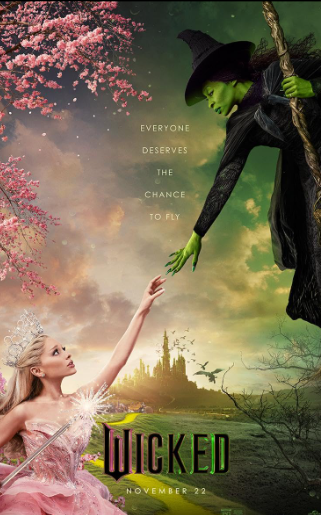
The film is directed by Jon Chu, who has a few prior musicals on his list, including the fantastic 2021 film, In the Heights, but nothing with quite such grandeur. Winnie Holzman, who wrote the broadway musical, also co-wrote this adaptation along with Dana Fox (Fox also wrote 2021’s Cruella, but I haven’t seen it). The absolute stunning cinematography, including of Shiz University and the Emerald City, was done by Alice Brooks, who also worked with Chu on In the Heights to give Washington Heights its colorful, gradient looks. She should be a lock for an Academy Award for Best Cinematography. The Land of Oz is as a vibrant and wicked as ever. Speaking of locks, if Paul Tazewell, the costumer designer, doesn’t win the Academy Award for Best Costume Design — for Grande’s Galinda alone! — then what are we even doing with that category?! I’m sure John Powell, the composer, will be in the mix for the score as well. If you walked out of Wicked not having experienced goosebumps when Elphaba took flight for the first time, I question if you even have goosebumps. I’m getting ahead of myself, but that entire scene reminded me of two superhero films. First, 2008’s The Dark Knight because Elphaba is being erroneously cast as the villain of the story and is being hunted by the “authorities,” just as Batman was. Secondly, 2013’s Man of Steel when Superman takes flight for the first time. It’s momentous like when Elphaba does! That orchestral chest-thumping score swoops in like the air beneath Elphaba’s broom, especially when she really vrooms away to end the film. Finally, it’s unfortunate that the Academy doesn’t have a category for choreography because I’m always in utter awe of how choreographers and the dancers pull off these big dance sets so well on film. Aside from the cinematographer and the actors themselves, choreography is the most spellbinding aspect of any great musical like Wicked. Kudos to you, Christopher Scott!
This isn’t the 1939 film The Wizard of Oz. Wicked starts off with the Wicked Witch dead and all of Munchkinland celebrating and showering Galinda with approbation (because that’s just the thing with her, as we come to find out). Before Galinda can fly away in her bubble in a fitting visual metaphor, a brave soul in the crowd asks something like, “What made her so wicked?” That’s when we learn Galinda and the Witch were friends, or as Galinda qualifies it, they “crossed paths.” No, not the yellow brick road, but the path that set them for Shiz University.
Elphaba was born green after her mother had an affair. Hopefully we find out who the father was in the second part! Her not-father, Frexspar, the Governor of Munchkinland (played by Andy Nyman, who eats up every scene he’s in with disdainful villainy), didn’t want her. From then on, she was an outcast. When her younger sister, Nessa (played lovingly, if rightly understated, by Marissa Bode in her first feature film!), who is paraplegic, goes to Shiz University, Frexspar makes Elphaba tag along to protect her. That’s when Madame Morrible (played by Michelle Yeoh, who is able to play the warm mentor the first three-thirds of the film and the cold villain when the time comes to great effect; talk about range!) takes interest in Elphaba’s powers. Much to Galinda’s chagrin, that is, since Galinda’s ambition is to be a sorcerer. Elphaba and Galinda become roommates, and at first, don’t like each other. Which is to say, Galinda doesn’t like Elphaba because she doesn’t understand her and has a certain level of naivete about her, perhaps colored by her vanity and ambitions. But it’s also Galinda’s naivete that makes her hilarious throughout the film. Grande’s delivery is pitch perfect and her mannerisms only amplify the hilarity, like when she pretends to faint on the couch awaiting a dark secret from Elphaba once they do become best friends. She had me belly-laughing numerous times. Every time she did that hair flip, I lost it (Elphaba’s attempt at it was great, too).
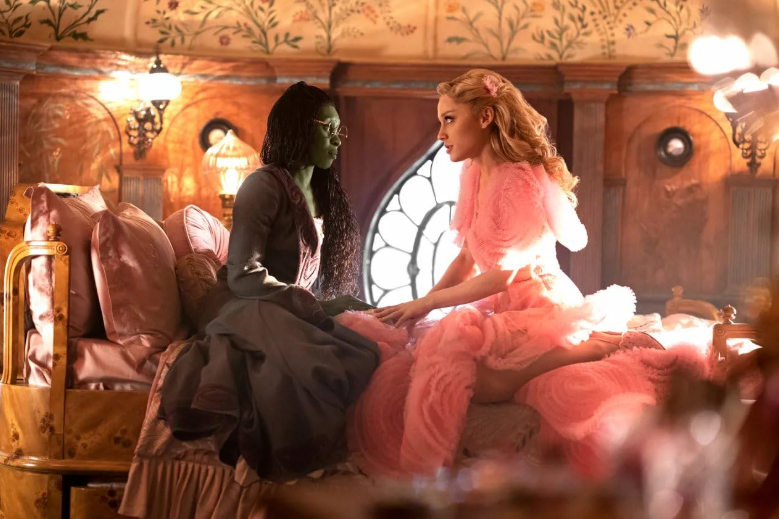
It’s while at Shiz University that we see how much Elphaba is maligned and bullied because of her greenness. In a world with talking animals and sorcerers I guess being green is apparently a step too far. Initially, as mentioned, Galinda goes along with her bad treatment, even giving an ugly black hat (that we associate with the witch!) to Elphaba because she knows it is hideous. Elphaba, though, takes it as a peace offering of sorts and forces Morrible’s hand to teach Glinda sorcery. This finally wakes Galinda out of her bubble, especially when Elphaba shows up wearing the hat and is laughed at and derided by her classmates. In the most touching moment of the film, Galinda walks up to Elphaba and begins doing Elphaba’s dance, which brings the crowd onboard with Elphaba. Elphaba cries through the dance routine. Me, too! Thereafter, they become best friends and the hilarious moments of, say, Galinda trying to change Elphaba’s wardrobe, commence.
While at Shiz University, Elphaba learns from Dr. Dillamond (who is played by Peter Dinklage, who doesn’t quite get the chance to show off his range), a goat and history professor, that talking animals are being persecuted and that’s why he’s the only one of his kind left at the school. Galinda, in typical naivety, can’t understand why a goat is unable to pronounce her name. Later, this is why she will change her name to Glinda in his honor. Secondly, she can’t understand why a history professor is stuck on the awful past. Alas, the past becomes present when Dr. Dillamond is roughly taken from the classroom and seemingly arrested and replaced with a new professor who is proud of the lion in his cage (is this the Cowardly Lion?!). Which is to say, he’s proud of the mechanism of the cage. Elphaba has had enough and is shocked at how everyone is ready to acquiesce so easily and quietly to what they just witnessed with Dr. Dillamond. She casts some sort of sleeping spell on everyone. Only, it doesn’t work on Fiyero (played by the absolutely game Jonathan Bailey), a prince from another county who Galinda had the hots for, so he comes along with her after rescuing the lion. There is a blossoming connection between Fiyero and Elphaba, but I think he’s too scared to allow it. He runs off.
Eventually, Elphaba is allowed to go see the Wonderful Wizard of Oz (with the perfect casting of Jeff Goldblum owing to his zaniness), who will grant her heart’s desire. Of course, Galinda thinks Elphaba’s heart’s desire and her dreams are to be in the same position as the Wizard because that’s her heart’s desire and dream, but instead, Elphaba wants the Wizard to help the animals being persecuted. Soon, though, she realizes that not only is the Wizard a fraud who is no wizard at all, but that he and Morrible are in cahoots to persecute the animals. In fact, they manipulated Elphaba because they want her to help them crush the animals because every group needs someone to hate. The metaphor of a guy the public sees as an all-powerful being who is actually weak and hides behind a ferocious facade is a presently salient one.
That’s when Elphaba, who offers Glinda to go with her but is rebuffed, flies away because she prefers freedom to what was on offer in the Emerald City.
What a beautiful film filled with poignancy about what makes us all the same despite our differences, and how much power even one person can possess when they dare to push back. The film also serves as a clarion call about the danger of a would-be leader who lacks character and skill tapping into the uh, wicked, side of our nature, and even the shallowness of doing good for the sake of receiving praise. What is good is good in and of itself, not because the students of Shiz University will like you or Fiyero will marry you. Sorry, Galinda! Intentions matter. I loved the musical moments, but I also loved the quiet moments. That’s the mark of a successful, resonant musical: when they can reach the heights of a musical note and the lows of human fallibility with equal aplomb.
For what it’s worth, my three favorite songs from the film:
- “Defying Gravity” by Elphaba, Glinda, and Ozians because it’s combined with the aforementioned powerful moment of Elphaba flying.
- “The Wizard and I” by Madame Morrible and Glinda because whew boy, Erivo hits a high note at the end that had all my hair standing up combined with a gorgeous shot, too, at the cliff’s edge. It’s also sad because Elphaba sings about a prophecy she has that the Land of Oz will have a celebration all about her. Oof. She was right, just not in the way she anticipated.
- “Dancing Through Life” by Fiyero, Glinda, and others because it’s perhaps the most fun of the song and dance numbers (“Popular” by Glinda is there, too, because it’s hilarious). Bailey kills it, and it’s the moment I thought, too damn bad there isn’t an Academy Award for Choreography because holy moly, that was awesome with the incorporation of the books and that big wheel thing.
I can’t wait for Part 2!


 Milam's Musings
One thought