
Spoilers!
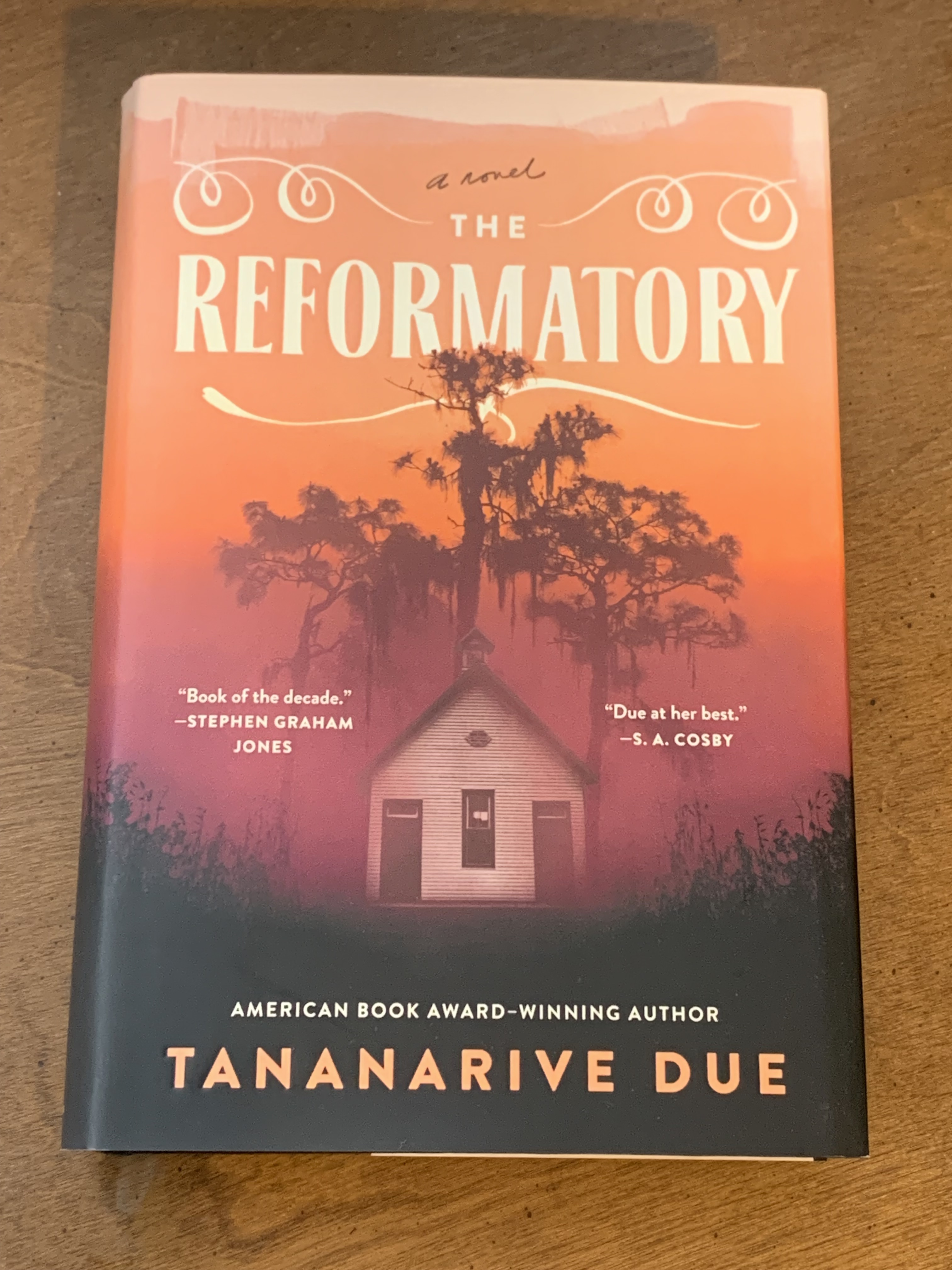
There is more than this. That is the siren song echoed down through the generations of many an oppressed people. It is also the siren song throughout the pages of Tananarive Due’s chest-tightening 2023 historical fiction book, The Reformatory. The book concerns the mistreatment of 1950s Blacks in Florida, particularly young Black boys at so-called reformatory schools. Jim Crow is alive and well in such swamps, where they wear you down one wrong at a time until the whole world seems wrong, to paraphrase one of the characters, but through such a facade, there is more than this. There has to be. To believe otherwise is to already be dying, to acquiesce to it all. And the protagonists in Due’s story from adults to 16-year-old Gloria to her 12-year-old brother Robbie are far from ready to obey in advance. There is too much living to be done, and too much freedom to be had.
It starts with a kick. Robbie sees a white boy from a well-to-do family make a pass at Gloria. So, he kicks the much bigger boy in the knee. Jim Crow demands acquiescence, especially to such well-to-do white families. Head bowed. Eyes averted. No whistling to white girls and women. Yes, sir, and no, sir. A skirmish like that ought to have been nothing, but in Jim Crow Florida, it was everything that sent the Stephens’ family into turmoil. Of course, it was already in turmoil, owing to the father, Robert Stephens Sr., who dared to amass a union at the place he worked. He was chased out of town on false accusations of rape against a white woman. He’s in Chicago, leaving Gloria and Robbie alone when all of this happens. Robbie’s kick is more than just a kick because it’s Robert Stephens Sr.’s son doing the kicking. Time to punish him for the “sins” of the father. He’s promptly accosted by the white boy’s father (punched in the ear, more accurately) and then arrested. Without formal charges or a trial of any kind, a local judge sentences Robbie to six months at the reformatory school, the Gracetown School for Boys, in the fictional town of Gracetown, Florida.
Due based the reformatory from hell in her book as an ode to the real Robert Stephens, her great-uncle, who died at the Dozier School for Boys in Marianna, Florida, in 1957, at the age of 15. He was one of many, and shockingly, that school closed as recently as 2011. The fictional reformatory is run by Warden Haddock, a psychopath who runs the reformatory like a prison and a tyrant. The town is okay with it because a.) they see it as putting Black boys in their place (even though there are whites there, too), and to use a common refrain one hears now with respect to mass incarceration, if they’re there, they must have done something to deserve it; and b.) through the unpaid labor of the Black boys, they get corn and a printing press, among other “positives” for the town. Like a plantation from the Old South, Haddock has “overseers,” or dorm masters, who are Black and keep the boys as young as six and as old as 21 in line. Even the most minor of infractions can lead a boy to the perversely named Funhouse for lashings, or worse, the Box (essentially a box in the ground akin to solitary confinement), or still worse, the shed to be anally raped by a broom handle wielded by Haddock. Shortly after arriving, Robbie and his friend, Redbone, are sent to the Funhouse and receive 20 and 30 lashes, respectively, for the infraction of talking about running. That scene was difficult to read and resulted in one of many aforementioned chest-tightenings. Haddock’s particular brand of evil also manifest in how he gaslights the boys. Not only by wrapping what he’s doing in God and the Bible, but by telling them that if it was anyone else, it would have been worse. That, in effect, he’s taking it easy on them. The psychological rationalization necessary for Haddock, the town, the sheriff, and so many others under Jim Crow and slavery before then to think of themselves as the good ones, the righteous ones, is staggering to consider, but I digress.
Robbie’s “saving graces,” if there are any, are two-fold. First, after the lashing and while healing at the infirmary, he meets Mrs. Hamilton, the volunteer music teacher, who recruits him to play trumpet. That gets him out of picking corn and harder work. Mrs. Hamilton’s a WWII veteran and a widow. Her husband survived WWII, but was killed by an angry white mob upon returning. Her brother, Percy, works as one of the “dorm masters.” Secondly for Robbie, as a “haint hunter.” Haint is another term for ghost. There are ghosts aplenty at the reformatory because of how much death has occurred there. Much of it by the hands of Haddock himself either directly — setting a fire that killed 25 boys in 1920, resulting in the most prominent haint that “befriends” Robbie and Redbone, Blue — or by forcing boys to kill other boys. Haddock even killed his own baby sister when he was just a kid himself. Like a true psychopath, he keeps reminders of his kills in the form of photographs stashed away in his desk. He knows they could ruin him, but he can’t resist the temptation. Boone, the meanest of the Black “dorm masters,” and the closest to Haddock, helps to catch the haints by laying dirt traps gleaned from his grandmother’s grave. Once they learn of Robbie’s ability to see haints, they leverage him to catch more haints. As Robbie comes to realize, it wasn’t enough for Haddock to kill Black boys over the years at the reformatory, he’s trying to take their souls in death, too. Along with the photographs, Haddock keeps a mason jar of the haints captured thus far. Robbie must keep capturing haints or risk the wrath of Haddock and Boone, which will be directed at Redbone. They’re callous monsters. Blue has a request, or demand, of his own for Robbie: Break into Haddock’s office and take the photographs and the jar to free the haints already captured.
Robbie’s dealing with a lot as a 12-year-old boy. But he’s not alone. Outside of the reformatory, the pugnacious and righteous Gloria is taking up his cause with anyone who will listen. First, she makes a daring ask of the well-to-do family to see if they’ll reconsider punishing Robbie. It’s largely futile, although they agree to talk to Haddock about not administering 20 lashes against Robbie (too late). Then, Gloria enlists the help of the white woman she works for, Miss Anne, to give her the money to get a Black defense attorney to talk to the judge. Miss Anne was an interesting character as the white archetype who wants to help the cause and mitigate the plight of Black people, but who is too afraid to make waves. To be fair, her father was already killed by white people for being too friendly to Blacks. She’s also a lesbian at a time when that could have gotten her in trouble, too. Ultimately, Miss Anne does right by Gloria and gives her the money. Not that she ultimately needed it because she connects with the NAACP’s lawyers, who don’t take her money. The NAACP lawyers try to reason with the judge who sentenced Robbie. It doesn’t work, either. Then, there’s the issue of the local sheriff and the Ku Klux Klan accosting Gloria and her godmother, Miz Lottie, thinking they are harboring Gloria’s father. They burn down Gloria’s home. They arrest her uncles on trumped up charges. They come searching for her specifically, so she hides out at Miz Lottie’s and then Mrs. Hamilton’s houses.
I should mention, Gloria has her own ability, too, a sort of precognition, to know what is going to happen to others and herself. For example, with one of the NAACP lawyers, Harry T. Moore, she knows will be killed in a bombing shortly. Due used a real life story. Moore and his wife were one of the first slayings of Blacks in the Civil Rights era in 1951. Nobody was ever prosecuted, naturally. Or Ruby McCollum, who helped Gloria connect with the NAACP. Due also used a real life story. McCollum killed a wealthy white doctor in Florida in 1952 for abusing her. She was convicted, nonetheless, of murder by an all-white jury and deemed crazy. One that actually didn’t pan out was Gloria’s precognition that she would be the one driving the getaway truck to rescue Robbie. Miz Lottie still ended up doing that. Gloria’s precognition abilities didn’t really have much effect one or another on the plot, though.
Gloria and Robbie’s mother can’t help them, either, as she died before the events of the book from cancer, but she appears as a vague haint to Robbie and is the one that reminds him: There is more than this. Indeed, once Gloria realizes the system isn’t going to help and is what’s caused all of this in the first place, she hatches a plan with Miz Lottie and her uncles, one of whom used to work at the reformatory, to help Robbie run from the reformatory. Which is no small thing! Running could, and most likely would, end up in his death, if he was caught. Even if he managed to get away from the campus, with Haddock, Boone, and hunting dogs on his heels, the townsfolk get $50 if they catch a runaway.
But with the help of Blue and Redbone, who unfortunately is killed by Haddock’s nefarious machinations, Robbie is able to accomplish the goals of Blue and Gloria: He successfully steals the photographs and haint jar, and then slips through a hole in the fence through the woods to Gloria, who is waiting with Miz Lottie in a truck to take them to a train to eventually take them to Chicago using Miss Anne’s money. Along the way, though, Blue asks Robbie to wait to be almost caught by Haddock. In a tense moment in a book filled with them, Haddock shoots Percy, who was with him, and nearly shoots Gloria who came to help Robbie. As he approaches Robbie though, all the haints spilled, or freed, from the jar turn one of the hounddogs wicked and he attacks Haddock, ripping out his throat and killing him. Thus, Gloria and Robbie escape, and Percy actually survives, too.
If I had any tweaks I would have wished to see with the ending, I do wish Boone faced some sort of comeuppance as well. He was awful. Not as evil as Haddock, but complicit. I also got it in my head that Mrs. Hamilton could have been like Miss Honey in Matilda and been the new mother, as it were, to Gloria and Robbie helping them reunite with their father in Chicago. Alas, the children make it to Chicago and giddily reunite with their father without her help.
Within the lifetime of people still alive today, authoritarianism existed in America for whole swaths of people. The authoritarianism of norms and mores, like Black people bowing their heads for white people, and the authoritarianism of two-tiers of justice for Blacks and whites, where the sheriff and his people can burn down a Black house with no recourse for the victims, but if a Black boy kicks a white boy, he is sentenced to a de facto prison and faces severe punishment and even death. Haddock is the embodiment of evil when it comes to the reformatory and the system, but one man alone cannot make a system, as Due reminds us in the book and in her Author’s Note, stating, “Everyone would try to say that only the warden left mauled in the creek had created the unholy suffering at that place, when the whole town had had a hand.” It is precisely that aspect of institutional racism and injustice that most Americans have no interest in reckoning with. Essentially, we prefer a “few bad apples” rendering of history. It’s easier, more sanitary than to believe an entire system was arrayed against a people for generations, killing and maiming so many.
But also, many, like the fictional Gloria and Robbie, found that there was “more than this,” if only they persisted and survived long enough to reach the other side. That may not provide much solace for the trail of blood that crisscrosses the maps of history, but for the living, they have to have something to hold onto and that’s enough for now.
Due’s book is heart-wrenching, claustrophobic, and infuriating, as books, fictional or not, tend to be about the Jim Crow South. The eggshells characters, even children like Gloria and Robbie, have to navigate, create natural tension and plot points for a book like Due’s. There is so much more here, though, than the evil ways of Haddock and the other characters in The Reformatory. There is also the beauty of sibling love, boyhood friendship, hope for the future, and the hope in those who do not obey in advance. This is a masterful must-read I couldn’t look away from, as difficult as it was to gaze upon our history.

 Milam's Musings