
Spoilers!
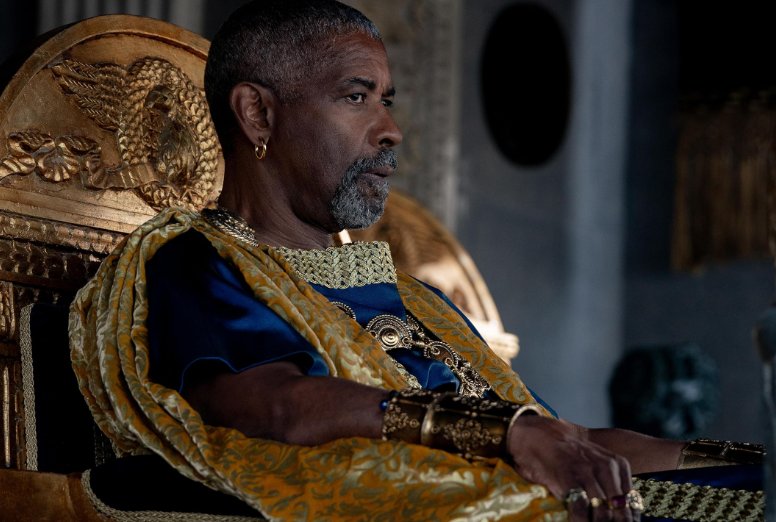
An empire can rot from within when its leaders acquiesce to a mad king, or in the case of 2024’s Gladiator II, two mad kings, and ignore the will of the people. It can get bad enough that those leaders will even bend the knee and applaud the appointment of an actual monkey to a seat at the leadership table, if that’s what the mad king has so ordered. Fortunately, there are always those within an empire (or country) who push back and indeed, fight back, if it becomes necessary.
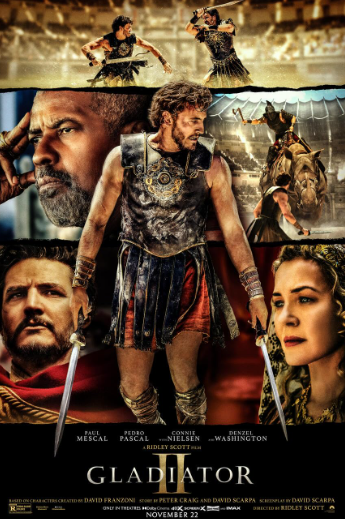
I’m not sure if anyone was particularly clamoring for a sequel to 2000’s Gladiator featuring Russell Crowe, but who doesn’t like to spend time with the Romans? Plus, it made a lot of money, so it’s surprising it didn’t get the sequel treatment for 24 years. Apparently, they aren’t going to wait as long and a Gladiator III is already in the works. But I’m getting ahead of myself. Like the first, the sequel is directed by Ridley Scott, who obviously has an extensive filmography dating most notably back to 1979’s Alien. For what it’s worth, my favorite of his is probably 2007’s American Gangster also featuring Crowe and Denzel Washington, who is in Gladiator II. Different writers were tapped for the sequel: David Scarpa and Peter Craig. The latter has some nice credits to his name, including 2010’s The Town and 2022’s The Batman. I’ll give them some credit for writing nice, soaring lines for Paul Mescal’s Hanno (then, it’s later learned he’s Lucius Aurelius, the son of Maximus, Crowe’s character from the first film), and subtly sinister lines for Washington’s character (Macrinus). John Mathieson returned as the cinematographer. Arguably, the best scene from an aesthetic standpoint — even surpassing the fight scenes in the colosseum, which were still great to look at — was the opening scene when the Roman army captures the African city of Numidia, where Hanno was sent to after the events of the first film. The Roman ships rolling in with the Numidia arming waiting, and then the firebombs and arrows start flinging was a heckuva way to re-introduce filmgoers to the Roman Empire. Finally, the thunderous, epic music you expect in a movie like this was supplied by Harry Gregson-Williams, who had hard shoes to fill from my boy Hans Zimmer, but he did well. It’s not a score I’m going to back and listen to, but it worked well with the film.
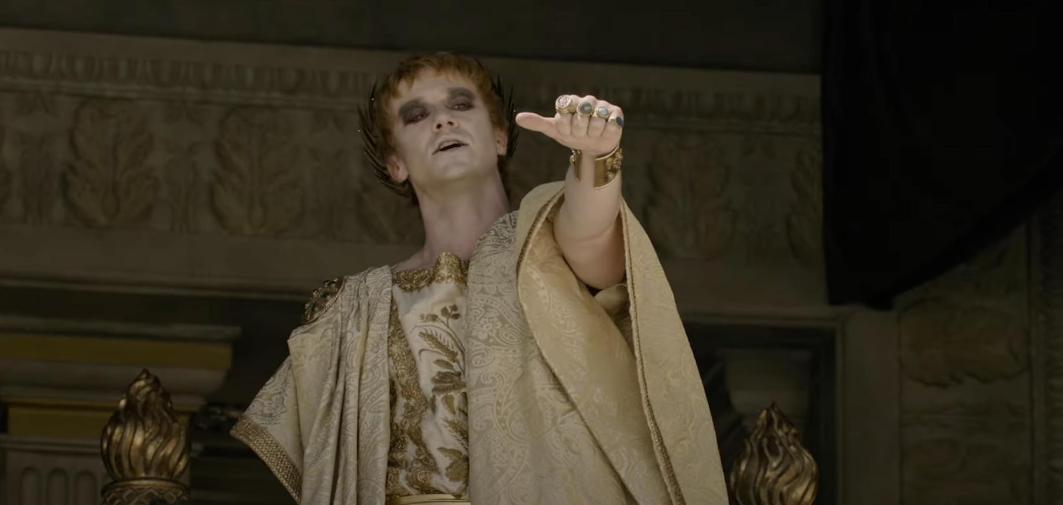
So, after Hanno is captured and his wife killed by the Roman General Acacius (played by Pedro Pascal, who managed to add a lot of gravitas to his short moments on screen), Hanno is sold to Macrinus to be his gladiator in training, with the hopes of eventually becoming free. The cloud hanging over all of this is that, as alluded to, Rome’s Empire has two mad kings: brother Emperors Geta (played by Joseph Quinn, who is going to be overlooked because of Washington, but his venom was conveyed well) and Caracalla (played with fun insanity by Fred Hechinger). The former is more straightwardly evil in the pursuit of world conquest, Rome’s subjects be damned. The latter is insane due to a brain disease and he walks around with a pet monkey. They push the bounds of Rome’s reach so much and the oft-repeated “dream of Rome,” that General Acacius plots to overthrow the Emperors with his wife, Lucilla (played by a returning and ageless Connie Nielsen), who is the mother to Lucius. That makes Lucius the Prince of Rome. But ultimately, Macrinus is conspiring against that. As a former prisoner-of-war to the Romans himself, he seeks the throne. He ultimately kills both Emperors after manipulating the mad Emperor Caracalla and has a showdown with Lucius. Washington is Washington, of course, but he actually plays this character quite interestingly. He’s rather eccentric and zany initially while slowly unfurling his more sadistic side. It makes for an against type for Washington. Even once he’s fully revealed himself and his intentions, I don’t see the Washington from American Gangster or 2001’s Training Day, as examples. It’s a different portrayal completely: a desperate would-be king as opposed to a fallen king.
After vanquishing Macrinus, Lucious gives a rousing speech to both parties — the existing Roman army protecting the palace and the original 5,000 who were loyal to General Acacius ready to overthrow it — to establish a peace and a new future for Rome, manifesting the “dream of Rome.” I do think moments like that, or in the colosseum, are funny because without microphones or megaphones there is no way everyone is hearing you! I’d be in the back on my horse going, “What did he say? Are we fighting or not?”
While Gladiator II doesn’t have the magnetism of Crowe, it makes up for it in the steely, unrelenting evil of Washington. They also throw in some different ways of doing gladiator battle in this one, including rabid monkeys (much bigger than Emperor Caracalla’s!), sharks, a rhino, and plenty of bloodletting. I particularly liked the moment when the Roman people are prepared to give Lucius mercy, but he doesn’t accept mercy from the Romans and kills the other guy. The rabid monkey scene, which is the first challenge for Lucius’ character, realistically would have ended the film right then and there because those monkeys looked vicious. But hey, I’ll accept it because it’s what made Lucius stand out to Macrinus. Finally, I would add that the film was perhaps 10 to 15 minutes too long.
If you’re looking for a fun time at the theater with sword fighting, ship battles, gladiators avoiding deadly sharks and rhinos, and roaring speeches to oppose the tyranny of madness, then Gladiator II is for you, too.

 Milam's Musings