
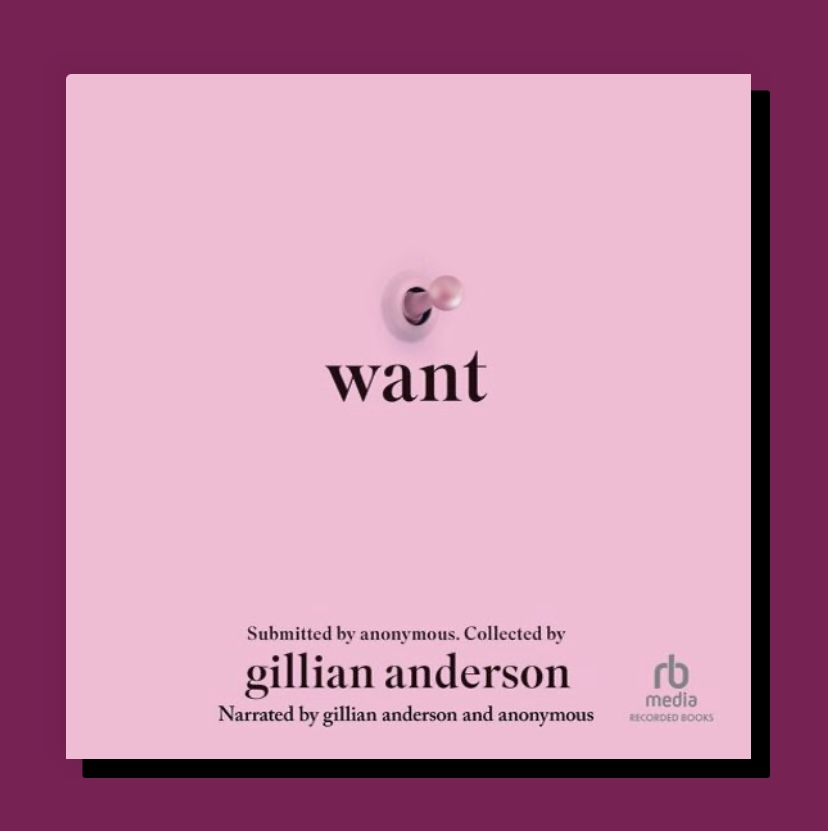
One of my fondest memories of going to Barnes & Noble in my early teens was standing in an aisle reading through the PostSecret books. Started in 2004 by Frank Warren, people around the world would mail their secrets anonymously on homemade postcards to him, which he would curate into PostSecret. While they included sexual fantasies and even misconduct, they covered the gambit of anything that could be considered a secret (habits, hopes, dreams, etc.). I’m not sure what it says about me or readers of PostSecret that we “enjoyed” this voyeuristic-like look under the collective, albeit individual, psyche of other humans — perhaps for the same reason we read anything: to realize we’re not alone in our own habits, hopes, dreams, and fantasies. That we aren’t singularly weird. Gillian Anderson, the American actress best known for the TV series, The X-Files, which incidentally I’ve never seen, updated this concept and narrowed its focus in 2024’s collection, Want: Sexual Fantasies by Anonymous. Of course, I’m drawing that line between Want and PostSecret; Anderson was actually inspired by Nancy Friday’s 1973 book, My Secret Garden: Women’s Sexual Fantasies. Friday’s book collected women’s fantasies and get this: women fantasize, too! That’s sarcasm, but in 1973, that was still a relatively revolutionary and novel concept. In a variety of manifestations, it still is today. Which is partly why Anderson took up the task of doing an updated version, as it were, of My Secret Garden for the 21st century. She wanted to see what’s changed, what hasn’t, and how technology has altered fantasies. If it wasn’t clear, either, the submissions are all from women, which is why I said the focus was necessarily narrowed.
Anderson received enough submissions to fill multiple volumes, so, she and the publisher curated it down into a digestible book. The submissions are contained within certain subsections throughout the book, including stranger fantasies, less mainstream fantasies, and fantasies that are of a more abstract, philosophical nature, among others. The fantasies come from women of all backgrounds, countries, income levels, relationship statuses, whether they have children or not, religious affiliation, and sexual orientations. Indeed, Anderson collected the aforementioned demographic information, if the anonymous submitter filled it out, and what’s most useful about it is what anyone paying attention likely suspected. We’re all largely the same in that we desire. There is, of course, variation in what is being desired and the details, but we all want to be desired and to be loved.
In college, I wrote a weekly column and one of my column pieces was about how marvelous humans are in their sexual proclivities. It’s the Rule 34 concept of the internet. If you can imagine it, there is likely porn of it. Which is to say, far from seeing it as something grotesque or worse, something to be banished from society, I find such varied proclivities, so long as they are consensual and safe, a beautiful reflection of society. Humans are interesting! From those who want to roll in the hay with Bigfoot to those who want “moresomes,” there is no real limit to what we fantasize about and desire. Don’t yuck people’s yum, or to put in the familiar way, don’t kink shame!
But I also have to say, I always have two caveats whenever I read anything (or in this case, listen to anything) of a sexual nature. First, I feel like there is a natural curating that happens with those willing, even anonymously, to reveal their sexual fantasies. Which is to say, there is a certain type of person who submits to such things, just like with PostSecret, and that makes it difficult to extrapolate overarching themes or make any definite proclamations about the State of Sex™ in the world. Secondly and similarly, people either aren’t truthful about their sexual proclivities or aren’t truthful to themselves about their sexual proclivities, even when granted anonymity. That’s why self-surveys about the number of sexual partners, for example, are difficult to take seriously. None of this is to diminish Anderson’s project or the women who submitted. Or even to necessarily upend the veracity of the submissions. I’m just cautioning against any of those overarching extrapolations.
Finally, one more note about the submissions. Some of the fantasies included in the book are extraordinarily detailed. I wonder if that is because when you ask people to sit down and write out their fantasies, they’re going to be necessarily detailed rather than transposing how the fantasy is utilized in practice when they’re pleasuring themselves. In other words, I could be terribly wrong, but I cannot imagine anyone in the act of self-pleasure is running through such detailed and intricately plotted fantasies. So, I think there is something to be said for the chasm that exists between fantasy in practice versus fantasy in writing. Which of course, the former is different from fantasy in reality as well. As Anderson regularly and rightly notes, just because someone fantasizes about something doesn’t mean they would actually do it, like abduction or rape fantasies, as perhaps the most salient examples.
Regarding the demographic information, I’m not sure there is much notable to reflect upon other than, I was surprised (and again, this could be the bias with the sampling of people who would submit to such a project) how many people identified as pagans and there was even one Satanist. The latter’s fantasy was about her park supervisor dominating her in bed. I don’t think it’s wise to transpose religious affiliation (or the other demographic information) with how sexual fantasies manifest. Nor is it wise, either, to transpose childhood or adult trauma on how sexual fantasies manifest. Humans are too complicated and complex for such smooth psychological mapping.
What most interested me from a big picture perspective about the fantasies was how many women in committed relationships (heterosexual, gay, pansexual, etc.) just weren’t satisfied with their sex lives with the person they most loved. These women encompassed the range of ages and how long they’d been with their partner. I found it rather sad how many felt like they couldn’t be open or honest or communicate their wants to their partner. It is perfectly healthy to have fantasies that don’t involve your partner — that’s what makes them fantasies in the first place! You’re not going to fantasize about someone or something you already have, although of course, you could fantasize about your partner in a different context. But the disconnect in satisfaction is troubling. When fantasy better satiates someone, for lack of a better word, that also seems a troubling issue in any relationship. For example, one woman had been married for 13 years. Unfortunately, her husband suffered from depression, which deleteriously impacted his self-worth and sex drive. Through the first five years of their marriage, they had sex twice a year lasting at most five minutes each time. To survive, quite literally, and satiate herself, she fantasized about the Weasley twins (yes, from Harry Potter!). Eventually, fortunately for them, their marriage and their sex life improved. That’s an extreme example, though, and having suffered through major depression, I empathize with how it complicates a good sex life for both parties.
My other big takeaway was how many women had some manifestation of “mom guilt.” Or shame is another way of saying it. The women in the book (married and not married, with children and without children, too) were saturated in attendant shame with their fantasies. Because they’re supposed to be a mom, a wife, a boss, and a feminist. Or whatever the case was. A few women throughout the book felt they had to throat clear about their feminist bona fides and their adherence to a sex positive outlook (all good things!) before detailing their brutish male-dominated fantasy. That’s what I meant earlier by how self-reporting on sex can get complicated. Even within the sanctuary of our own brains, we gaslight ourselves about what we want and what that says about us.
Overall, I thought Want was a fascinating look into the minds of women the world over, psychologically and sociologically. Again, without making any grand statements or extrapolations. I can say with full honesty (I know I’ve repeatedly made a stink about self-reporting!), this wasn’t a titillating exercise, with the exception of a handful of fantasies that directly appealed to me. Again, Want was more so an interesting prospect to see just how wide the wants and desires are of humans no matter the demographic makeup of the individual person. The audiobook was read by Anderson, largely in the introduction and to introduce each subsequent section, and then the fantasies were read by a half-dozen or so anonymous voice actors. It was a bit much! To listen to 12-ish hours of graphic, detailed sexual fantasies — even attempting to do so with detached, intellectual curiosity — was a lot. Especially for the longer submissions, I found myself zoning out, like, okay, I get it. I imagine I would have felt the same had I read the book, too. Also, I understand what Anderson was doing so as to differentiate her voice from a fantasy she was referencing, but the affectation she put on reminiscent of a whispery ASMR narrator was grating for me. Still, overall, if you’re also sex positive, not someone to kink shame, and are curious about the breadth of human sexuality and desire, then you’ll find Want an interesting foray into the unspoken, the unfulfilled, and the unfettered.

 Milam's Musings
One thought