
There’s not really spoilers here per se since it’s all about fallout!

When the equivalent of Superman dies in the Marvel universe, all heroes, godlike, mutant, augmented by a spider or a machine, and human alike mourn his passing. In 2007’s Fallen Son: The Death of Captain America, each major Marvel character represents the five stages of grief in the fallout to Captain America’s death from the Civil War between superheroes. The graphic novel’s author Jeph Loeb, acknowledges in an interview within the book that Captain America is their Superman and his death is treated as such (and of course, likely had to be influenced, I would think, by the success of 1992’s The Death of Superman). Obviously, nobody trusts a death in comic books, especially of such a stalwart, popular character like Captain America, but it still makes for an interesting storytelling device, especially utilizing the five stages of grief motif.
If you’re familiar with the Marvel Cinematic Universe, then you know what the Civil War alluded to before. Tony Stark/Iron Man goes along with the government’s efforts to provide oversight of superheroes, as it were, and Steve Rogers/Captain America is diametrically opposed to the idea, pitting the two superheroes and their respective allies against each other. At some point, to prevent further fighting, Captain America in the comic books turns himself in and then is promptly assassinated by someone presumably at the behest of the Red Skull, Captain America’s longest running and greatest foe. (I believe it’s later learned to be a brainwashed Sharon Carter, a former love interest of Captain America’s.)
Given his character, Wolverine appropriately starts us off representing Denial. He doesn’t believe Captain America is really dead, and thus, is also the voice of comic book fans. He enlists the help of Daredevil to track down Crossbones, who took a shot at Captain America. But in reality, Wolverine wants to see the supposed dead body of Captain America to confirm his death. He does and it does.
For Anger, we turn to the Mighty Avengers (on the side of Stark) and the New Avengers (on the side of Captain America). The former uses Tiger Shark, who is attacking a missile base, as a punching bag to unleash on and uh, work through their anger. Meanwhile, the Thing from the Fantastic Four, Wolverine, Spider-Man, Luke Cage, and others are having a poker match. I didn’t know that apparently, they like to have poker matches! Anyhow, Wolverine and Spider-Man nearly come to fisticuffs, but it’s obviously all just pain. Wolverine even, rather sweetly it must be said, shadows Spider-Man to make sure he gets home okay.
Bargaining is represented by Clint Barton, aka Hawkeye, who was considered dead, but who confronts Tony Stark over Captain America’s death. In a literal form of bargaining, Stark offers Hawkeye Captain America’s legitimate and iconic shield. Hawkeye indeed can wield it effectively, and is then offered by Stark the opportunity to become Captain America. In other words, Stark is at the bargaining stage of thinking any person can at least be the hero the country needs by assuming Captain America’s role, not realizing that there is only one person who can actually be Captain America and that’s Steve Rogers. Of course, Hawkeye doesn’t take him up on it and instead leaves Stark alone in the rain.
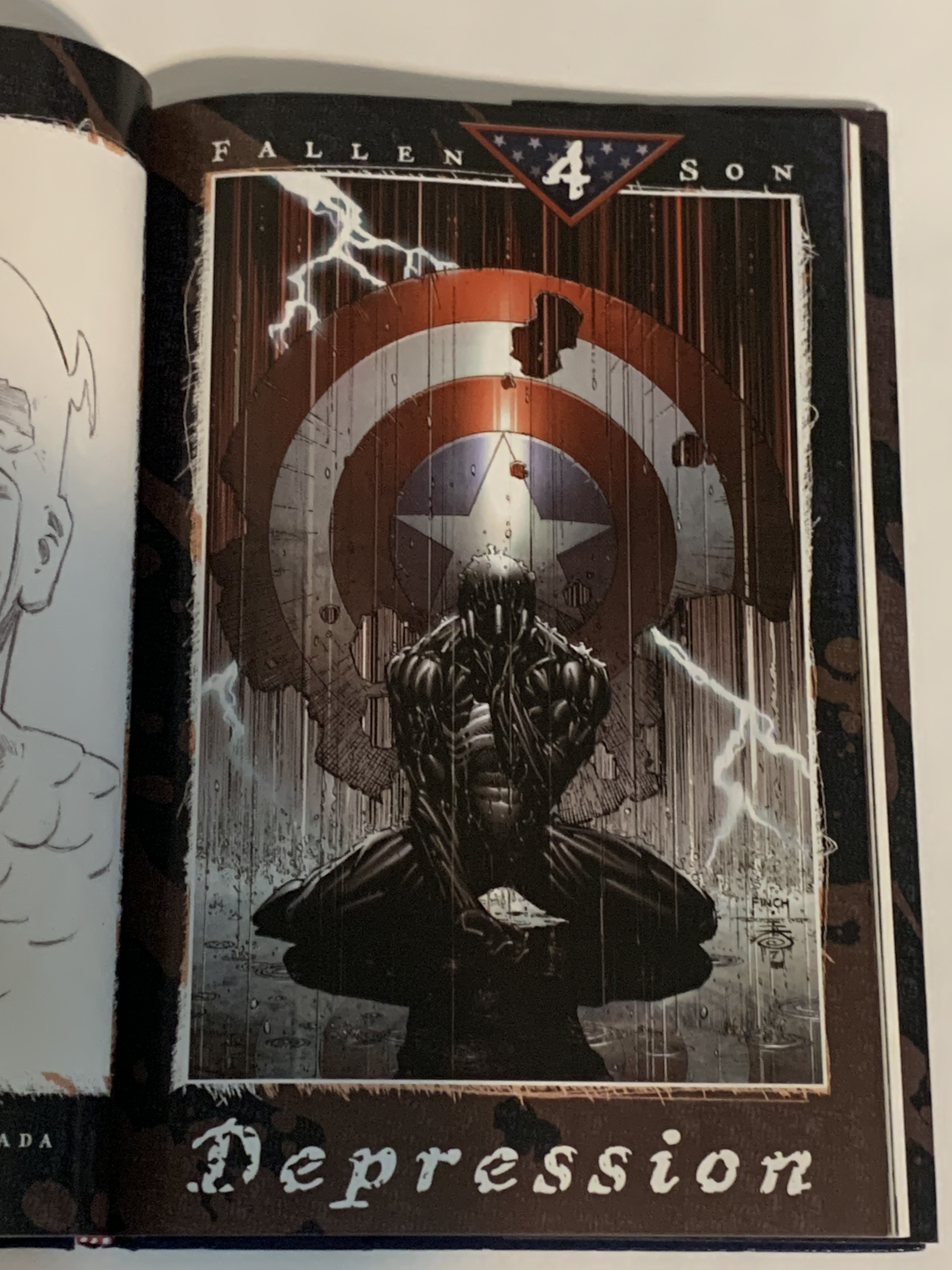
As if there was any doubt, especially from the Anger section, Spider-Man represents Depression. At such a young age, Spider-Man’s dealt with a lot of grief: the death of his Uncle Ben, Gwen, his love interest, and others (Gwen’s father, and Harry Osborn). In perhaps the best line of the graphic novel, Spider-Man reflects, “A true hero’s legacy is judged by the lives he’s saved, his will be judged by those he’s lost.” Thinking he’s about to be accosted by one of his foes, the Rhino, Spider-Man goes on the offensive, not realizing that Rhino was just visiting his mother’s grave. In a moving reflection — as he’s being pulverized by Rhino, mind you — Spider-Man reflects on the time Captain America saved him from the Hulk’s wrath. Spider-Man intervened against Hulk’s rampage upon New York City and was getting punched by the Hulk for his interference. I’m a sap; I’m getting teary-eyed thinking about what Captain said as he saved Spider-Man: “You did well, Spider-Man. I’ll take it from here.” What a freaking hero and bad-ass. Oh, back in the present, Wolverine, who was shadowing Spider-Man, pops up to save him from Rhino. Wolverine then offers Spider-Man some sage advice about grief and depression: You never quite get over it, you simply learn to live with the pain and life will get better … someday. Certainly.
Finally, Acceptance is an incredible scene at the funeral service for Captain America where those divided by the Civil War come together to bid farewell to the hero. Sam Wilson/Falcon gives a rah-rah speech pointing out how everyone came together for Captain America, and no matter what Captain America was called over the years (there was a few iterations, including the Nomad!), at the end of the day, it was the man, Steve Rogers, who mattered. Captain America’s body is later then sunk into the Arctic, a callback to how he was discovered frozen in time to catch him up to modern times.
My brain works in amusing ways. I thought I’d go for a lighter read after finishing the biography of Robin Williams by grabbing a graphic novel. I picked the one about grief and its five stages. Not a light read, as it turns out! It was sad, moving, and inspiring in the sense that Captain America and what he stood for is inspiring. Obviously, I wish I had planned this better and read some of the graphic novel collections that came before it (Civil War and his death itself), but as a way to cap off (heh) Captain America’s death, it was quite effective.
Also, what’s fun about this collection is that it includes the aforementioned interview with Loeb, a comprehensive history of Captain America (for example, he used to use a triangle shield!), and the first few 1941 issues of Captain America fighting the Nazis and his first clash with the Red Skull. Those were particularly enjoyable for slang of the time, like Captain America calling people skunks. Bucky is his sidekick, a kid who was a mascot for the Army. But it’s funny to have a kid fighting with him because it’s not as if Bucky had any actual powers in the way Captain America does! Then weirdly, also included in the collection of these first issues is the story of Hurricane, the son of Thor. It must be an extraordinary one-off trying to capitalize (at the time) on Captain America since there’s not even a Wikipedia entry! After that is a character named Tuk, who is from the Stone Age, and is apparently one of the Inhumans. I actually thought it was a neat concept.
This is a great, must-have collection for any comic book/superhero fan. The artwork from the various artists (Leinil Yu, Ed McGuinness, John Romita Jr., David Finch, and John Cassaday) helps convey the grief and each of the respective stages. I’m most fond of — which is to say, I most relate to — the Depression section with Spider-Man that Finch captures exceptionally well. It helps that Spider-Man has the black suit on, further adding to the depression vibe.
Of course, my only issue with Fallen Son is that I’ve gone done a rabbit hole of adding all kinds of stories, previous to and after this one, to my Amazon cart. Alas.

 Milam's Musings