
A bit of a weird book to warn about spoilers, but just to be safe … spoilers!
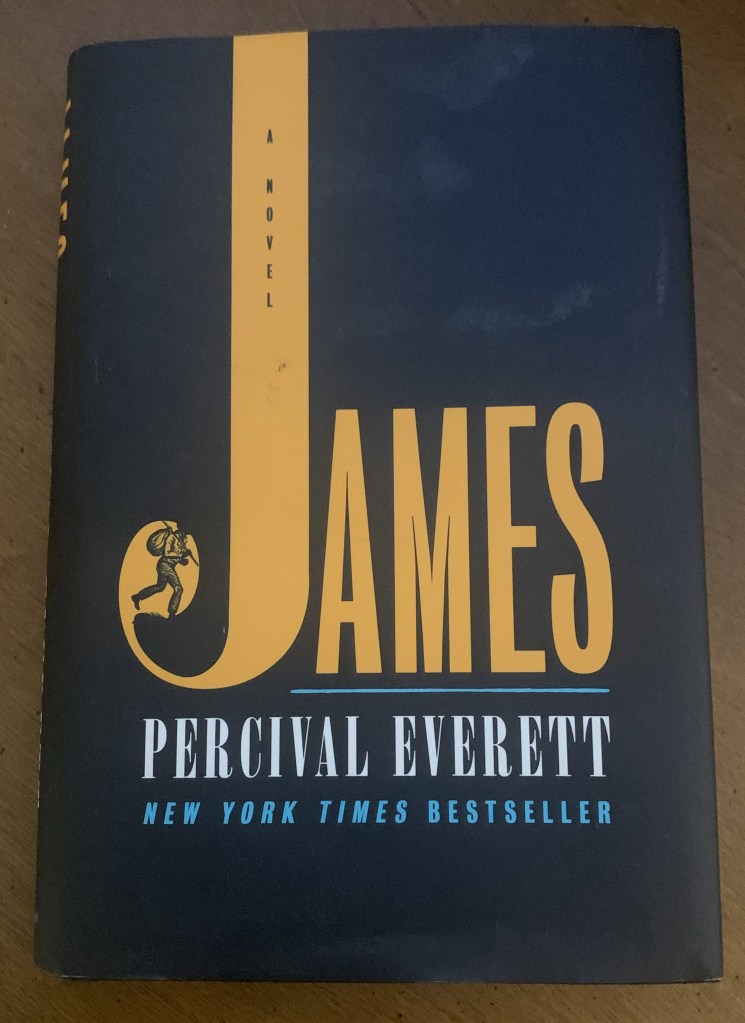
The power of language through speech, reading, and writing is radical, liberating even. To have a name of your choosing is to be someone untethered by the control of another. Correspondingly, then, controlling language is to control the mind, which controls the body, which controls a people. The yoke of slavery in the United States may have seen its most bombastic severing during the Civil War, but slaves were tearing at the yoke the moment they were forcefully ripped from their homes in Africa and set upon the seas in slave ships for the new continent. By keeping their oral traditions, their songs, their language. By daring to learn English and to read, to write, to philosophize. By existing and thriving beyond the chains meant to hold them and the rope to end them. A fraught, perilous journey to be sure, often leading to familial separation, rape, torture, and death, but it is a yearning too potent to be smothered. In Percival Everett’s 2024 book, James, we see a world teeming underneath the white and powerful, yearning to be free, to enact justice without the threat of injustice in return, and its titular character standing athwart the river of hate determined to swallow him up, body, mind, and soul, and him saying, “No.” Everett’s James relishes in the absurdity of slavery and White power, often to comedic effect, while never losing sight of just how deadly that absurdity was and can be. James is unforgettable, powerful, espousing a wholly unique voice, and generational.
James is loosely based, incidentally since we’re talking about the power of reading, on the book that took my reading to another level, Mark Twain’s 1884 book, Adventures of Huckleberry Finn. While James and Huck are inextricably linked in James, as the story moves along, James (decidedly not his slave name of Jim) has “adventures” of his own to navigate and survive. Now, it’s been a while since I’ve read Huckleberry Finn, but some of the story beats are similar, such as the impetus for the escape from Missouri, Huck running from his alcoholic, abusive father, and Jim to avoid being sold and separated from his wife and daughter. In addition to being a runaway, Jim is also suspected of murdering Huck. Like the book its loosely influenced by, James and Huck come across the Grangerford and Shepherdson familial feud (where James receives an invaluable pencil in which to write, thanks to the help of a fellow slave, and then has to witness that same slave lynched for it), as well as the two conmen, so-self-named the King and the Duke, who epitomize the absurdity of white power and yet, its twin branch of serious deadliness.
However, what’s different about Everett’s book is that James’ mind and manner of speech is much different than in Twain’s book. Indeed, most of the slaves in the book are different in mind and manner. They speak to each other without “slave speak.” They only put on slave airs and the slave dialect, if you will, when around white people. James even teaches the younger slaves how to speak proper slave around white people for their protection. Much of what undergirds it is the conviction that white people are gullible and easily fooled. Which is certainly the case. After all, if white people don’t see Black people as humans, warranting the full rights and dignity of personhood, then it follows they would be astonished by Black people speaking well, reading, and writing, not to say anything about refusing to be deferential to white people in their behavior.
James is also deeply invested in philosophical and moral questions about slavery. Whenever he’s in a delirium, like after being bit by a rattlesnake, or sleeping, he has debates with John Locke and Voltaire. He argues with them about how they could write such lofty ideas about human freedom while, nevertheless, benefitting from slavery. In other words, philosophers like them, or even those who, at least denounced chattel slavery while not being ardent abolitionists, were in the squishy moral quagmire of seemingly being okay with slavery’s continued existence. Such squishiness is best encapsulated by, I believe, John Locke, who just goes, “Well then,” to anything James postulates. In the book, James is “bought” out of slavery (after being sold into it again, as it were, upon capture) by Emmett, a white man, who leads the Virginia Minstrels. These are white men who pretend to be Black for the amusement of white people. Norman, who becomes a friend and runaway with James, is able to pass as white. So, he’s a Black person passing as white pretending to be Black. James is Black, who is pretending to be a white person who is pretending to be Black, so he can be in the group. The absurdity abounds! The Virginia Minstrels even do a cakewalk dance, which James doesn’t understand since slaves do the cakewalk to make fun of white people. Norman tells James the white people don’t get that. “It’s never occurred to them that we might find them mockable.” Indeed, Everett is telling us a truth that has been around, and is still around: one of the most powerful ways to fight back against white supremacy is to mock those who absurdly think they are supreme! But the point is, Emmett is that type who is “okay” with bonded slavery, just not chattel slavery, at least until James absconds and then it’s time to lynch him.
One of the more radical acts James partakes in is to write with his aforementioned invaluable pencil. Given the philosophical underpinnings of the book, I thought about Descartes’, “I think, therefore I am.” In James’ case, it’s that, as well as, “I write, therefore I am.” The act of writing, of transposing himself to the page, made his existence more real than ever before, beyond the trappings of slavery. One of the more amusing bits that speaks to the absurdity of white power is when James comes into some books and initially frets about reading them, wondering what would happen if Huck saw him reading. Then it occurs to James, How could he know that I was actually reading? It’s such a clever point in the sense that, Huck and many fellow white people weren’t literate, or if they were, they certainly weren’t as well-read as James is portrayed as. So, Huck wouldn’t know if James was reading or not. It was a completely private affair and completely free and, therefore, completely subversive. Goosebump moment. Reading is radical, which is why books have been banned and burned for centuries.
More absurdity is that because this white supremacist world didn’t see Blacks as worthy of attention, things like reading and writing could take place right under their noses. Or as James puts it when he’s put on stage in front of an entire Christian revival, he realizes how being “incidental in the white world” can work to his benefit. Of course, there is also something to be said for Christians upholding slavery. That is why James does not believe in God or the Bible. They use the Bible to maintain slavery.
A similar throughline between the two books, though, is Jim/James being paternal toward Huck. In Huckleberry Finn, Jim is paternal, owing to Huck’s inquisitiveness about Jim’s station in life, the fact of him being just a boy in a dangerous world, Huck’s abusive father, and Jim’s own moral compass. With James, all of that is true, to the point where in a the classic philosophical dilemma of who to save when you can only save one, James saves Huck from certain death instead of Norman. But James also later reveals that he is Huck’s actual father.
While Jim is freed by Miss Watson in her will at the end of Huckleberry Finn, James has different plans. Is it evil to fight back against evil?, he wonders. I do not believe so. James, hidden behind a barrel on his old plantation as he waits to journey to find his wife and daughter who have been sold to a “slave breeder,” must witness a female slave raped by the overseer. Intervening would have meant death for him, her, and who knows who else. But he feels guilty and enraged, all the same. He leaves the plantation and returns to a nearby cave. That same overseer happens upon the area, and James takes the opportunity to strangle him to death. Killing the overseer, even in a premeditated way, was just, in my estimation. He then kidnaps Judge Thatcher from the plantation and leaves him by a tree (this is how he knows exactly where to go to find his family). Above and beyond acknowledging or being fearful of the situation he is in, Thatcher is more aghast that a slave can talk so eloquently.
At the plantation where his wife and daughter are, James frees a few slave men from their chains and with their help, frees everyone on the plantation and shoots and kills the plantation owner. Everyone scatters perhaps to freedom, although James acknowledges they could also be killed. James, his wife, and his daughter make it to Iowa just as the Civil War is beginning. When James is asked his name by a local sheriff, he replies, “I am James.” When asked, “James what?” He replies, “Just James.” He’s claimed his name, and in so doing, has reclaimed himself.
The writing prowess it takes to balance the weighty subject of slavery and all its implications (human bondage, humiliation and degradation, torture, beatings, rape, and death) with the heartfelt bond between a slave and a boy, as well as poke fun with ample humor at the absurdity of it all, is impressive. Everett manages it with tact, insight, and a pen that flows like the Mississippi River. As far as I am concerned, James ought to be read and ruminated on by everyone. It is that good and important.

 Milam's Musings
One thought