
Spoilers!
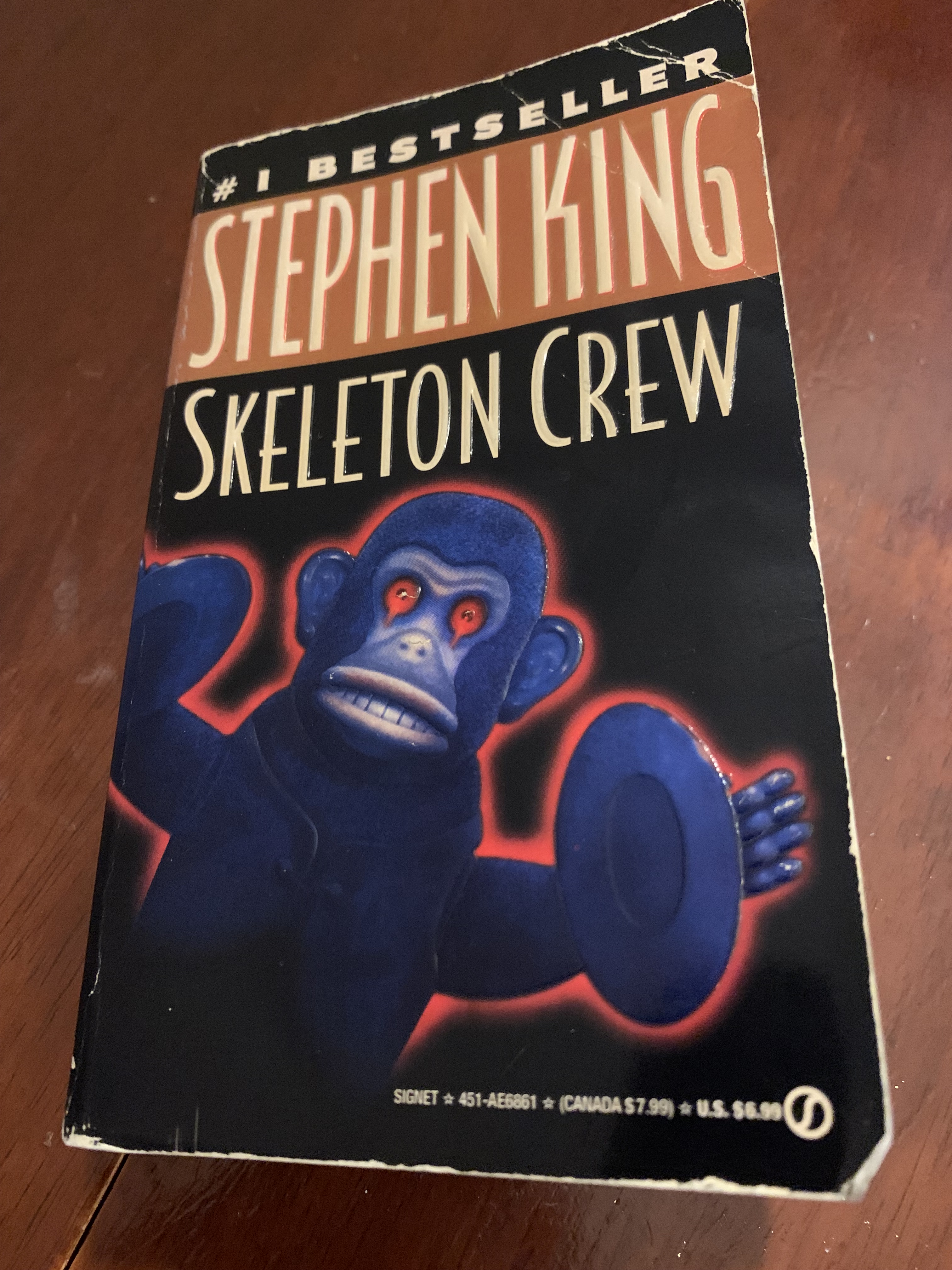
We all have a monkey playing the cymbals in our head, clanking away. Some of us just hear it more clearly, or tune it out better, as it were. Stephen King taps into that madness, that “flexible bullet,” as he calls it, in his 1985 short story collection, Skeleton Crew. King admits in his Introduction that writing short stories is a harder game only growing harder — and he ought to know given how long his novels tend to be — how hard it can be to catch the brevity lightning. With short stories, you need to punch in and out quickly. For the most part, King achieves brevity with his short stories, save for incidentally, his most recently written one in 1983, “The Ballad of the Flexible Bullet,” which I thought went perhaps 20 pages too long. In Skelton Crew, he has one short story he wrote at 18 (“The Reaper Image”) and the aforementioned most recent one written when he would have been 36. The reason he likely mentioned that is because all writers, even those intent on writing novels, have always tried their hand at the short story whether at 18 or 36 (after much success, no less!) because it is hard and in the difficulty is the allure.
If you’re a longtime reader of King’s, or a Constant Reader, as he calls us, you become familiar with the way King writes and it’s comforting. His Kingisms and his style is precisely why we come back to him. The levity within the horror, the cultural references, the horror itself, of course, and most of all, the deep humanity of his best characters. But also with King, which perhaps is more exposed, if you will, in a short story collection, are the downsides of his Kingisms, the bits within his stories he overdoes. For example, many of the characters, particularly the women or motherly figures, in Skelton Crew are depicted as fat and grotesque in their fatness. But also, from a structural writing standpoint — and who am I to critique King’s writing?! — quite a few of his short stories start with a similar set-up: someone orally sharing the story while others listen or the story is shared by someone writing it down. I know either option makes for an easy way to get into a story without a lot of the world-building he would normally do, but it felt like a crutch by the fourth or fifth time.
That all said, I highly enjoyed reading King’s collection of 22 short stories, obviously enjoying some more than others as is bound to happen with that many stories. He brought the levity with the horror, the culture references, the horror itself, and the deep humanity. I don’t know if writers intend to do this with their story collections, but if there are overarching themes that largely (but not entirely) thread throughout these stories it is one of giving into the monkey in your head. The bad thoughts. The despairing thoughts. Whether as a child who can’t possibly realize the full manifestation of those thoughts or an adult who ought to, King’s Skelton Crew is drenched in the blood only our basest thoughts can conjure up.
I’m going to take each story in turn, hopefully briefly, and then I’ll do a perfunctory ranking at the end.
The Mist
As a huge fan of Frank Darabont’s 2007 film adaptation, I had never actually read the short story it was based upon, so I was thrilled to do so here. “The Mist” is also the longest of the short stories in the collection, clocking in at about 131 pages. That gives King ample time for his world-building about an encroaching fog on a small town and the predatory, extra-dimensional creatures lurking within the fog. But like with any great King story, “The Mist” also features the pros and cons of a small town faced with panic: some turn on each other and some band together. King even mentions at one point how the “mind is a monkey.” Because in a moment of panic, as much of the town is huddled together in a grocery store, some go off into the fog. The veneer of civilization is far thinner than any of us would like to imagine and in “The Mist,” it is dismantled fairly quickly, even if some prefer its delusion and comfort. The two biggest differences I clocked between the short story and the film adaptation: 1.) David, the main character, sleeps with Amanda in the book in his own moment of the world-is-ending panic. This, despite being married. I didn’t particularly care for that (interestingly, in the Notes, King doesn’t either!), but I get what King was going for with the panic madness. 2.) Most notably, the ending. King for once provided an ending that is hopeful — David, his son, Amanda, and others escape the grocery store and appear to be heading to Connecticut where a safe haven may be — and I didn’t like as much as the film version. Go figure! The film adaptation is one of the bleakest you’ll ever see. Realizing all hope is lost, everyone in the car shoots themselves, but there’s no bullets left for David. Just then, the military appears, having cleared the fog and stopped all of the creatures. King hints at this possibility in his ending, but he doesn’t actually go there. So, yes, in a rare circumstance, I prefer the film’s ending. Despair all the way!
Here There Be Tygers
A story about Charles, who really, really has to go to the bathroom and Miss Bird was a jerk to him about it, and when he finally is afforded the opportunity, there happens to be a tiger in the bathroom. He tries to warn the school bully and Miss Bird in succession, but both fail to heed his warnings and are promptly, presumably, eaten by the tiger much to his delight. Fun little story and relatable to (the needing to go potty part, not the tiger part).
The Monkey
A film adaptation of this short story was released this weekend and it’s also the cover image of my edition of the collection. Essentially, a boy finds a monkey with those clapping cymbals and it turns out to cause the death of people in his life. He tries to banish it from his life to no avail, only for his son to rediscover it (or it to rediscover him) years later. Aside from the continuing metaphor here of the monkey in your head, King offers what I interpreted as subtext of the monkey standing in for racism, given the way the monkey is described by appearance and with the use of the n-word. This and “The Mist” felt like the most classic King stories familiar to his Constant Readers. It’s one that’ll stick with you and perhaps is the most horrifying of the novel (this and maybe “Gramma”).
Cain Rose Up
A nasty little bugger of a story from King about Curt Garrish who has a nihilistic little monkey in his head, envisioning how people die and then becoming akin to Charles Whitman by picking off students with a rifle from his dorm room. This is the second-most “levity in the horror” of the short stories and that makes it all the more terrifying.
Mrs. Todd’s Shortcut
Anything is possible in “Mrs. Todd’s Shortcut.” Mrs. Todd has figured out how to fold maps (and time) in on itself to cross long distances in a short amount of time. It made me wonder if she’s passing through the dimensions that produced the creatures in “The Mist”?! King said in his Notes that this story was rejected by three magazines, including Cosmopolitan. See, even King has faced rejection. I liked it, though.
The Jaunt
One of my favorites from this collection is the nifty, if horrifying, science fiction story, “The Jaunt,” about a scientist in our time who discovered how to teleport. Then, many years later, humans are using such technologically to make the “jaunt,” as it becomes known, to Mars. A man and his family are set to do that while the man tells his family the whole story behind the jaunt. What the original scientist couldn’t figure out is what was happening to the test mice from Point A to Point B. As it turned out, eternity. They were experiencing eternity. Physically, they were fine. Mentally, they were in hell. So, for it to work for humans, they need to be knocked out during the jaunt. The man’s son decides to fake inhaling the gas to experience eternity. It is horrifying. Indeed, for its implications, “The Jaunt” is the most horrifying of the short stories. Imagine being alone with the monkey in your head … forever.
The Wedding Gig
This one came across to me like King’s version of a noir story set in the 1920s, I believe, featuring a ridiculously fat bride-turned-gangster. I dug the noir vibe, not so much everything else.
Paranoid: A Chant
I don’t have much to say about this one since it’s one of the shorter short stories in the novel and it’s a poem. But it is apiece with the other vibe of having a monkey in your head: paranoia. Tinfoil hats for everyone! Maybe that’ll sedate the cymbals.
The Raft
One of my favorite, most horrifying short stories in the collection. Like “The Mist,” I quite like horror that takes place in one location. Here, four college kids out on a boozer decide to swim to a raft in the middle of a lake. Unbeknownst to them, some sort of extra-dimensional black hole is waiting in the lake to eat them. It does so, one-by-one. Funny enough, I was eating Honey Grahams right before reading this, and then King references them. Randy and LaVerne, two of the characters on the raft, have sex while all of this craziness is happening, reminiscent of David and Amanda from “The Mist.” Which means, I didn’t like it. That said, I loved everything else. Staring into the black hole is hypnotic and dangerous, similar to being conscious during the jaunt in “The Jaunt,” and of course, Nietzsche’s quote about gazing too long into the abyss. Also, did Randy live or not? I’m assuming not since his situation was rather hopeless.
Word Processor of the Gods
King admits he didn’t execute this one the way he envisioned it in his head (which all writers know is the case with almost all stories) and it shows, to be honest. There was a great germ of an idea here — a word process that either creates or destroys anything in reality, and a man using it to create the family he always wanted — but it left a lot to be desired, primarily because it felt too brief and ended abruptly.
The Man Who Would Not Shake Hands
I imagine this short story as King’s attempt at the sorts of myths and legends that permeate the culture, like if you go down this haunted road, you’ll see a ghost, or if you go to lover’s lane yada yada, that kinda thing. He’s self-referential about it, too. A man in a 1919 poker match doesn’t want to shake anyone’s hand. After he wins the equivalent in today’s money of $20,000 (holy moly!), one of the other poker players shakes his hand. The man flees, terrified. George tries to get him to take his winnings with no luck. Turns out, the man had an ancient curse put upon him in formerly Bombay, India, where if he shook someone’s hand, they would die. Sure enough, the other poke player dies. The man then shakes his own hand to kill himself. Interestingly, George’s butler, Mr. Stevens, seems to be immortal?! I didn’t know what that was all about.
Beachworld
Perhaps another theme bubbling throughout King’s short story collection is the allure and hypnotic nature of eternity. In “Beachworld,” eternity is represented by endless, dangerous sand dunes. It got under my skin in the way sand can get on your skin.
The Reaper’s Image
You can certainly see flourishes of who King would become as a writer since he wrote “The Reaper’s Image” at 18. Similar to “The Man Who Would Not Shake Hands,” “The Reaper’s Image” is a classic tale of a cursed mirror who, well, kills anyone who sees the Reaper when they gaze upon it. King at 18 wrote this one more straight and serious than King of later years. He hadn’t found the levity in the horror yet.
Nana
His Bonnie and Clyde story, with lots of carnage along the way. For Constant Readers, Ace Merrill even shows up here to beat our main character bloody. I especially enjoy King when he’s at his most bloodlusty, like here.
For Owen
The shortest story of the collection at two pages, and another poem. It’s about King walking his son to school and his son disgruntled with other kids picking on him. Cute.
Survivor Type
Another one of my contenders for best short stories of the collection. A completely sick and deranged story that only King could conjure up. A surgeon tests the theory of one’s will to survive and live through repeated traumas after being shipwrecked on a deserted island. At one point, trying to kill a gull for food, the surgeon breaks his ankle. He then realizes he needs to amputate his foot to survive, and does it. Again, King with his levity (and this story is the one that primarily embodies (heh) levity in horror in this collection), he has this narcissistic, lawbreaking surgeon put his foot in his mouth … literally. He eats his foot, desperate for food! It continues from there with another foot, then his thighs and so on. I wrote in my notes, “Funny and fucked up.” King in a nutshell, folks.
Uncle Otto’s Truck
Was it the truck or the greedy man who sought his partner’s land? It was the killer truck, I think.
Morning Deliveries (Milkman #1)
I mostly just didn’t understand how someone could survive long as a milkman if he was delivering scorpions and poison to his customer base.
Big Wheels: A Tale of the Laundry Game (Milkman #2)
Mind monkey make you crazy (plus alcohol). Milkman wins again.
Gramma
Admit it, at some point or another, all kids are scared of the grandmas (or grandpas). King just Kings it up, making the Gramma into a Lovecraftian creature, which then imbues the little boy with powers he can’t wait to dole out on his unsuspecting, bullying older brother. As I mentioned, one of the more haunting and horrifying stories of the collection. Also, perhaps the story to inspire the namesake of the collection, as the little boy learns the “skeletons in the closet” of his family.
The Ballad of the Flexible Bullet
A bit too long in the tooth aside, I loved this story that is King’s tongue-in-cheek way of addressing what his fans always want to know: how do you come up with the stories you do? Elves! Little elves under the keyboard, of course. There is no pinpointing how the muse muses.
The Reach
I suspect “The Reach” is going to be one of those sneaky short stories that lingers with me long after I’ve finished it. A woman who has lived on an island off of the mainland has never crossed over the reach. She does so in her final days, riddled with cancer and hearing and seeing those who died long before her. It’s actually a rather beautiful, if still haunting, story about old age and dying, another subject King has long been interested in.
So, if I was going to rank them then (and keep in mind, it’s 22 stories, so the lower you go down the list doesn’t necessarily mean I disliked the story):
- The Mist
- The Jaunt
- The Raft
- The Monkey
- Survivor Type
- Nana
- Gramma
- The Reach
- Beachworld
- Here There Be Tygers
- The Man Who Would Not Shake Hands
- Cain Rose Up
- Mrs. Todd’s Shortcut
- The Ballad of the Flexible Bullet
- The Reaper’s Image
- Uncle Otto’s Truck
- Word Processor of the Gods
- The Wedding Gig
- Paranoid: A Chant
- For Owen
- Morning Deliveries (Milkman #1)
- Big Wheels: A Tale of the Laundry Game (Milkman #2)
Sorry, Milkman.

 Milam's Musings