
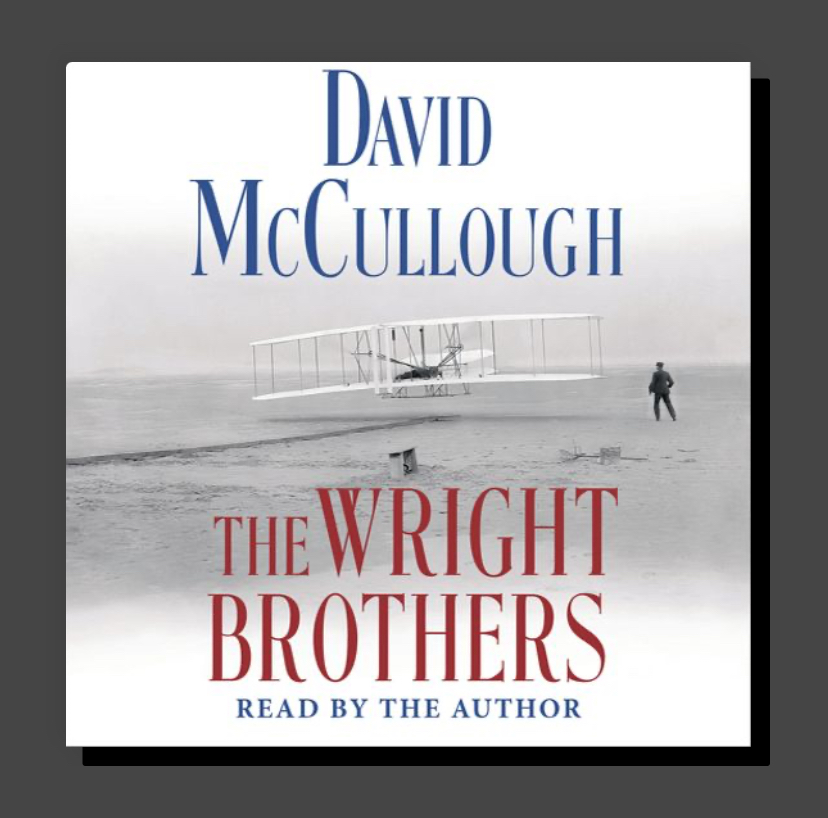
Imagine being born in 1880 when the primary mode of transportation was horse and carriage and train. The automobile was still 28 years off and not in majority use for another 21 years still. Taking to the skies at the time — being like the birds — was seen as foolhardy at best and a punchline at worst. So, imagine that 28 year old born in 1880 witnessing man fly. How extraordinary! Imagine being the flyer — to be the first human being in the history of the world to soar through the skies in such a manner. Among historical moments I’d love to witness, seeing man fly for the first time is certainly high on the list. Achieving flight represents the best of humanity: ingenuity, industriousness, and intrepidness. Thanks to a few willing to forge ahead against the naysayers, billions of us are better off for it. Esteemed historian David McCullough details the awe and wonderment of flight via the plucky, rather stoic, unflappable Wright Brothers in his 2015 book, The Wright Brothers. McCullough’s book also served as a lovely ode to Ohio, the birthplace of flight, both of our skies and of space, and particularly, of a Dayton, Ohio (only 45 minutes from me!) hard to imagine in the present day.
The Wright Brothers, Wilbur and Orville, had an admirable relationship as brothers. They grew up together and worked together extensively, rarely fighting, always supportive of each other, and certainly complimented each other in personality that would bode well for the fame and attention to come. Wilbur was the soaring orator among them, with Orville more disposed to shyness and it seems, bouts of depression (“one of his moods”). They both also remained bachelors throughout their lives and even when they had, for lack of a better word, ample opportunity to entertain flyer groupies, they abstained. Instead, they found unity in purpose and set themselves on an unwavering mission to fly. McCullough said their mechanical aptitude came from their mother, who also encouraged their tinkering and playing with toys. Their father, Bishop Milton Wright, was a steadfast presence throughout their lives, who supported them in their endeavors.
What I found most interesting about the Wright Brothers’ upbringing, aside from their supportive parents and the anecdote of using cocaine as a toothache remedy when Wilbur was hit in the mouth with a hockey stick (and later, he had to go to an insane asylum for a spell to deal with the drug effects!), is that the Wright Brothers don’t have the “Podunk” vibe perhaps some would think or ascribe to them, given they’re from Dayton, Ohio. Bishop Wright kept copious books in the house, far more, McCullough explains, than was common for the time. Bishop Wright encouraged the value of reading in the boys. As such, Wilbur and Orville were incredibly well-read and cultured, which would surprise their European counterparts when they came to the continent. But as I said, Dayton was also on the upswing at the time of the Wright Brothers and the turn of the century. Indeed, Dayton, relative to its population, was number one in the U.S. for patents on file.
Before flight, the Wright Brothers jumped on the latest, most popular mode of transportation sweeping the country in the 1890s: bicycles. McCullough said the bicycle was considered by people at the time a “boon to mankind,” a beauty, and good for the soul. Like anything new that comes on the scene, though, not surprisingly, there were protests. Yes, protests against the bicycle! Critics worried they were morally hazardous to children. You read that right, morally hazardous because children were biking miles away from home instead of reading. The Wright Brothers started their own bicycle company and it took off eventually, with 150 bikes sold per year. That said, I thought they seemed rather aimless in this period. Wilbur didn’t go to Yale like he dreamed of, and they overall didn’t seem to have much of a plan per se for their future other than capitalizing on the bike craze. Notably, they did try their hand at the printing press, even having their own newspaper for a few years.
“Man will never fly,” it was decreed. It’s a fantasy, people further said, and besides, what purpose would flight serve anyway? Such shortsightedness! Again, thank you to the people over the ages who saw beyond such narrow parameters. The Wright Brothers decided to give flight, and building a flying machine, a whirl using their bike company monies to fund their endeavor. It wasn’t exactly clear from McCullough’s book, and it’s possible I missed it, how exactly the Wright Brothers made the leap from fixing and selling bicycles to deciding to build a flying machine other than that as children, they had always been interested in the prospect. They were not daredevils. While they weren’t daredevils, they were still cognizant of the risks, which is why they never actually flew together in those early days. If one died while flying, the other could continue the work. They were studious and “two of the workingest boys.” They were almost monkish in their quiet, unpublicized devotion to flying, taking their machine and testing it out at Kitty Hawk in North Carolina. Once they realized the advantage of curving the wings for flight, others started taking notice. At one point, Wilbur gives a speech to the engineer society in Chicago and one of the attendees called it the “Book of Genesis in the Bible of 20th century aviation.”
After about four years of testing everything out, by 1903, they made it. The Wright Brothers were able to go half a mile in the air. While other would-be aviators at the time had much more pomp and circumstance and money to attempt flight — unsuccessfully — the Wright Brothers did it through their own initiative and skill for less than $1,000. Even then, The Dayton Daily Journal, whose reporter also happened to represent the Associated Press, rejected it. Reporters didn’t believe them! The U.S. government didn’t take an interest, either.
Still, the Wright Brothers kept at it. In 1904, Wilbur, I believe, flew a half mile and even made a half circle turn, which was a major achievement at the time. This was at Huffman Prairie, a flying field in Dayton. They did 50 test flights, and again, basically nobody cared. It wasn’t until Amos Root, a fellow Ohioan known as the “Ohio Bee Man,” took notice and wrote about the Wright Brothers’ accomplishments in his bee column that others picked up on what they were doing and its significance. He wrote about them in his trade publication, Gleanings in Bee Culture, “…these brothers have probably not even a faint glimpse of what their discovery is going to bring to the children of men. No one living can give a guess of what is coming along this line, much better than any one living could conjecture the final outcome of Columbus’ experiment….” Indeed, the Bee Man was spot on. He offered his eyewitness account and writing to Scientific American, which also promptly rejected it. When the Wright Brothers managed to be the first to fly a powered machine in a full circle, Root said it was the “greatest sight he had ever seen in his life.” I can believe it! The Flyer 3 was the first practical airplane ever, and by the summer/fall of 1905, they achieved 15 miles on one flight. While American media and the American government were skeptical or hesitant to pay attention, the British and the French were very much interested.
My favorite part of the book is when reporters finally caught on and started attending Wilbur flying the machine in Europe in 1908. I had goosebumps at the reporters describing the awe and wonderment of it all. Wilbur did his first public display in France and then Orville followed suit at Fort Meyer in Virginia. The Wright Brothers would get $25,000 from the U.S. military if they could sustain 40 miles per hour. Unfortunately, in one of the flight runs, Wilbur’s passenger, Officer Thomas Selfridge, died in a crash in 1908. He became the first flight fatality. Orville was critically injured, too, but would recover, albeit with nagging injuries the rest of his life that would ultimately retire him from flying in his late 40s. But what is fascinating about the crash is that President Theodore Roosevelt was interested in going up with Orville. Imagine if it had been him as the passenger! He was the first president to go down in a submarine, so it would not have been unprecedented for Roosevelt to do something so daring. Indeed, he would go on to do it two years later, just not with the Wright Brothers.
After their successful exploits in France, including having the Kings of England and Spain witness Wilbur fly, the Wright Brothers had about $35,000 in the bank, or roughly $1.1 million. Thanks in part to the Wright Brothers’ influence, France seemed to be the nation becoming the hotbed of aviation, as well as the hotbed of aviation fatalities. That’s bound to happen, though. The more flight occurring, the more risk, and the more potential for fatalities. But in France, there was also a proliferation of aviation factories, clubs, specialty newspapers, competitive events, and so on. Dayton, and the United States writ large, would get its turn when the Wright Brothers returned to the states. It was nice to see the Wright Brothers finally get their proper due and a homecoming in their home state.
I also thought it was neat how close the Wright Brothers were with their sister, Katherine, who was also very supportive of her brothers and became the only woman in the world at the time to make three flights. Or that the Wright Brothers took their father, Bishop Wright, up with them, making him at 82 years old the oldest person to ever be in a plane. He was recorded as telling them, “Go higher, higher!” How lovely that he lived long enough to see their success and experience it.
After 1911, Wilbur never flew again because the Wright Brothers were bogged down in patent lawsuits and their business, but also, Wilbur died a year later after contracting typhoid fever again. He was only 45. At this point, which I was obviously expecting, I was hoping McCullough had some insight into how Orville took his brother’s death since they were so close. But unfortunately, he didn’t elucidate much at all on it. Bishop Wright was still going strong for another few years, even walking with Katherine and Orville for women’s suffrage (again, suspecting he was the oldest one there). He would die at 88 in 1917.
Katherine would go on to marry in her 50s, which created a rift with Orville sadly. He stopped talking to her and didn’t attend her marriage. He even resisted visiting her when she became ill with pneumonia. Thankfully, he did make it to her beside prior to her death in 1929 at the age of 54. Now, it was just Orville. Interestingly to me since it’s nearby, he received an honorary degree from the University of Cincinnati (and also Harvard, but whatever!). But seriously, it’s neat he lived long enough to see jet engine flight, the sound barrier broken in flight, and unfortunately, also the destruction the Wright Brothers’ invention, flight, wrought upon the Earth during WWII. Orville said about WWII that he hoped what he and Wilbur invented would bring lasting peace to the world, but they were wrong. Nonetheless, he (rightly) had no regrets while finding the use of the plane to drop bombs during WWII deplorable, analogizing their invention to fire. You still want someone to discover fire and harness it for all the good its given the world while also dismaying the death and destruction its also given the world. Orville died in 1948 of a heart attack.
In addition to Ohio being able to claim the Wright Brothers, Neil Armstrong (walked on the moon), John Glenn (first American to orbit Earth), we can also claim seven U.S. Presidents. The one I most admire is, of course, Ulysses S. Grant for kicking Confederate ass. But it was rather poetic that the Wright Brothers’ success and recognition also came at the time when an Ohio President, William Howard Taft, was in office to do the honors. But most beautifully, and how McCullough fittingly ends the book, is by recounting how when Neil Armstrong set foot on the moon — only 66 years after we first lifted off the ground with the Wright Brothers’ flying machine, a fact I regularly marvel at — he carried a piece of the Wright Brothers’ wing from their 1903 plane in his bag on him to the moon.
Humans, at their best, like the Wright Brothers, are what engenders much hope and inspiration in me. We can aspire to be better, to dare, to defy the odds. The Wright Brothers did that, as two humble boys born in 1867 and 1871. They changed the world ultimately for the better.

 Milam's Musings
One thought