
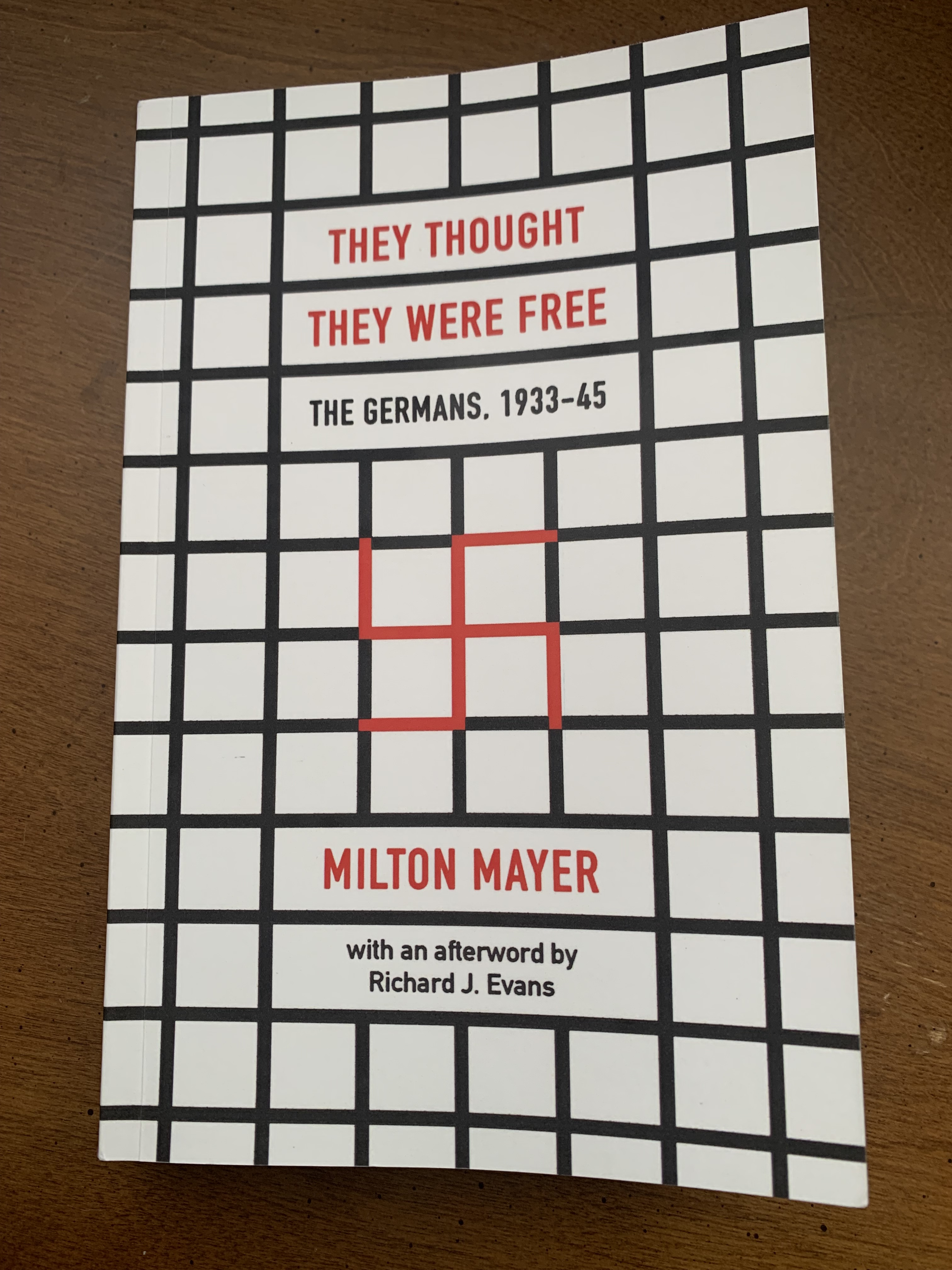
Ascertaining what is in the hearts of men whose hearts are submerged in totalitarianism is an end goal outstripping necessity. Which is to say, we will never extrapolate from the Nazis any satisfactory confession to explain the coarsening of their hearts toward the annihilation of Jews. We need not parse whether someone was an enthusiastic Nazi or not (a “fanatic,” as it were), nor whether even after 1945 they still harbored the seeds which bloomed their previous hatreds, to properly assess what is within man — the human character — that can be bent toward the embrace of totalitarianism. To that goal specifically, you are unlikely to find a more popularly accessible, fascinating book than Milton Mayer’s 1955 book, They Thought They Were Free: The Germans, 1933-1945. Indeed, one is unable to liberate or free men’s submerged hearts which willingly swam to totalitarianism. They knew not of their submersion.
In a quote echoing somewhat that of H.L. Mencken — “Democracy is the theory that the common people know what they want, and deserve to get it good and hard.” — Mayer’s thesis is that totalitarianism, Nazism, came to Germany like Dracula welcomed into the abode.
“Now I see a little better how Nazism overcame Germany — not by attack from without or by subversion from within, but with a whoop and a holler. It was what most Germans wanted — or, under pressure of combined reality and illusion, came to want. They wanted it; they got it; and they liked it.”
Mayer went to Germany and stayed in the college town of Marburg (he refers to it as Kronenberg in the book, though, but I’ll keep referring to it as Marburg in this review). There, he met his 10 “Nazi friends.” A tailor, an unemployed tailor’s apprentice, a cabinetmaker, an unemployed salesman, a high school student, a baker, a bill collector, an unemployed bank clerk, a policeman, and perhaps the one of with the most social clout in German society, a teacher. On the advice of the institution paying his way, Mayer did not tell his Nazi friends that he was a Jew. In the course of hours of conversation, it was the Nazis, who without prompting, discussed Jews, continuing resentments, and doubts about the Holocaust. Mayer also didn’t tell them he had other sources of information (denazification papers) to corroborate or contradict their stories as needed.
Mayer opened his book with a fictionalized telling of a night at the Huntsmen’s Rest on November 9, 1638 in Marburg. All is quiet. The Watchmen sing the quiet village to sleep. Soldiers at the Huntsmen’s Rest celebrate the 15-year anniversary of their liberation from siege. Festive and lovely. Fast forward 300 years, the eve of Kristallnacht, the “Night of Broken Glass,” of the Nazis’ pogrom against the Jews, which included the destruction of Jewish homes, hospitals, businesses, and synagogues, Nazi men at Huntsmen’s Rest, including Karl-Heinz Schwenke, the Nazi tailor, are roused into setting fire to the Marburg synagogue. Jewish males are then rounded up for their “own protection,” including by Willy Hofmeister, the Nazi policeman. While it may have been the case in Marburg that such a scene was relatively gentle, throughout the rest of Germany, the arrests were violent and intrusive, resulting in Jews being murdered along the way.
All of these men, Mayer surmised, felt little. Little in comparison to the machinations of their country and of their State (the government). Little men such as them do not meet the State, as existed, often. Adolph Hitler brought the State to them. By “bringing bigness down,” Hitler lifted “littleness up,” Mayer said. Hitler made them feel part of something. Heinrich Wedekind, the Nazi baker, who Mayer seemed to disdain the most for his ignorance and brutish character, when asked why he believed in Nazism, said, “Because it promised to solve the unemployment problem. And it did. But I never imagined what it would lead to. Nobody did.” Or Hans Simon, the Nazi bill collector who Mayer also seemed to disdain, denied the Holocaust and argued even if it happened, Hitler was not to blame since the Jews were likely German traitors. One of the darkly funniest parts of the book, is that Simon boasted of his ability to recognize a Jew. Remember, he is boasting of this in the presence of a Jew (Mayer). Or take Schwenke, the Nazi tailor, who blamed the Jews for ruining his ancestry for generations back and for stealing from them, and then in another breath, talked about how great his ancestry was without any troubles or blemishes. Of course Mayer, like any of us upon hearing that, would have the impulse to highlight the contradiction and then see Schwenke’s reaction. Mayer realized, however, it was fruitless to do so because “men’s lives are what they think they are.” If we’ve learned anything from our present moment under the Trump administration, it is that. Men do not care about their hypocrisies. They move on to the next one and the next while we blather on about the priors. Indeed, many of the Nazi men seemed to look back upon that prewar Nazi period, 1933-1939, as a golden time for Germany, when they mattered and were uplifted. And what of Hitler? Was he evil? No, Hitler, to these Nazis, was betrayed by his allies, associates, and aides. Hitler made the big little and subsumed one’s identity to his identity, or to put it another way, Hitler became the State and the State was them. Thus, to blame Hitler, and to see Hitler as evil, was to blame themselves and see themselves as evil. Even those like the Nazi teacher, Heinrich Hildebrandt, who had visited France many a time and spoke French and was certainly well-educated and started out as an anti-Nazi (who hoped his records as such would never be uncovered), came to join the Nazis out of fear, so he said, and besides, he could disrupt what he could from the inside, with his little rebellions as a teacher, came to like Nazism because it “broken down class division.” However, the notion of disrupting what one can from the inside is a dangerous slippery slope to enter upon. As Mayer noted, “non-resistance to the milder indulgences paves the way for non-resistance to the deadlier.” And so it was. I have the most angst reserved for the teacher precisely because he ought to have known better, given his education.
That said, something I keep ruminating on after finishing Mayer’s book, is the philosophical, moral, political, and social question at the heart of any examination of Germany and the German people’s descent into Nazism: “What would you have done?” Would you have protested the milder indulgences? Or certainly, the deadlier ones when it reached that point (albeit, the point then is that it’s too late)? For, as Mayer said, one feels uncertain to step out on a limb to oppose the popular tide. It immobilizes them. To sound the alarm, one fears being seen an alarmist, and yet, that is exactly the issue: to alert against the backsliding. Then what? And what can one do against the State anyhow? Mayer analogized to the U.S. government’s internment of Japanese during WWII. What was I, a citizen in Wisconsin, he postulated as an example, to do? Therein lies the problem with encroaching totalitarianism. That non-resistance, whatever causes it, accumulates and accumulates until the deadly indulgences are already underway and readily accepted.
I struggle with that question within the historical context of Nazi Germany, imagining if I were a German, or in Mayer’s example of Japanese internment in the U.S., or in the present context, watching our own democratic backsliding under the Trump administration. It feels inadequate to merely be on sound moral footing amidst the popular swell of anti-democratic indulgences. When it’s lost, what comfort is there in saying, at least I am not lost? As it is, I do not have any worthy answers.
The popular narrative arc is that the Germans were susceptible after the punishing Treaty of Versailles that ended WWI, combined with the later worldwide economic depression, to a strongman taking advantage and hold of the country. But of course, those seeds of hate, anti-Semitism existed before Hitler, before WWI and the Treaty of Versailles. And indeed, that feeling of littleness, remoteness from the State, and the insatiable desire to be part of something, is resonate throughout the ages. At its core, National Socialism was anti-Semitism. What helped make National Socialism possible was how easy it was to “other” the Jews since many Germans didn’t live with or know, by design, Jews. Nazism is not a political ideology that begins with an intellectual foundation and then violence manifest from it to maintain it. Nazis’ whole program was “thinking with our blood.” It’s about superiority and that those inferior must be eradicated. Which is why in the modern context, those who take on the mantle of the Neo-Nazi are so concerning: They are not merely espousing a “difference of opinion,” no matter how odious; they are out for blood. That is Nazism. As Mayer explained, Nazism started out in practice — the threat of violence and actual violence — and then tried to backfill it with intellectual theory. Of course, they didn’t necessarily last long enough, certainly no Thousand-Year Reich, to achieve adequate backfilling. Nevertheless, this attempt at backfilling achieve another goal: making the “little men” of Germany distrust the intellectuals and to see them as unreliable. Detachment from the intellectual is one of those warning bells of backsliding into totalitarianism.
“Men who do not know that they were slaves do not know that they have been freed.”
Nazis, like any totalitarian force before them, were bullies. Deadly bullies, to be sure, but bullies all the same. As such, Mayer repeatedly noted how much his 10 Nazi friends whine and whine to him. They can hit and hit and hit, but if you hit back, now they’re upset. Classic bully behavior. Again, it all goes back to the concept of these were little men — insecure men — who were made to feel like big men. And it also goes back to the German orientation toward the State. Mayer had an interesting back-and-forth with one of the Nazis about government; the Nazi thought having a strongman was good for decision-making. In other words, the American sees himself as the ruler of the State — we possess and express the sovereign will of the State — and thus, in possession of political power, whereas the German sees the State as so magnificent and them so little by comparison; thus, they are without political power. In Mayer’s estimation, after 4.5 million Germans immigrated to the United States between 1819 and 1888, the rest were left behind to conform, as they saw no way out (presumably he meant of their political order and orientation to the State as such).
On a different matter of “state,” shame is a state of being, and one for which Mayer thought you can’t compel people into feeling. Certainly, I think it works better for society if “societally” people feel a sense of shame rather than having it “foisted upon them,” but whether Nazis or our present day, that sense of shame is gone. Indeed, the current occupant of the White House famously lacks it. I’m certainly not sure one can extrapolate outward. Even in a country under the willing spell of National Socialism, can we talk about 70 million people as a collective — as constituting a national character? Then, how do we address shaming an entire country and its countrymen? Mayer kept asking his 10 Nazi friends, “What did you do that was wrong, as you understand right and wrong, and what didn’t you do that was right?” But he was never going to get a satisfactory answer. If there was shame to be had, at least with those 10 Nazis, it was too deep to confront. When Mayer realized Carl Klingelhofer, the Nazi cabinetmaker, is wearing a sorrowful mask about how “no good came of” National Socialism, he wanted to confront Klingelhofer with the fact that he only said that because National Socialism lost. Mayer thought, “If it had won, you’d be drinking blood with the rest of them.” That’s the other problem with shame. Does it accompany one, who having lost, is being questioned by the victor or is it a separate, agonizing entity of its own making? In any case, Mayer again, like the hypocrisy issue before, saw no use in verbalizing what he thought. For after all, admitting their guilt after the fact is one thing, but hardly heroic. Heroism and the courageous act would be to “throw themselves under the iron chariot of the State” at the time. Alas, none did, and it is that which is unforgiveable. Interestingly, we forget, there existed Germans on the precipice of dictatorship, who believed it could “not happened here.” That where it happened elsewhere, it was because those were backward countries. Germany and Germans represented high culture, the best of Western civilization across music, the arts, philosophy, science, and technology. Then it happened, and not only happened, but it happened worse in Germany than anywhere else.
Mayer spent the last few chapters dealing with the American occupation after WWII and the West/East divide. He argued, “What they [the Germans] needed, and went on, needing during the whole of the American occupation, was a peculiarly American genius for contentious and continuous talk and a framework not of law, but of spirit. Everything else they needed they had genius enough and more, to produce for themselves.” In other words, he didn’t look too flatteringly at the American occupation in terms of it succeeding as a way to necessarily mitigate or alter that which led to the Germans becoming Nazified in the first place. Worse still for Mayer, who was a noted pacifist who was vociferously against American entry into WWII (at least pre-Pearl Harbor, but I assume thereafter, too), was the American project of remilitarizing the Germans after the war. Aside from that being dangerous, he thought the Germans too tired to be rearmed. Instead, they wanted reunification, which would come nearly half a century later. To Mayer’s earlier wish about talk, that would come sooner in the 1960s, when the Germans would better reckon with and confront their role in WWII and the slaughter of the Jews.
Richard J. Evans, a historian in his own right who did a three-volume series on the Third Reich, offered the Afterword for Mayer’s book in 2017. First, interestingly, he said that “speak truth to power” came from Mayer and was what guided his work. Indeed, I think Mayer in his choices with his 10 Nazi friends, spoke truth to power, albeit in a less bombastic, more subtle way than people may wish to see.
Beyond that, Evans did offer five worthy critiques of Mayer’s book:
- Marburg was more favorable to Nazism compared to the rest of the country than Mayer let on.
- Mayer excluded women from his “little men” analysis, even though women were necessary to the success of Nazism, Evans argued.
- The final chapters were weak and rambling compared to the rest of the book. True enough.
- Later, after the book’s publishing, Mayer received criticism for thinking the Germans could not be educated into democracy. He’s certainly been proven wrong on that score, and of course, was shallow to think it at the time, too.
- Evans argued rearmament proved possible in contrast to Mayer’s concern. Germany has been a steady U.S. ally for a while now, and interestingly, a steady force in Europe. Although it is interesting and sage from Mayer’s point-of-view, to have suspected that the Germans and the Russians would forge ties that would outlive the American occupation and anti-communism sentiment.
Those criticisms taken into account, Mayer’s book stands the test of time because it still offers insight into how people opens opened, willfully walked into Nazism’s embrace. After all, they thought they were free. And in that message will always be a clarion call to everyone of good moral conscience to be the bulwarks against such backsliding, to be alarmist when the naysayers argue otherwise, to disrupt even the “milder indulgences” lest they become deadlier ones.

 Milam's Musings
One thought