
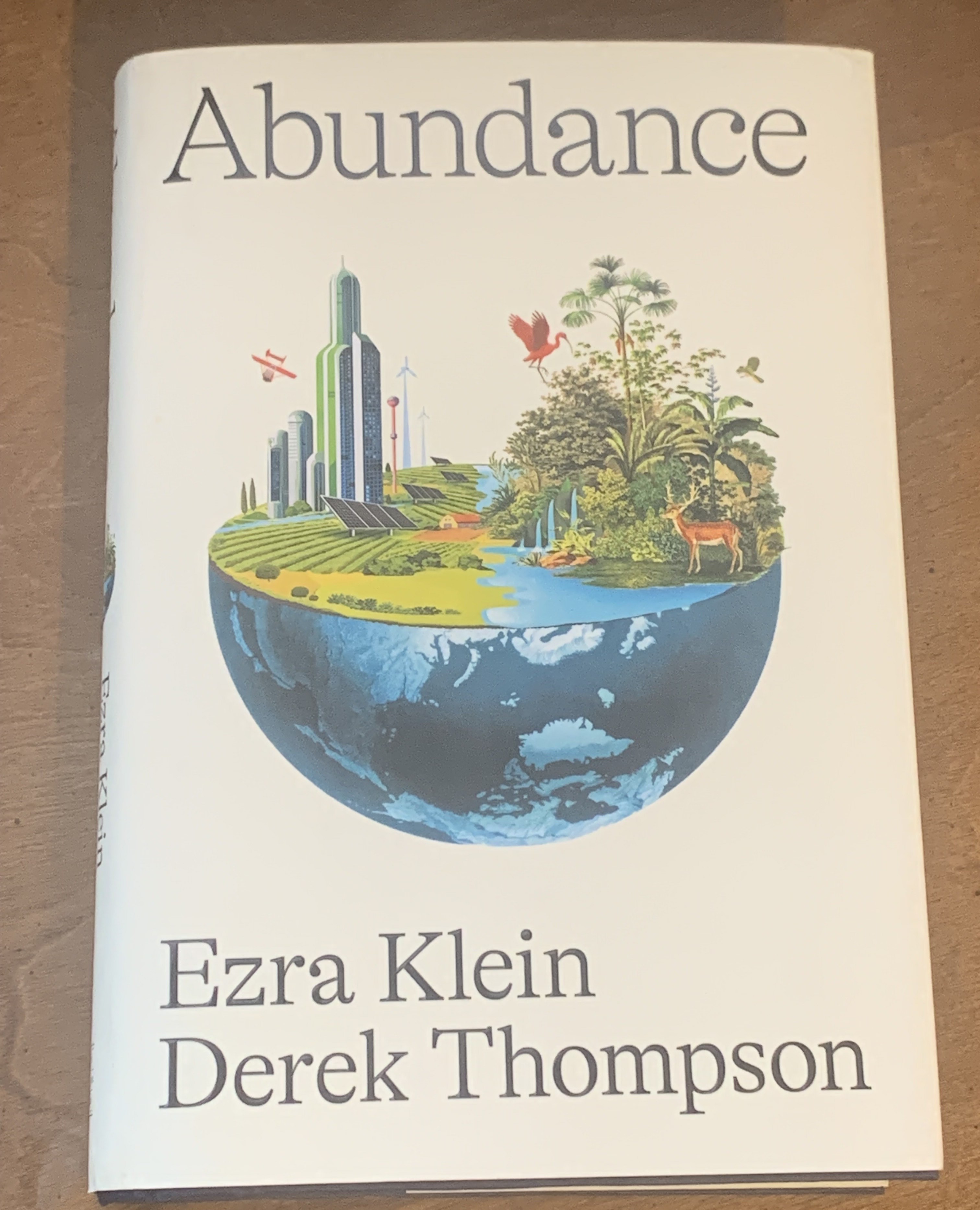
The greatest resource humans have at their disposal is their own ingenuity — not just to come up with ideas, but the prowess to marshal the necessary people and resources to implement, or build, those ideas. To use an example from the forthcoming book I’m about to discuss, what use is it to have the “eureka moment” of discovering penicillin, if you can’t then figure out a way to scale it up for mass production and delivery to millions of people? Ezra Klein, of The New York Times, and Derek Thompson, of The Atlantic, argue in their 2025 book, Abundance, that the way forward for the United States is to be results and outcome-oriented rather than process-oriented. To build for the future within the present. To invent, innovate, and deploy. To show that whatever one believes about the federal government — that it ought to be more limited in scope or larger in its offered services — that we ought to all agree on the basic premise that the government needs to work better for people at whatever it is charged with doing. As currently constituted, the government does not. Abundance is about looking at the scarcity of a thing — the lack of affordable homes in the United States — and wondering why and then figuring out how to build more and more quickly. In other words, as Klein and Thompson noted throughout the book, scarcity is a choice that we’re making, not a reality about the world we live in. By the same measure then, abundance is a choice we could also make in order to ensure the reality we want to live in.
Everyone on the left and right denotes the worst analogy for how to picture society through the lens of scarcity: as a pie. If it’s a finite pie, it’s a zero-sum game. There will be winners and losers. Haves and have-nots. But because of human ingenuity — that we are wealth-generators — reality is like creating an endless series of pies for the betterment of everyone. Choosing scarcity is to believe in the predominant pie theory, however, and that’s not a future I want, where we continue to fight over purposefully chosen, and dwindling, slices of pie. Unfortunately still, our currently constituted political order in the United States is turned against harnessing and unleashing the true power of human ingenuity. Authoritarianism and its attendant tentacles of corruption and one-man rule are ascendant not just on the right, but in America as a whole: strangling the government agencies and universities that corral the best and brightest, closing our borders to tomorrow’s best and brightest (and also, setting quotas on the number of the best and brightest from other countries we allow in), and instead of unleashing human ingenuity, funneling the entire machinations of not just the federal government, not just the United States, but our allies and the world itself through the whims and edicts of one man (President Donald Trump). All of which is to say, wittingly or unwittingly, this authoritarian movement, is embracing a politics of scarcity. I could do a whole treatise on how this is part and parcel with the other dominant strain coursing through the right presently: a faux-masculinity that sees the world as dog-eat-dog wherein then, fighting over crumbs from the dwindling pie is desirable and manly even, but I’ll save that for another day.
Since Klein and Thompson can’t hope to persuade the former authoritarian right, Abundance is largely aimed at where liberals (the left) have gone wrong in their policies over the last few decades and how to chart a path forward looking at government and society through a new lens, literally. Klein and Thompson aren’t listing out a bunch of policy prescriptions, as America, its economy, its people, its states, are too dynamic and diverse for such one-size-fits-all policy prescriptions. Rather, if you look at problems through the lens of abundance, then that will bring about the world we want. Broadly speaking, a fundamental way the two sides of our political order have operated is that voters are symbolically conservative, but operationally liberal. This is why there is that continuing tension between American voters who say they want lower taxes and smaller government, but also would absolutely bristle at government services and safety nets being dismantled. In a similar vein, Klein and Thompson sees liberals in blue states and cities, like California and New York, San Francisco and New York City, as symbolically liberal, but operationally conservative. That is to say, such states and cities are excluding by way of zoning and NIMBYism, for example, the very people they symbolically seek to help: underserved people of color and the middle class. They are simply priced out of those places. Indeed, what’s happening is that because of government policies in places like New York and California, they are pushing people to less productive cities like Phoenix. People would be more productive, and thus, make more money, in our big cities, but they simply can’t afford to live there. Cities are the cauldrons for unleashing human ingenuity. “Cities are engines of creativity because we create in community. We are spurred by competition,” Klein and Thompson said. This is why, for example, remote work offers nice work-life balance, but fully remote work is not necessarily conducive to progress and productivity: we need to be around each other because we learn from each other. That has served us well for as long as we’ve been a species. To uh, zone in on zoning specifically, it’s a tool for quite literally zoning out undesirables. While more overtly racist upon its conception and implementation in the early 20th century, its mechanism still remains true today even though liberals sanitize it with talk about “maintaining the character of the community.” Zoning is also an anti-growth strategy. Don’t build that. Klein and Thompson’s whole thesis is diametrically opposed to the core concept of zoning. What’s a consequence of an anti-growth mindset, of embracing scarcity and fewer homes being built? (If owning a home is seen as an asset, then the way to protect that asset and ensure its continued rise in value, it necessarily turns homeowners into NIMBYs, and as such, means fewer homes.) Homelessness. We tend to think of homelessness as the product of individual decisions, i.e., the person fell into drug addiction, suffers from a mental disorder, lost their job, etc. But I love the simple analogy Klein and Thompson offered up. Imagine a game of musical chairs is played with ten chairs and ten people. Everyone finds a chair when the music stops, even, they argued, if one of the players is on crutches. If there are nine chairs, then someone, probably the person on crutches, will be left out. “If you live in a city with too few homes, poverty and drug abuse and unemployment and mental illness make it likelier that you will be among those who end up without a home.” Build more housing! Which again, makes what seems like an intractable problem in California, homelessness, a clear policy choice. If we want affordable housing for all, it can’t be a rising, stable asset for a few.
A particularly pernicious form of this embrace of scarcity on the far-left is the degrowth philosophy (it gets even darker when it applies that misanthropically to depopulating). The degrowth philosophy believes what capitalism and its abundance has wrought upon the earth and our society is a net negative, so we need to scale back. The degrowth philosophy is asking high-income countries, like the United States, to be poorer and worse off, and for low-income countries and middle-income countries to not develop too fast, i.e., rise out of poverty, because they’ll deploy the same mechanisms that hurt the environment and society in the first place. I categorically reject the degrowth philosophy. In point of fact, as Klein and Thompson rightly noted, the richer we get as a country, the more we are able to turn to being better stewards of the environment leading to a cleaner, safer environment.
So much of liberal/leftist politics goes back to the pie analogy: how to distribute a finite set of pie pieces to the least well off. Very well-intentioned, of course, but misguided. Distribution is not necessarily the problem. It’s choosing scarcity over abundance. Build more! But I also think this is a worthwhile opportunity to point out what differentiates the United States from China, which builds a lot. Our political leaders, our pundits, and our people often look at China and wonder why they get so much built. It’s because they are an authoritarian country that need not worry about activists, opposition parties, organizations, judges, and anyone else who has negotiating leverage. To build in the United States is to have to negotiate with all of those stakeholders, which costs time and money, which means it takes longer to build. Again, that’s well-intentioned as well. Correspondingly then, our system rewards those who are best able to navigate this complex negotiating system. It is possible, however, to break through the complexity more efficiently to get things done and build. Pennsylvania’s I-95 situation in 2023, when a tanker flipped and cleaved off that important artery of commerce through the East Coast, is a prime example. Governor Josh Shapiro considered it an emergency and had the I-95 rebuilt in a matter of days instead of months.
What much of that aforementioned negotiation often entails is the courts. Klein and Thompson argued that liberal legalism has become “process-obsessed rather than outcomes-oriented.” “It had convinced itself that the state’s legitimacy would be earned through compliance with an endless catalog of rules and restraints rather than through getting things done for the people it claimed to serve,” they continued. Which is why Pennsylvania and Shapiro’s success surprised so many people and propelled Shapiro into Harris’ vice president selection conversation. I think there are some promising Democratic Governors in addition to Shapiro, who if the national Democratic Party embraced their mindset would have a better opportunity at winning elections, such as JB Pritzker in Illinois, Jared Polis in Colorado, Andy Beshear in Kentucky, and even Tim Waltz, who did become Harris’ VP, in Minnesota. None of them are without blemishes and areas I’d disagree with them, but they are looking through the abundance lens at least. [An aside on the courts and liberal legalism: I think the U.S. as a whole certainly, but both parties, too, have become too reliant upon the judiciary to solve our problems. Just as Congress has abdicated much of its authority and power to the executive over the decades, so, too, has Congress (and to some extent, in turn, the executive, often daring the judiciary to step in) abdicated “setting policy,” as it were, to the courts.]
Operation Warp Speed (OWS), which brought the COVID-19 vaccines to the world in record time, is another recent example of the federal government marshalling human ingenuity after the eureka moment and bypassing the usual stickiness of the process. Thanks to that effort, 10 million to 20 million lives were saved worldwide by the vaccines in the first year of the vaccination program. Klein and Thompson said the U.S. government spent less than $40 billion to develop, produce, and buy the vaccines. By those two metrics, OWS might arguably be the most successful program the government has ever spearheaded. And yet, as Klein and Thompson noted, its a political football nobody from either party wants to talk about, much less spike or learn valuable lessons from. Instead, Trump and his party have gone the opposite way, becoming the party of antivaxxers, who nominated the deadly clown Robert F. Kennedy, Jr. The same RFK Jr. who just made news for forcing out the very person behind OWS, Peter Marks. Marks, the Food and Drug Administration’s top vaccine regulator, cited in his resignation letter that Kennedy wanted “subservient confirmation of his misinformation and lies.” That’s what makes reading Abundance so difficult. I’m reading it at the time of a second Trump administration where much of what Klein and Thompson discussed — the force for good the National Institutes of Health (NIH) has been and still can be (if it rewards young scientists who are risk-taking better), as an example — are being gutted in the most incompetent and dangerous ways possible. To the NIH point, in the 1960s, Congressmembers pointed out the “worst uses of government money in science,” cherry-picking what seemed on the surface like silly scientific studies. Republicans do that today, particularly if they think it has anything to do with “trans” issues. But as Klein and Thompson rightly pointed out (and also, I think most of the examples are usually misunderstood out of context), it’s sometimes out of the most unexpected places of scientific inquiry and study that the next great discovery and advancement occurs. I’d prefer to hedge my bets on that rather than dismantle the NIH wholesale.
Again, in a world where we worry about the rise of China, both as a geopolitical power, but also has an engine of progress and technological prowess, the “abundance agenda” makes all the sense in the world. Build more of what we need and allow more people to come here so we can harness their ingenuity to then build more of what we need. John Arnold, the cochair of Arnold Ventures philanthropy, is quoted by Klein and Thompson and he nailed it, saying, “America has the ability to invent. China has the ability to build. The first country that can figure out how to do both will be the superpower.” Indeed.
While I don’t necessarily agree with everything put forth by Klein and Thompson (mainly centered around how to wield government power in relationship to the market), that’s beside the point, as I not only agree with their thesis around an abundance mindset and lens, but I believe it offers a better vision for the present and the future than certainly what Trump is offering, but also, what the current Democratic Party is offering. Last year, I also read Matt Yglesias’ 2020 book, One Billion Americans: The Case for Thinking Bigger; Hans Rosling’s posthumous 2018 book, Factfulness: Ten Reasons We’re Wrong About the World — and Why Things Are Better Than You Think; and M. Nolan Gray’s 2022 book, Arbitrary Lines: How Zoning Broke the American City and How to Fix It. The former two authors were briefly mentioned in Klein and Thompson’s book, but I feel all four of these books are of apiece: We need to radically rethink what we thought we knew about the world we live in and rethink what we believe is possible for the world we want to live in. What’s particularly great about Klein and Thompson’s addition to the conversation around how to think differently is that Abundance is quite accessible. It’s only 226 pages, the thesis is upfront in the Introduction and simple to understand, and there are ample “eureka moments” throughout bolstered by studies and real-world examples. Of course, as Klein and Thompson pushed back against, eureka moments aren’t enough; we need to marshal and deploy the fruits of said eureka moment. That’s where hopefully the accessibility of Abundance comes into play. I hope the leaders of today and tomorrow read it and importantly, apply it. Abundance also serves as a balm against the current Trumpian moment. The America I want to live is one of abundance, growth, and freedom, not the one being cultivated by Trump of one-person rule, dog-eat-dog, and the antithesis of meritocracy (the loons and clowns running his administration, including him).

 Milam's Musings