
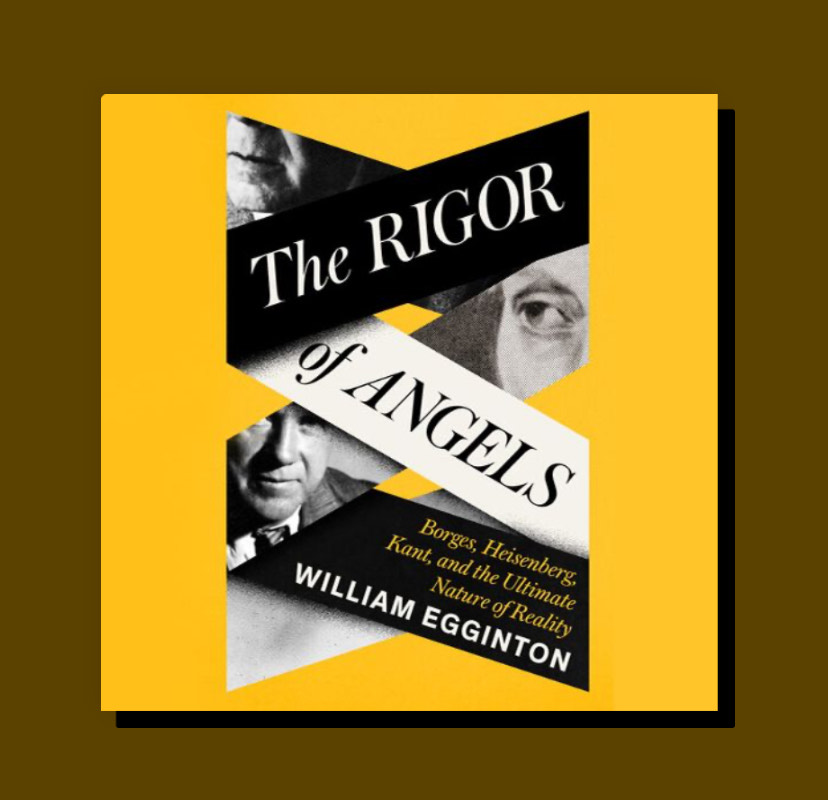
Reality is only that which we observe and measure and in so observing and measuring, we also affect reality, given we are part of reality. Which is to say, reality isn’t some otherwise existing entity to gaze upon with a telescope. To understand the nature of reality starts there, and then spirals into all sorts of metaphysical realms, quantum mechanics, and philosophy. William Egginton explores the contours of reality, and how we make up the tapestry of reality’s fabric, in his 2023 book, The Rigor of Angels: Borges, Heisenberg, Kant, and the Ultimate Nature of Reality. As you can see from the subtitle, Egginton does this by examining the ways in which Argentine writer, Jorge Borges; physicist and pioneer of quantum mechanics, Werner Heisenberg; and philosopher, Immanuel Kant, all contributed to radical thinking about reality. I’m no Egginton, so certainly, parts of the book, particularly the deeply scientific, were beyond me, but on a fundamental level, I found The Rigor of Angels beautiful, enriching, and mind-bending in the best way. He asks us to join him in a world of tension between real things and the idea of those things and to remerge anew in better understanding our place within it.
When we interact with the world, even to the point of myself observing myself, I’m not actually making an observation of the world as it is, but rather how it is perceived through my senses. There will always be that “veil,” as Kant calls it, between our perception of a thing and the thing itself. To think humans, fallible and all, despite our seemingly lofty systems of literature and art, math and science, and philosophy, are perfect arbiters of that reality is our ultimate blind spot in Egginton’s estimation. It was only through the 20th century and these three aforementioned men (among others) that we began to break through to the unreality of what we thought our constituted reality was. In the same way there exists a veil, however small and often undetectable, between the world as it is and my perception of it, there also exists a veil between me as a mover within the world and knowledge of the world. Because of the veil, there exists a natural limit to our ability to get at that knowledge.
At the quantum level, physical reality does not behave in any predictable, stable way. Like reality itself, particles do not exist independently of our interactions with them. As soon as we interact with the particles, the measurement affects how the particle behaves. A great line from Heisenberg goes, “… we have to remember that what we observe is not nature in itself but nature exposed to our method of questioning.” Everything at the quantum level hinges on what happens once the observation begins. It is only through imagining that reality is stable that creates stability, a somewhat necessary feature, or fiction, humans concocted to navigate the world. Indeed, there exists this middle space we can’t quite get at, wherein for example, a particle that changes from one thing to the next is at some point, both the thing it was and the thing it is becoming. And therein comes Borges with his literature, the paradox and labyrinth inherent to such a point in space and time. Borges was particularly fascinated by the Zeno paradox involving Achilles and the tortoise: When Achilles gives the tortoise a head start in a race, he guarantees that he will never actually be able to catch up and overtake the tortoise, for when he reaches the spot the tortoise once was, the tortoise has moved on to spot further ahead, and so on for infinitely.
Men are not angels nor do they have the rigor of angels analogized by Egginton to us deciding on the pieces on the chessboard. We yearn to order the world in this way and thus, to understand it in that way, but we are also pieces on the chessboard. We are the piece trying to understand the other pieces, the board itself, and even what is beyond the edge of the board (as in, is there an edge to the universe and if so, what is beyond it? If man were to put his hand beyond this boundary, what would happen? What would the hand go into?). Because of this, Egginton rejects the notion of Sam Harris’ determinism (he particularly goes strong at him) and that of the multiverse theory. Harris postulated at one point that if his atoms were so rearranged, then he would become the killer on the nightly news. But Egginton rejects the notion of determinism based on the Heisenberg uncertainty principle (I believe) and Kant’s view of reason and rationality, i.e., to reason is to utilize free will and to reason is to be free. It’s all probabilities! Knowability is not inevitability. Nothing is preordained. We cannot reason our way out of ourselves, even again, with literature and art, math and science, and philosophy. Because we’re biased about that, that’s why it was difficult to disrupt conventional notions of reality among previous great thinkers and scientists. We are relational beings, not detached from afar beings.
What particularly makes my mind bend is that in order to perceive something — to make any sense of that which is being perceived entails holding a memory of it — we also must then perceive ourselves perceiving within the passage of time. Of course, most of us don’t go around perceiving ourselves perceiving within a morass of existentialism, but when you take the opportunity to think about why and how we think and know what we do, or think we do, about the world, it is fascinating. Where I also find my bending my mind is imagining how a God would operate within time and space (or outside of it). That is, how can the cosmos, as some believe, be both eternal and created by God, which suggests a set beginning? Similar to the aforementioned example of a hand extending beyond the edge of the universe, if God can move the cosmos, from what into what? And what space and time is He occupying while He moves the cosmos? Some have also wondered if the universe is repeating itself infinitely and we just aren’t aware of it. But in a certain sense, it doesn’t matter! If the universe is repeating itself, it doesn’t matter if nobody with the memory of the thing being repeated is there to recognize (observe) the repetition!
I also appreciated Egginton’s book in that he doesn’t shy away from the men-are-not-angels aspect, particularly with regards to Borges and Heisenberg. Borges was too close to Pinochet, the brutal dictator of Chile, which would seem to have gone against what Borges previously believed. Heisenberg helped the Nazis and theoretically, if time allowed, would have enabled them to get the atomic bomb or long-range missiles. What’s important to emphasize is when the Nazis came to power in Germany, among many other manifestations of their authoritarianism, they were against science and the intellectual class and not only because many of those individuals were Jewish, but also because of what they represented. Sound familiar? Still, the Nazis relied on scientists, like Heisenberg, for their nefarious ends.
Egginton’s book is not a “popular science” book in terms of aiming to be accessible for the layperson like me. To truly follow long, you’d have to be well-versed in science, philosophy, and even literature. As a listening experience, notwithstanding the rather hoity-toity narrator (no offense, David Glass, I just thought you put too much sauce on your pronunciations!), the ability to follow along was certainly challenging. Even so, as I said at the start, gleaning the gist of what Egginton is saying about reality is enough to make the mind bend and perceive itself slack-jacked in wonderment.

 Milam's Musings