
Spoilers! Do not read, if you haven’t seen the film!
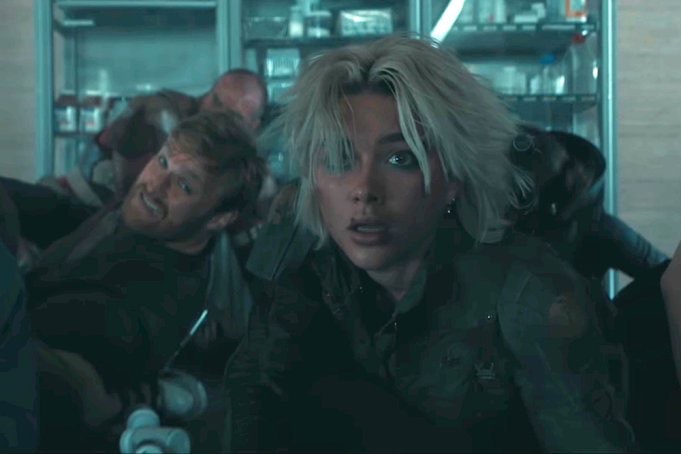
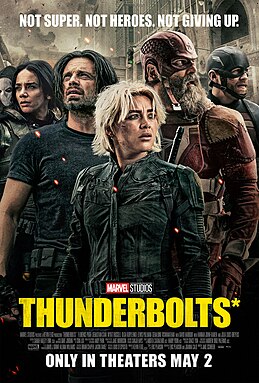
Depression lies. It tries to coax you into accepting its trappings, a hell space where its death throes rattle incessantly until you’re claimed. Give into the void, the nothingness of everything. Accept that you’re a burden to everyone around you. Acquiesce. Resistance is futile. And yet. In that yet is hope, a lightening of the enveloping darkness, a promise that there is still a tomorrow and it will be just a little bit better. In that yet is 2025’s Thunderbolts, a film about fighting back against the dying of the light, not giving into depression and the void. You can replace depression with grief, too, similar, but distinct from depression. Grief individualized to what Yelena (played by Florence Pugh, who I will have a lot more to say about!) experiences in mourning her sister, the Black Widow (Natasha Romanoff) in prior Marvel films, and is adrift without her. Grief that represents us at fans, still mourning, in a way, what was with the original Avengers and how nothing has quite seemed the same since. Thunderbolts is a film that tells us we matter and can contribute more than our negative thoughts, whether in the form of depression or grief, would lead us to believe. That, eventually, even with our depression or grief, we can take another step forward. But also, Thunderbolts, is self-effacing and self-deprecating: a film that knows it’s decidedly not the Avengers, again leaning into the viewers’ obvious awareness of this fact and mourning of a kind, and that these are a rag-tag assortment of characters. We come to love them anyway. We come to root for them precisely because of the inner adversity they faced and how they came to shed the yoke of depression and grief, or at least, make it more manageable to carry (since it never quite leaves us). All of what I’ve gone on about makes Thunderbolts seem rather, well, bleak, but it is in that rising up through the “and yet” that makes it a roaring success. It is in the intimate — a back to basics for superhero storytelling that doesn’t necessarily rely upon a world-threatening foe, albeit one does exist here — that Thunderbolts succeeds as the best film since 2019’s Avengers: Endgame. Let me say that again clearly: Thunderbolts* is far and away the best Marvel Cinematic Universe (MCU) film since Endgame. (I love the Spider-Man films and certainly some of the other releases since 2019, but this just hit different.) Along with that intimacy, the success of the film also rests largely on the more than capable shoulders of Pugh, who is a true modern treasure. Arguably, she’s the best young actress working today, and Thunderbolts*, whatever you want to say about genre constraints, gave her the platform to show why.
What’s interesting is that Jake Schreier is the director of this film, who only has two other feature films to his credit. I haven’t seen his other two films (2012’s Robot & Frank and 2015’s Paper Towns), but they seem apiece, interesting as it is to say given this is a Marvel property, with Thunderbolts*: intimate and dealing with outcasts, or those forgotten about, in one way or another. It was an inspired choice to go with Schreier and it paid off incalculably. Who would have thought a director without prior Marvel moviemaking to his credit, or any big blockbuster film, would create the first Marvel film in more than six years that felt like Marvel returned to form? Of course, credit also has to go to Eric Pearson for the story and screenplay, along with Joanna Calo who received credit for the latter. Pearson, uncredited and credited, has worked on many of the Marvel films previously.
In Thunderbolts, Yelena is downtrodden, going through her job as a paid assassin, or as she calls it, doing clean-up, for Valentina de Fontaine (played by the always delightful and assured Julia Louis-Dreyfus), director of the CIA. de Fontaine, though, is set to be impeached by Congress, including by junior Congressman Bucky Barnes, aka the Winter Soldier (played by Sebastian Stan) for illegal activities. To ensure Congress finds nothing on her, de Fontaine tries to quite literally incinerate everything, including her assets in the field: Yelena, who is trained similar to Romanoff as a Black Widow; John Walker (played by Wyatt Russell), a failed successor to Steve Rogers’ Captain America; Ava Starr, or Ghost (played by Hannah John-Kamen), who can phase through objects (she looks bad-ass!); and Antonia Dreykov, or Taskmaster (played by Olga Kurylenko), who mimics her opponents’ fighting style. de Fontaine sends each of them separately to an O.X.E facility under the pretense of stopping a thief. Essentially, she’s puzzled it out to have each of them kill one of the others. I think it’s Ava who shoots Taskmaster in the head. But after that, they realize what de Fontaine was doing and stop trying to kill each other. Also, Bob (played by Lewis Pullman, who pulled off the depressed and haggard look well) pops up in the facility. Nobody knows who Bob is and Bob doesn’t even seem to know why he’s there. Turns out, they all walked into an incinerator they are promptly locked in. They band together to escape and then to further escape the compound when de Fontaine sends agents after them.
It is upon escaping that we learn Bob has powers of some kind. He is shot dozens of times by the agents, but survives and then takes off like a cruise missile, only to then crash. Turns out, he proved the success of de Fontaine’s secret and illegal Sentry Project, whereby she would create a “hero” who is stronger than all the Avengers combined to protect the United States … and you know, answer only to her. After all, righteousness without power is only an opinion, de Fontaine says.
Bucky and Yelena’s dad, Alexei, or Red Guardian (played by the hilarious David Harbour), show up upon the misfits’ escape from the compound, with Alexei trying to save them with his limo, Bucky actually saving them, then imprisoning them, until he learns they are telling the truth about Bob. The chase scene from the compound was awesome, though, where Bucky with his cybernetic arm flips a Humvee and then likewise, flips the limousine. So, yes, Schreier brought the required intimacy, but he also showed glimpses of the action sequences we expect with such films.
I forget exactly when it happened, but Yelena hones in on the rag-tag nature of these misfits, self-deprecating about herself and the others: “What, do we all just punch and shoot?” It made me laugh because I feel like that was always the criticism of Black Widow, or Hawkeye (except “shooting” was a bow and arrow).
Turning Bob fully into the Sentry, replete with dyed blonde hair and a gold uniform, de Fontaine takes up shop in the old Avengers headquarters — furthering the nod to the fact that the Avengers of old are gone — and essentially invites Yelena and the others there. Her plan is to have Sentry kill all these mercenaries and look like the hero in the process. Bob, or Sentry, because of his depression and dearth of self-worth, believes what de Fontaine is selling him, that he can be godlike and matter as the Sentry. Thus, a fight ensues where he quite easily dispatches everyone, including Bucky, whose cybernetic arm he rips from his shoulder. He even bends Walker’s shield “like a taco.” When the Sentry realizes he doesn’t need to answer to de Fontaine, they try to use a kill-switch on him, which only turns him into the Void, the dark version of him. He’s completely shrouded in shadows and at his will, shadows envelope everyone and everything around him. What this means is he turns people into shadows and sends them into an otherworld “room” where they experience the worst memory of their lives over and over again. It’s terrifying! The first citizen he does this to is a little girl! I wonder what her “room” was, though …
Yelena before all this had a falling out with the group and particularly her dad, arguing that they are just losers and they suck. They can’t stop the Void. She’s mad at her dad for not being there after Romanoff’s death. She’s lost and depressed. So, when she willingly “walks into the void,” and accepts the shadow realm from the Void, it was shocking! Granted, I didn’t know about the room situation yet, so I thought maybe she really did die. Instead, she relives a childhood memory from when she was programmed as a Black Widow and eventually finds Bob in a room above one of his worst memories (his dad inflicting violence upon the family). Yelena and then the rest of the Thunderbolts, as they’ve taken to calling themselves after Yelena’s youth soccer team, jump into the void, too, to help Yelena and Bob. This shows you how intimate a film Thunderbolts* is: literally the way to stop the big bad is an inner fight, a fight from within.
The Void fights back against all of them, pinning the Thunderbolts down and going after Bob. Bob is nearly consumed by the Void, as he pounds away futilely against it, when Yelena and the rest of the Thunderbolts free themselves and together, proving that they are there for him, pull Bob off of the void. That image of them all together there for Bob, with Yelena whispering that she’s there for him, is one of my favorite images and scenes from a Marvel film period. With Bob regaining control, the Void disappears, as does the shadows that had descended upon all of Manhattan and those taken to their “rooms” are returned, including the cute little girl.
So, I should say, I had been wondering early on when we were going to get the title sequence for Thunderbolts*. After a while, I mused that this must be the longest time we’ve gone without a title sequence. Then, obviously, by this point in the film, I understood they weren’t doing it, but it wasn’t until what came next that I understood *why*. Somehow, de Fontaine staged a press conference where she introduces the Thunderbolts as the New Avengers. That’s why the withheld the title sequence. Whoa! As the credits roll, we get more meta commentary from real-life magazines and newspapers about how the New Avengers suck and are a poor imitation of the real thing. In the post-credits scene, the New Avengers are aware of the internet chatter and also that Sam Wilson, the new Captain America, has trademarked Avengers, which leads the Red Guardian to argue they should call themselves the Avengerz to avoid copyright infringement. The real point of the post-credits scene, though, is that something appears to be entering earth’s atmosphere from outer space: The Fantastic Four! Things are about to get super interesting!
What a lovely, daring in its way, and revelatory film. Somehow, Marvel achieved a tight balancing act of returning itself to Marvel glory and charting a new path forward with the New Avengers and did so in a wholly new way for a feature film in the MCU (it does echo 2021’s WandaVision in how it adroitly manages and conveys grief). I’m impressed, and again, I think Thunderbolts owes a lot of success to an unlikely director in Schreier for its intimacy and to Pugh for the ability to carry the load of that intimacy on screen. Man, I love Pugh and could watch her act all day.
The other reason I said multiple times now that Thunderbolts* is the best MCU film since Endgame is that this is the first time since the runup to that film where I’ve been excited about what comes next within this universe. I can’t wait to see The Fantastic Four: First Steps in July, which apparently kicks off Phase Six of the planned films, followed by Avengers: Doomsday. Presumably, as the New Avengers were talking about with regard to Sam Wilson, who are the Avengers if there are two competing factions, so to speak? Maybe by Doomsday, they merge. Nonetheless, let’s gooooo!

 Milam's Musings
One thought