
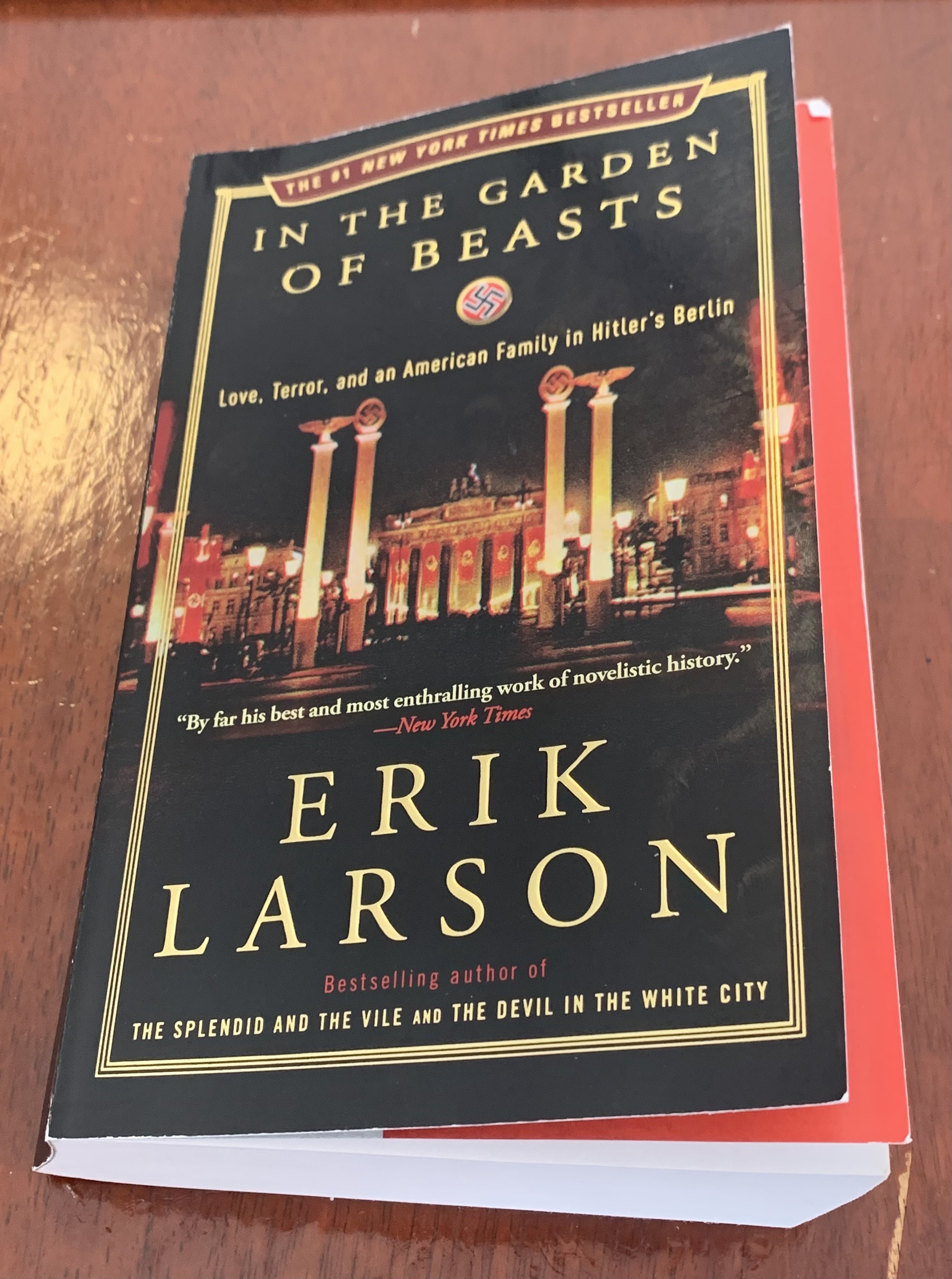
When the storm comes, it is no solace or great vindication to have correctly identified the warning signs and alerted people. It is only for the posterity of history books and that those of us in the present and future may heed such signs before the storm arrives next time. In Erik Larson’s gripping 2011 book, In the Garden of Beasts: Love, Terror, and an American Family in Hitler’s Berlin, the gathering storm is Hitler and Nazi Germany. Unfortunately, those within Germany and the wider world thought the unserious, almost farcical-seeming Hitler regime would implode of its own accord or the German people would put an end to it. Beyond that, then maybe Hitler could be contained by the “adults in the room.” Or otherwise appeased. Worse still, though, were those in the West, including within America at the highest levels of government, who thought Hitler was rejuvenating Germany and if it meant vitriol and violence against Jews, well, to be fair, in the estimation of these anti-Semites, the Jews are a problem, after all. What resulted, as the world ignored the lessons of WWI and sleepwalked into a world of tyranny and aggression, were the deaths of 6 million Jews in the Holocaust, including hundreds of thousands of Gypsies, homosexuals, the disabled, Catholics, political prisoners, and of course, depending on the source, 15 million military personnel and 45 million civilians as a result of the war itself. And yet. On the streets of Berlin in 1933, the year of Hitler’s ascent to chancellor of Germany, all seemed so normal to outsiders, visitors and tourists, American and otherwise. But naturally, one cannot accurately assess the depths a country’s soul and its people have plunged by merely visiting. Time in the city, open eyes and ears, and reading between the lines is the only way to ensure an appraisal worthy of respect. Larson’s main protagonist would eventually come to such a conclusion and be ridiculed and detested for it by the Nazis, yes, but also by his own American State Department.
William Dodd, 64, teetered on the edge of retirement so he can finish his series on the American South, The Old South, with also wanting to make a bigger mark in the world. A history professor in 1933 Chicago, Dodd was an ardent Jeffersonian Democrat and an admirer of Woodrow Wilson’s — indeed, seeing him as the second coming of Jefferson. (My estimation is that is largely owing to Wilson’s “make the world safe for democracy” speech ahead of U.S. entry into WWI.) One of the more notable points of Dodd’s academic tenure is bravely facing down Confederate veterans who wanted to rewrite history and outright ban history unfavorable to them. Dodd said, “To remain silent is out of the question for a strong and honest man.” That sensibility would portend well for him, eventually.
Nobody wanted the ambassadorship in Germany at that point, so it eventually fell to Dodd, who accepted. It was not totally out of pocket; he received his doctorate in Germany in 1897 and was fluent in the language. However, he was very unlike the “pretty good club,” I think they called it, a culture endemic to the State Department that applauded and cultivated opulence and extravagance. This was not Dodd. Especially during the Great Depression, he thought an American representative ought to live within his salary. He drove a Buick in Germany. Dodd was humble and somewhat understated, more prone to history lectures than late night soirees. Dodd wasn’t alone, though. Upon taking the job and moving to Berlin, he brought with him Mattie Dodd, his wife; Bill Jr., his 20s-something son; and Martha, his 24 year old daughter. Mattie and Bill Jr. are largely nonfactors and noncharacters in Larson’s book. The primary focus is on Dodd and Martha. His starting point, among many sources and triangulations of confirming information, Larson relied upon Dodd’s own diary (published later by Martha and Bill) and correspondence with government officials, and Martha’s diary, correspondence, and book about her time in Germany. Because of that, we do learn a lot about Martha, which amounts to her being sexually active with a range of fellows back home and once in Germany, including Nazis and Communists, and the famed author, Thomas Wolfe. In fact, in one of the more eyebrow-raising moments in the book (that doesn’t have to do with violence), Martha becomes close with Ernst Hanfstaengl, foreign press chief (a BS job) for the Nazi Party. His nickname was Putzi, and Putzi was close to Hitler. Putzi was clearly using her, if you ask me, and at one point, actually suggested she date … Hitler. He wanted her to be “Hitler’s woman.” Martha and Hitler did meet and talk, but it never amounted to anything further. In the Coda to the book, Larson shared “table talk” between Hitler and his people, saying they didn’t tap into Martha, the daughter of a U.S. Ambassador, enough, and that she was hideous looking.
Regarding Martha, it wasn’t enough that she was sympathetic to the Nazis or had affections for Nazi men, but she also went headlong into a relationship with a member of the Soviet Union’s embassy, Boris Vinogradov. I came away from their dalliance thinking Boris was merely using her, again as the daughter of a U.S. Ambassador, to be recruited into the NKVD, the precursor to the KGB. He didn’t want to marry her and told his handlers as much. What I find amusing is this staunch communist, who literally had a shrine to Vladimir Lenin in his living quarters and put him above Martha, was worried what she would think upon touring the Soviet Union, i.e. come away with a negative impression compared to America and other European cities. Talk about cognitive dissonance. Weirdly enough, Martha became a communist (and somewhat of a spy) anyhow and fled the United States during the Dies Committee (the House Committee on Un-American Activities) in the 1950s, which was going after Americans with communist leanings. You can’t script this stuff: she was in Prague when the Soviet Union invaded Czechoslovakia in 1968. She bet on the wrong horse twice, and yes, I have disdain for Martha. While she eventually came to reevaluate her initial fondness for the Nazi revolution, as best I can tell, she never fully atoned for her foolishness.
Nevertheless, it is through lens of these trysts and Martha’s naive eyes that Larson elucidated the descending darkness over Germany. Indeed, I think it was inspired by Larson to use Dodd and Martha as a microcosm in which to tell the story of Germany’s descent into fascism. Many books have been written about Hitler’s rise and WWII, but this was a wholly unique way into the story, intimate and startling in its intimacy, given the horrific grandiosity to come.
The setting for Dodd, his family, and his Ambassadorship, would be Teirgarten in Berlin, equivalent to our Central Park in New York City, and its literal translation, Larson said, is “garden of the beasts.” This is an apt location and metaphor for Larson to utilize as a title for the book. The beasts in the garden were close to where Dodd was staying: Gestapo Headquarters, the German Foreign Office, the Soviet Embassy, the Reichstag Building (which would be set on fire and blamed on communists), and even the Reich Chancellery where Hitler stayed. Everything is up for control when led by an erratic totalitarian. Jewish coalitions in America want to host a mock trial of Hitler at Madison Square Garden? Hitler and his government are going to whine to the U.S., and they won’t let it go. When Dodd retires from the State Department, but still gives lectures about the danger Hitler poses, they will whine to the U.S. to denounce him. Even the damn candy fruit drops had swastikas on them. So, it’s no surprise that they tried to control people’s perceptions of Berlin. Still, it was the Teirgarten that proved the safest place to have walks and conversations free from the seeming omnipresence of the Gestapo’s surveillance system.
Among the gravest mistakes the West made, including America and Dodd initially, in dealing with Hitler and his regime, was thinking they were dealing with likeminded, rational state actors. Hitler and his ilk were not at all rational. As Consul General George Messersmith out of the Berlin consulate put it, “With few exceptions, the men who are running this Government are of a mentality that you and I cannot understand. Some of them are psychopathic cases and would ordinarily be receiving treatment somewhere.” He also warned about Germany’s danger to world peace for “years to come,” if the government remained in power. Messersmith is one of the unsung heroes for at least trying to sound alarm bells with his dispatches far earlier than anyone else in a similar position. People doubted him and the veracity of his reports detailing Germany’s democratic backsliding and hostility toward Jews, though. One of those people was Martha, again naive in her view of Germany, thinking reports of violence and oppression can’t be true because she has seen only what they want her to see: a small slice of Berlin near the Hotel Esplanade. She would later take a more active view of what she was witnessing in that, she approved of the “Nazi revolution.” Another example is CBS radio broadcaster, H.V. Kaltenborn, who thought Messersmith was exaggerating or getting bad information. That is, until his own son was attacked by a Storm Trooper and the police did nothing about it. Admittedly, part of me thought, now will you open your eyes? Furthermore, the early days of the concentration camp at Dachau fooled visitors, too. Larson noted the cleanliness and efficiency of the camp had little to do with a desire to treat the inmates humanely. SS Officer Theodor Eicke wrote the rules for Dachau, which in part, said, “Tolerance means weakness.” His “pupil,” Rudolph Höss would go on to be the commandant at Auschwitz. Again, also, there was outright acceptance and encouragement for and of Hitler’s takeover of Germany and the resulting pogrom. One example is Charles Crane, a businessman and philanthropist, who Dodd dined with, who told Dodd, “Let Hitler have his way.” As it happened, Crane would die in early 1939 before Hitler truly had his “way.” It’s worth noting that Dodd was somewhat sympathetic to the anti-Jewish viewpoint Crane and others within the American government, particularly at the State Department, espoused: That Jews were partly to blame for their plight. Dodd said while he didn’t approve of what was happening to the Jews, the Germans nonetheless had a “valid grievance.” To be clear, no, they did not. Later, Dodd would write to the State Department that he had too many Jews on staff, which made his job difficult, particularly the “embassy’s relationship with Hitler’s government.” Worse still, Dodd wanted Messersmith gone because he erroneously thought him of Hebrew descent.
At the start of my review, I alluded to the comical, often farcical shading people had of Hitler as a figure and his government overall, thus, portending its imminent collapse (if only). In other words, Hitler wasn’t taken seriously. Hitler was seen a indolent (lazy), with Larson going on to say, “He rose late, worked little, and surrounded himself with the lesser lights of the party with whom he felt most comfortable, an entourage of middle-brow souls like Putzi Hanfstaengl derisively nicknamed the, ‘Chauffeureska,’ consisting of bodyguards, adjutants, and a chauffeur.” Hanfstaengl (again, an ally of Hitler’s!) wrote, “Hitler looked like a suburban hairdresser on his day off.”
Perhaps nobody had the imagination, or forethought, to conceptualize how someone like that rose to power in the first place and commanded it thereafter. Which was part of the issue in stopping it. I know it’s cliche, and often foolhardy, to compare foreign affairs to American politics, and certainly, historical matters to modern American politics, but I couldn’t help but think of our present moment and president in America throughout reading Larson’s book, but most pointedly, in the aforementioned description of Hitler and how he was viewed by the world. You see it all the time with President Donald Trump. How could so many be taken in by this guy? A spray-tanned reality TV show host, without any work ethic or apparent knowledge of how anything works? And yet. At another point, Hitler is described as childlike. So, childlike, unserious, comedic at times, and yet, so damn dangerous. That combination is lethal, owing to people not taking seriously the person because of the unseriousness of it all, the unreality of it all (a word mentioned multiple times about Berlin in Larson’s book as the darkness descended), and the resulting dangerous follow through.
Another lesson to learn from this time (and again, I can’t help drawing an analogy to today), is thinking others within the government can control the erratic man at the top. Vice-Chancellor Franz Papen, who enjoyed the affection of President Paul von Hindenburg, was one such man who thought he could control Hitler. “Within two months we will have pushed Hitler so far into a corner that he’ll squeak.” Larson called it possibly the greatest miscalculation of the 20th century. Relatedly, one of the weirder items about history is the belief that President Hindenburg, who was 85 at the time, would stop or contain Hitler. He was fully bought in, best I can ascertain! He was still president, for example, when the Night of the Long Knives occurred between June 30 and July 2, 1934, where Hitler personally, along with the SS and Gestapo, executed scores of political opponents and other citizens deemed fit for execution. Hitler claimed the death toll was 77, but the number could be as high as 1,000. Indeed, after the Night of the Long Knives, Hindenburg sent Hitler a letter, offering his “most profound thanks and sincere appreciation” for putting down “treason.” Gross. Such a violent event in a modern European country ought to have been the moment where the wool was pulled off of everyone’s eyes. Instead, Hitler was still treated like he could be dealt with rationally as a fellow statesman. Dodd held a Fourth of July party at his residence days later. Also, to be clear yet again, the plot Hitler worried about from within and he used to justify the violence, was fictious, born of a paranoid mind (everyone in the Hitler regime was paranoid that others were coming for them, and in some cases, they were correct). But even if it were true, it doesn’t justify summarily executing people! I thought I was taking crazy pills reading the West react at first with credulity to Hitler’s claims. As if that would make it okay! The disconnect between what Hitler was doing and how the world was responding was painful to read. It would be another four and a half years, after Kristallnacht or the Night of Broken Glass, the pogrom against Jews where 91 Jews were killed, 30,000 arrested, and 267 synagogues destroyed, that FDR finally issued his first public condemnation of Hitler.
Backing up some, one of the most infuriating aspects of those early days and weeks with Dodd as the Ambassador to Germany was his, and the State Department’s, refusal to warn Americans against visiting Germany after many attacks on American citizens in the country. That was part of a bigger issue Larson continually highlighted and questioned: The American government, from President Roosevelt to the State Department, refusing to publicly condemn Hitler and his government and do anything to cause diplomatic consternation. At this point in the story, I jotted a note to myself that Dodd merely wanted to finish his four-volume Old South, and forget what was happening around him. Fortunately, he would come to rise to the occasion, at least inasmuch as one in his position could at the time. That would come soon after, when Dodd pushed back for the first time in the most assured way he knew how: a history lecture. He gave a talk to the Berlin branch of the Chamber of Commerce on October 12, 1933, where he aimed to “exert quiet pressure toward moderation.” In his speech, Dodd said, “… one may safely say that it would be no sin if statesmen learned enough of history to realize that no system which implies control of society by privilege seekers has ever ended in any other way than collapse.” To fail to learn from such blunders was to chart a course toward “another war and chaos,” he added. Prophetic indeed. For as little of a man as they projected him to be, the German government always made an effort to stymie Dodd; after the speech, Joseph Goebbels, chief propagandist for the Nazis, blocked publication of the speech.
Getting an accurate gauge of how regular Germans felt about Hitler, Nazis, and the future of Germany at that time can be fraught with difficulty. Those after-the-fact in memoirs, Larson noted, tried to make themselves seem more anti-Nazi than they perhaps were in practice and reality. Still, one unambiguous sign that there was at least some brave Germans opposed to Hitler was when he had the nation vote on his government’s job and his aims for the rearmament. To be sure, it was obviously not a true gauge of the voting public, given the threats and coercion involved. Despite that, 2.1 million Germans (out of about 43.5 million Germans who voted) made the “dangerous decision to vote no.” Good for them. On the flip side, I have measured disdain (qualified because I wasn’t in his shoes) for German author Hans Fallada, who stayed in Germany, and allowed Goebbels to literally alter his writing and books. No thank you. There is no level capitulation the authoritarians will accept and no level of capitulation worth your own pride and morality.
While I admired Dodd trying to pushback against the State Department’s “pretty good club,” and later, his efforts to pushback on cajoling Hitler, the former is ultimately what led to his ousting by December 1937. The following year, Mrs. Dodd, who was worried like her husband about what was to come in Europe, died before the world went to hell. William Bullitt, who became Ambassador to Paris, wrote to FDR in 1936 about Dodd, stating, “He hates the Nazis too much to be able to do anything with them or get anything out of them. We need in Berlin someone who can at least be civil to the Nazis and speaks German perfectly.” To be clear (my third and final of these): There is no such thing as hating the Nazis too much and no world in which they ought to be afforded civility. So much of the State Department of this time was made up of cushioned cowards at best, and ardent, Hitler-approving anti-Semites at worst. Indeed, Dodd’s successor, Hugh Wilson, was a Hitler-loving, Jew-hating piece of crap.
Nonetheless, upon returning to America, Dodd, frail and grieving his widow, continued giving lectures about the dangers Hitler posed to world peace. In one June 10, 1938 speech in Boston, Dodd discussed Hitler’s hatred of Jews and that his intent was “to kill them all.” Nobody in a position of power was listening, except the Germans who complained about it. Even as Dodd lay on his deathbed, Goebbels took to mocking Dodd in his newspaper. As Larson observed, if Dodd was of such little import and effect in his ambassadorship, Goebbels and the German government’s response to him, even upon his death, suggested otherwise. Larson’s final words on the matter (before the Epilogue and Coda) are succinct and poignant, “In the end, Dodd proved to be exactly what Roosevelt had wanted, a lone beacon of American freedom and hope in a land of gathering darkness.” Which is why I came to admire Dodd in the course of reading this book. He stuck by his principles and his character, much to the chagrin of his colleagues and superiors within the State Department and to Hitler and the Third Reich. That’s something. While it may not have been Dodd’s Old South he so desired to complete as his legacy, but it is something to stand athwart such gathering darkness and shout the truth. As he stated years earlier, to remain quiet is out of the question.
Dodd would live long enough to be “vindicated,” as Hitler invaded Poland in September 1939. But as I said, that is hardly a welcome vindication.
Larson’s book is harrowing because you know how this story ends, but you’re fully invested in how the characters in Hitler’s Berlin will react and deal with the unfolding events. In the Garden of Beasts, like the best books about the rise of Hitler and WWII, provides ample lessons we would be wise to heed before our own gathering storm.

 Milam's Musings
One thought