
Spoilers!
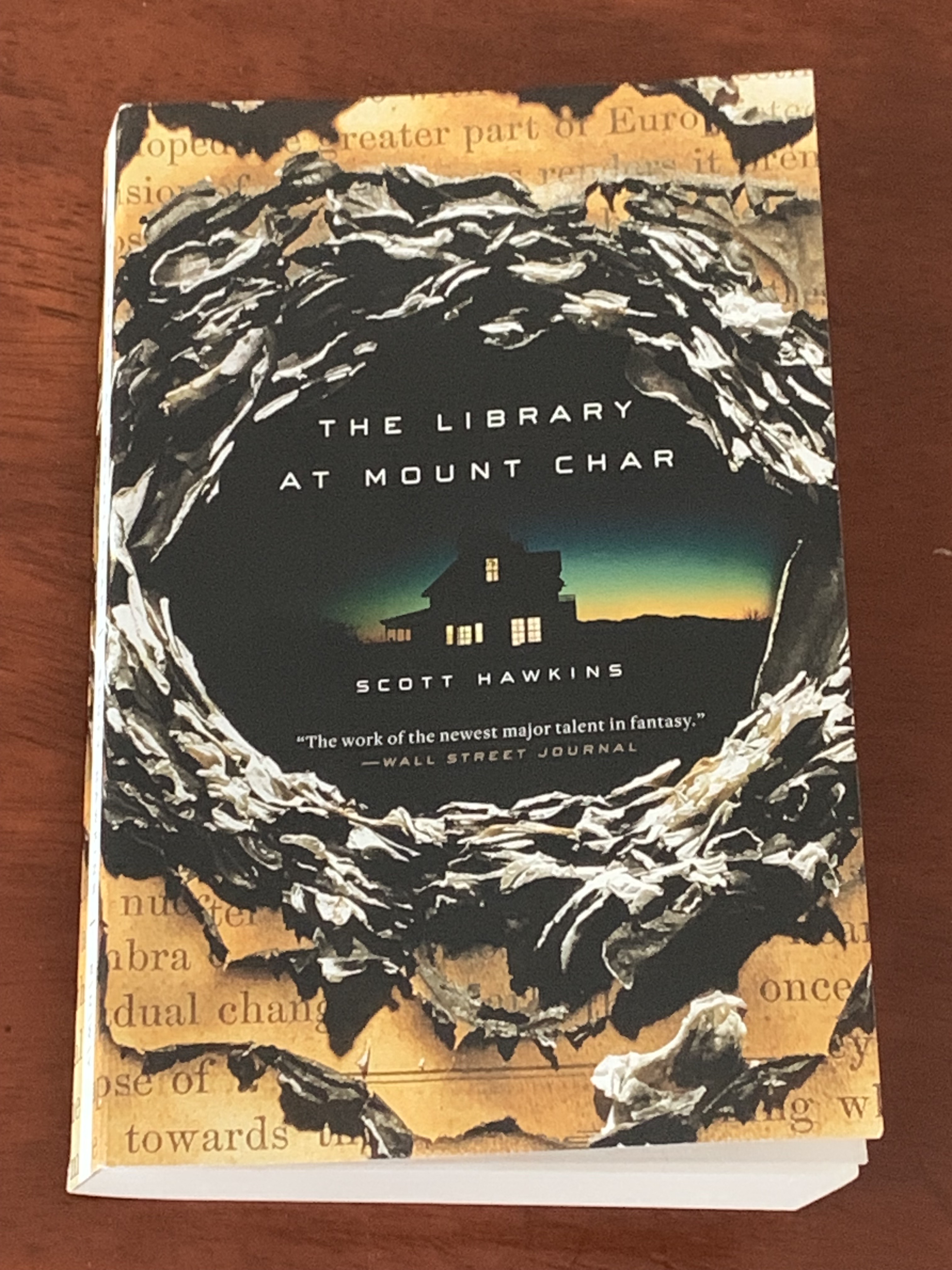
In a world of gods, human reality is beyond comprehension. Or at least, it is of insignificance. When the gods are playing chess, humans are below even the pawns on the chess board, but as with any great book of this kind, it takes a human with deep compassion to show the gods, or at least a god, a different way. Scott Hawkins’ debut novel, 2015’s The Library at Mount Char, is both macabre and horrific in ways nearly unimaginable — Clive Barker and Jack Ketchum might blush — while also being endearingly, achingly human in the best way of us. A blend of horror and fantasy, philosophy and comedy, Hawkins’ book is unforgettable, unputdownable, and unbelievably difficult to distill into any genre-specific confines. Like the Library at the heart of the book, one just has to traverse the pages to begin to glean the work Hawkins has conceived here.
Father is the designation for a sadistic godlike figure, who is essentially the emperor of the reality we know about. He created a Library to catalog his knowledge. There are 12 main catalogs, including murder and war, languages, healing (which includes resurrection), relationships with the animal kingdom, death, and even cooking (because food crosses all planes and all realities!). Father takes 12 children as his apprentices to fit these slots. David is his warrior, who is nearly godlike in his ability to fight, so much so that a literal battalion of America’s best warriors stood no chance against him (and with him showing up with a spear at a machine gun fight). Jennifer is his healer and better than him at it, but is also a pothead (no judgement). She repeatedly brings the children back to life when Father punishes them by killing them. Michael talks to the animals. Margaret is the one who lives in the other realm of the dead. And Carolyn is the one who knows all the languages ever spoken. One of the main “rules” of the Library and of Father’s is you must never share your catalog’s knowledge with another. Presumably, it would be too much power for one person to amass and thus, they could challenge Father. Carolyn is secretly doing this and shrouding herself in the stereotyped image others have of her of being “shy and mousy.” Also, for what it’s worth, the White House seemed to be aware of Father, so much so that they tried to bomb him when Carolyn and the others were regular American children. Later, they arrived at a treaty of sorts. After the White House sends those aforementioned warriors after David, he goes to the White House and kills everyone and beheads the president. Margaret sits with the president’s severed head in her lap — to give you an insight into some of the gruesomeness of this book.
To set her plan in motion, whereby she kills Father and David, Carolyn enlists the help of Steve, a one-time serial burglar to burglarize the home of a detective, where she frames him for the “murder” of the detective (he was already one of the “Dead Ones”) to ensure he goes to prison and encounters Erwin, a war hero-turned-Homeland Security agent, who is investigating a prior bank robbery Carolyn committed. These two compassionate, good-hearted people are necessary to everything that unfurls. In other words, Steve and Erwin are the less-than-pawns in Carolyn’s chess match against Father and David to set-up the climactic moment (somewhat mid-way through the book) when Carolyn is able to kill David. Or rather, nearly kill him because there is something worse than death: suspended animation of all the pain possible to feel. That creates a ball of black energy around David’s body. So much so that David becomes our new sun, a dark sun, so it’s not exactly a particularly habitable-forming sun, but it’s better than the earth freezing out. That’s why I said these beings are godlike. Carolyn made a new sun out of David.
I thought it was interesting two things happened off page. First, Carolyn surprised and killed Father with a knife. Secondly, Erwin, who was characterized as more or less the best possible modern human warfighter we have, was able to make David bleed in a fight with him. That surprised even Carolyn. I would have loved to have seen both moments on the page!
Anyhow, after David is killed, Carolyn takes Steve and his lioness — long story short, Carolyn convinced a lion and his cub to protect Steve and then Steve and the lioness formed a strong bond; it was quite cute — to the Library, a separate universe to ours. Carolyn compares it to a Big Mac: our universe is the Big Mac and the Library is the wrapper. That is also a small insight into the comedic flourishes Hawkins adds to the book. I also liked Carolyn’s exasperation whenever Steve said what she was doing was “magic.” There’s no such thing as magic, she repeatedly says. Or demons and possessions, for that matter. So, the Library contains all the knowledge that Father amassed across thousands of years, and even then, as Father later explains (after Carolyn resurrects him), he still doesn’t know everything. There’s endless regression of knowledge and of beings like him. Nobody knows who the “first” is, if a first exists at all.
Steve is dismayed in his penthouse within the Library Carolyn set up because he still has access to CNN and Anderson Cooper. So, he’s watching as the world devolves into anarchy because the yellow sun is gone, famine is rampant, and riots are common. The Library is also within our universe’s “space” causing earthquakes and the volcano under Yellowstone is set to erupt. Steve doesn’t understand how none of that perturbs or concerns Carolyn. She dismisses it all. She thinks humans will “adjust.” Steve, ever the compassionate person, albeit coincidentally the person who put that seed in her head back when they were children, leans into his Buddhism and self-immolates. He martyrs himself because he realizes he is Carolyn’s “heart coal.” By killing himself, he’ll finally get through to Carolyn. That precipitated her resurrecting Father to understand everything better and then to bring everything back to normal. She makes Steve the yellow sun, which burns even brighter than the previous one, rights other wrongs (she “talked” to the volcano under Yellowstone to calm him down), and then breaks Erwin out of federal prison (he was in there for holding the most recent president hostage so he would try to nuke the Library, which was ultimately futile, like shooting someone’s shadow expecting it to kill the person, Carolyn explains) because she needs him to do some “errands” for her. We know that other entities or godlike beings are coming for Carolyn’s position, hinting at possible sequels in this universe or reality.
What we learn from Carolyn’s dialogue with Father is everything was rather preordained by him. He knew Carolyn would always be his heir. He knew Steve would martyr himself. He knew David wasn’t tough enough. He knew, or as he said, had faith that Carolyn would resurrect him after first killing him. That, along with the idea of infinite regress, are the two Big Ideas I’m walking away from Hawkins’ book with, along with, of course, the most potent theme: compassion for all living beings, from lions to an entity that’s lived thousands of years (the prior yellow sun and an acolyte of Father’s) to even Margaret, who was last seen cradling the former president’s decapitated head.
What a ride! Going in completely blind, I wasn’t ready for how philosophical, comedic, and certainly, how gruesome, Hawkins’ book would be. Hawkins deftly navigates horror and absurdities with deadpan humor and earnest humanity (often using a lioness as a stand-in to do so, no less!). Since this book is now 10 years old, I’m excited to dive into the rest of Hawkins’ catalog (see what I did there?).

 Milam's Musings
One thought