
Spoilers!
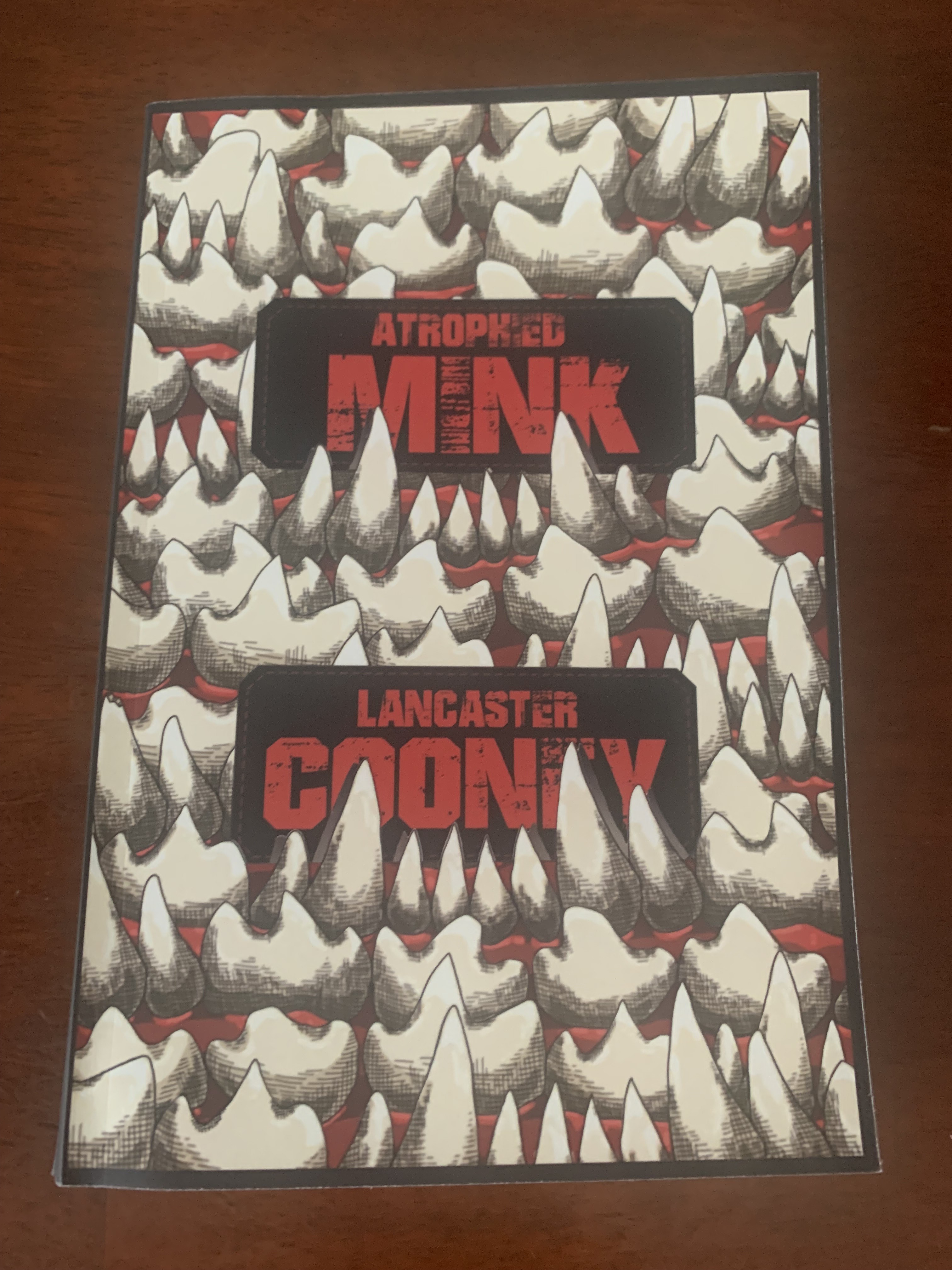
Revenge has a momentum of its own once it curdles in the brain, or perhaps the heart, where it’s more apt to germinate. Lancaster Cooney’s debut novella, Atrophied Mink, is a propulsive, gritty Appalachian revenge story, featuring an unlikely heroine in 14 year old Jacobi, who is hellbent on righting the wrongs in her small town of Lower Guild in Central Kentucky.
Those wrongs start with the murder of Jacobi’s own mother, Allison, which the police have written off as an accident on a dock abutting Lower Guild Lake. Jacobi, in her grief and bid to get close to her mother, tries on her makeup and clothes, and eventually an old mink coat dating back to 1943 and her grandmother. The mink coat is a conduit or vessel for shedding light on what actually happened to her mother. She was stalked and preyed upon by Emit Soot, a man with bloodlust in his eyes and permeating his thoughts, along with a fittingly (if macabre), “eat the princess” tattoo on his arm. Emit Soot is a fantastically grimy name for a killer and villain, by the way. It’s a name that makes you want to hock a loogie as you say it.
Jacobi’s sidekick is Jonah (all great main characters need a lovable sidekick!), a meek boy, ready to assist Jacobi where he can, but knowing he’s not capable of the power she wields, the force of her. Jacobi and Jonah are characters that would fit comfortably within Stephen King’s oeuvre. Particularly potent and reminiscent of the best of King is Jacobi’s father, Danny, who completely collapses mentally and physically headlong into addiction after Allison’s death. The chapter, “An Intervention of Sorts,” was heartbreaking and heart-wrenching to read. To Jacobi, her father might as well be dead, too. Unfortunately, there’s no corporeal punishment she can mete out to save him.
In, “Murmuration’s”, we learn how the mink coat came to be. Jacobi’s grandmother freed minks from certain grotesque slaughter for their fur to make coats. As gratitude, the minks gave her the coat. Which is to say, this revenge is generational. More could be said on that. How women being threatened by men is indeed a generational concern passed down, like a coat, from one woman to the next. In fact, in, “Up All Night, with Rhonda Shear,” Jacobi says as much. She talks about feeling her grandmother and mother’s presence within the mink coat. “How she could feel their agency, as well as the presence of those who came before them.” Generational. That same chapter also contains the line that influenced how I started this review: Jacobi assures Jonah, as she’s on the precipice of killing Soot, that he doesn’t need to fear her. “I’m not a monster. Just something set in motion.” She’s at her breaking point and it’s time to orient the breaking around some other people.
Other events are swirling around Lower Guild that warrant Jacobi’s attention, too. Class divide breeds contempt, which breeds a time to “eat the rich,” as it were. When two boys, Deke and Keith, hit Emmy Carlson with their vehicle causing her to be paraplegic I believe, Jacobi seeks revenge for her affable, cute former babysitter. But also, those two boys are emblematic of the class divide: They’re from Upper Hearth, the richer area, and thus, face no consequences for what they did. In a great passage reflective of the divide, Jonah runs into the local cemetery and notes, “It was unkempt for a cemetery, unlike that of Upper Hearth Cemetery, a mere five miles up the road. Even the dead were given hierarchy.” Jacobi endeavors to put ’em into the ground, all the same, even if the flowers over their gravesites are prettier.
Nobody but Jacobi and Jonah cares what happened to Emmy. The other high schoolers laugh when Keith makes fun of her in her wheelchair. Keith in particular is doted on as the town’s baseball phenom, owing to his extra middle finger (don’t blush past the metaphor there!). Jacobi takes bolt cutters to Keith’s prized middle finger one day in the hallway — or was it the perpetually revenge-seeking minks?! — and in a gruesomely bloody Epilogue, kills Deke and his hoity-toity parents. (It was also perhaps even more haunting than it was gruesome, given Deke was with his parents for a period of time before realizing they were dead.)
Boy, a slow teen in the town for lack of a better word, is also set-up, literally, as a red herring. He likes animal carcasses and totes them around. Soot would, unbeknownst to Boy as to his true intentions, use Boy as a decoy out near his home on Lower Guild Lake. In other words, what was fascinating about the “two momentums” meeting at a climax in the book is that Jacobi had her mink coat propelling her forward and like any good paranoid killer, Soot also had an inkling someone or something was after him, too, hence the decoy.
Cooney writes with descriptions and clipped lines that echo Jack Ketchum in gruesomeness and Cormac McCarthy in style — lines you don’t merely skim by, but words that burrow under your skin and indeed, make it crawl — which added heft to Soot as a villain juxtaposed to Jacobi’s righteousness. “Chirpie’s” is where Cooney is at his most devilish and gritty, showing how Soot sought Allison, Jacobi’s mother. In a nice play on words as Soot observes her, Cooney gives us this: “And there she was, leaning against the very support beam he once leaned against. Sippin’ that cigarette. Completely unaware that Soot was slipping in his mind.” Oof, that’s good. Another detail from the same chapter that made my skin crawl because it’s such a minute detail but speaks to Soot’s mind “slipping” is when he insists on smelling Allison’s martini glass. If that doesn’t make your lip snarl in disgust … But I think the apex of Cooney’s ability to write with grotesque aplomb and controlled frenzy comes in, “Violence Told Twice.” The chapter is told from Jonah’s perspective at the lake as he watches Soot be killed. “Then it all went to shits and fervor. A cataclysmic fuckstorm. Organs spilled out onto the ground with the pattering of panicked fish.” The organs as “panicked fish” is a searing mental image.
But, as I’ve compared him to King already, like King, Cooney can also write with the deepest of humanity, compassion, and love. “Cinderella” is an example of that, displaying Danny’s love for Allison and why Jacobi also adored her mother. Emmy leaves after babysitting her and Allison scootches up next to Jacobi in bed to comfort her. However, the most tender, lovely chapter is the one on the same day Allison is killed, “Death of a Proven Creature.” (Great title.) Allison and Jacobi take a friend’s canoe and go out on Lower Guild Lake with the friend’s dog, Sambuca. Just laughter and togetherness. Before everything went to hell.
Atrophied Milk was the best kind of horror: a very human villain who makes you uncomfortable, a heroine you admire and root for, with earned gruesomeness that doesn’t forget about the heart and humanity of it all, with something bigger to say simmering just below the surface. Cooney’s first outing with a novella is a success at making me feel in myriad ways and certainly at making me want more of Jacobi and her mink coat! I can’t wait to see and read what Cooney cooks up next.

 Milam's Musings
One thought