
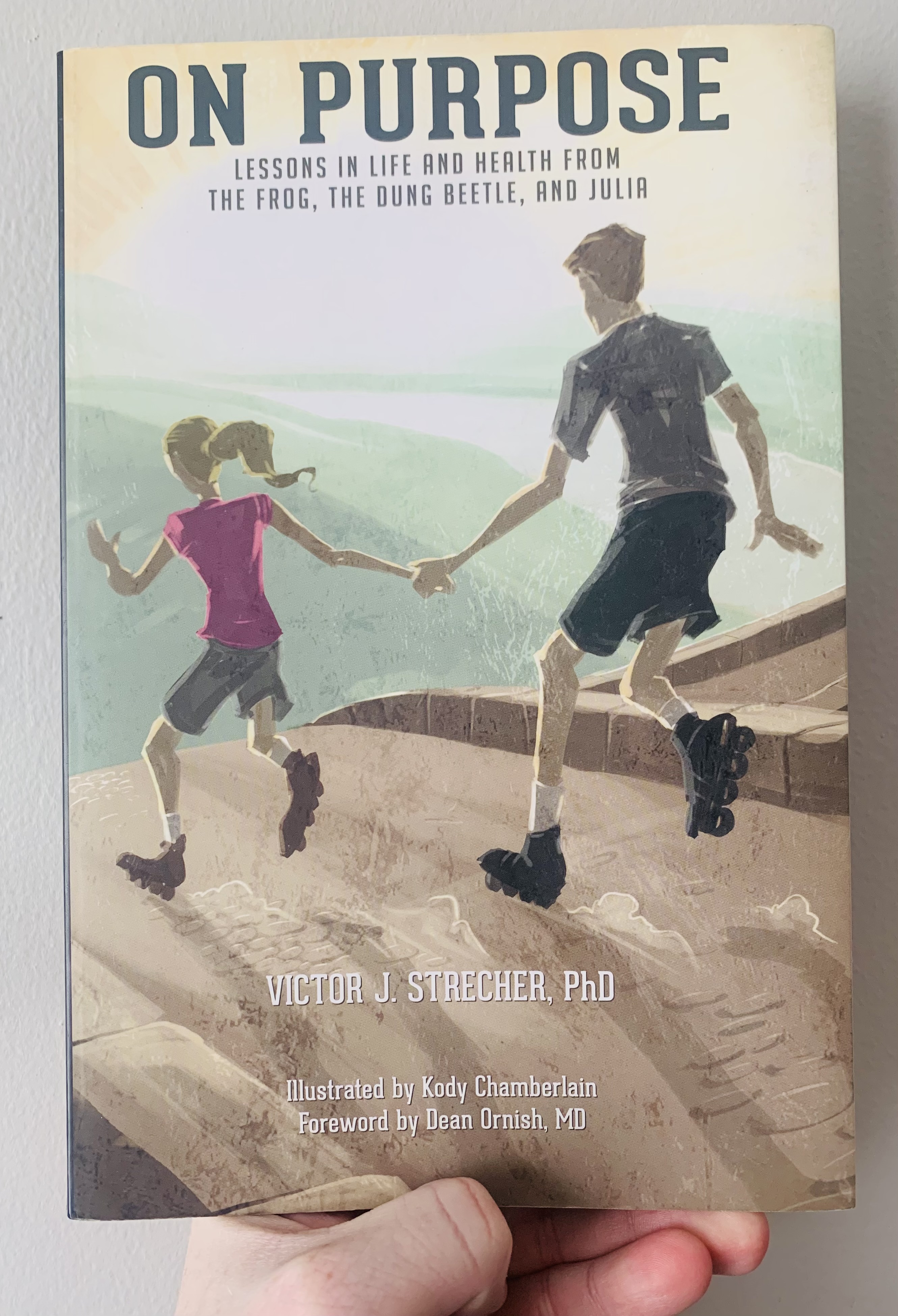
We’re all going to die and humans are uniquely positioned (so it seems) to be aware of this fact, but we stridently avoid discussing it, at least in American culture. Uncovering the purpose of life in the face of our death then is the question that has vexed philosophers, scientists, theologians, and everyone in between since humans started thinking. Ultimately, succinctly, I think the purpose of life is to do as Welsh poet Dylan Thomas suggested, “rage, rage against the dying of the light.” We all have to find our purpose — the fulcrum upon which to rage. Perhaps, then, a fear of death is a fear of living, a fear of having not found such purpose. A fear of having gone “gentle into that good night,” to quote Thomas again. When something like grief consumes us — death or a loss of some kind — purpose can feel like a futile notion. But at the risk of utilizing the cliche, grief is love and in love one finds purpose again; it just may take more time through the grief journey. All of which is to say, Dr. Victor Strecher’s 2013 graphic novel, On Purpose, Lessons in Life and Health from the Frog, Dung Beetle, and Julia is a profound, albeit accessible, entry point into addressing one’s grief, thinking bigger than ourselves, and indeed, finding purpose.
Dr. Strecher is a professor of Health Behavior and Health Equity at the University of Michigan’s School of Public Health. In 1990, his second daughter, Julia, was born and shortly thereafter, they learned she needed a heart transplant. When she was nine, she needed a second heart transplant. Unfortunately, she died in 2010. Strecher was adrift, a fitting metaphor since he begins his graphic novel with a dream involving Julia and then taking a kayak on the water to reflect on how it was time to move forward. To keep living and certainly, to be happy can feel like a betrayal of the person lost, and yet, in reality, to continue living is a beautiful tribute to the person and a continuation of their legacy. Dr. Strecher only needed to find his purpose again in a world without Julia. A friend told him the best way to begin moving forward, especially when sad, is to teach someone something. I interpret that as both a way to a.) get lost in the sauce (in a good way!), i.e., to keep busy and moving forward, and b.) through teaching others, you also learn from them, and in so doing, it can help you move forward. Dr. Strecher decided to teach about purpose, life, health, and death.
On the surface, defining health appears easy enough. To be healthy is to not be dead, for one, and to not be sick. While these negative, or external, considerations are important — in some respects, the greatest project and success of modern humans is our war upon diseases of the body with all manner of health interventions, perhaps most significantly vaccines and antibodies, ensuring more babies don’t die within five years, and extending our life expectancy — there is a whole category missing from such discourse. I said diseases and not dying are negative or external in the way that, for example, we have negative rights, i.e., protection from intervention by external actors (other people, the government). This missing category is tantamount to positive rights, then, or those items in which I’m entitled to for well-being. To slightly deviate from the analogy, the entitlement for well-being in my formulation does not so much come from government as positive rights activists would attest (such as a right to education, housing, healthcare, etc.), but rather ourselves. I have a positive duty to my health and well-being to take care of myself. Which is to say more clearly, there are lifestyle changes I can make to be healthier. Those lifestyle changes do not necessarily mitigate all external elements, environmental and genetic, but they’re a helpful part of the equation. Indeed, what is missing from only a disease-oriented measurement of our health is both our own agency in directing our health outcomes and our own perception of our health. The latter is vitally important. Dr. Strecher uses the example of Japan, where people have among the greatest longevity on earth, but also one of the highest rates of suicide anywhere in the developed world. Conversely, Costa Rica reports one of the highest rates of life satisfaction. Notwithstanding any concerns you may have about self-reporting surveys, where would you rather live? Japan or Costa Rica? Or as Dr. Strecher puts it, what motivates you, death or life? The avoidance of one or the embrace of the other?
One of the metaphors Dr. Strecher uses (again, notwithstanding if we think it’s actually true or just serves as an apt metaphor), which I think maps on to the experience of grief nicely, but is applicable to the wider conversation about health and all manner of other socio-political issues, is the frog in boiling water. As the metaphor goes, put a frog in boiling water, it’ll immediately jump out, but put it in cold water and slowly heat up the temperature, the frog will fail to notice the change and die. The onset and all-consuming nature of grief is akin to this, wherein one is traversing through Elisabeth Kübler-Ross’s five stages of grief (and not necessarily in a linear fashion, importantly) and before you know it, you’ve changed. As Dr. Strecher puts it, there was who he was before Julia and who he is after Julia. They are two different people. In a real sense, the person you were before your loved one died also died with them, hence why finding renewed purpose is so essential. Of course, whether it’s the grief lens (Dr. Strecher said he wasn’t fine and didn’t want to be fine) or other ways in which the ever-heating water sneaks up on us, we tend to build walls around our perception of reality (I flipped Dr. Strecher’s thinking here, as he argues major illnesses or death, among other issues, can break down the walls of our ego). Anything that may contradict the reality is hindered by the wall. Sometimes we have a “drawbridge” that allows other information in, but it’s not as common. Change threatens our ego and thus, hits the wall of our reality because it makes us defensive. To change then is to use motivation not tied to ego, but rather our core values. This is where Dr. Strecher arrived at the concept of “self-transcendence” and the example of the dung beetle. Oh yeah, let’s go!
As the term indicates, self-transcendence focuses on that which is bigger than ourselves (our ego!). The dung beetle, a nearly holy fixture in ancient Egypt, is so dedicated to rolling its dung with purpose that Dr. Strecher argues it’s a form of self-transcendence. Finding purpose enables self-transcendence. Most have probably heard of Abraham Maslow’s hierarchy of needs. It’s a pyramid of what humans need in life from physiological needs at the bottom through safety and social needs and then to esteem needs (respect from others and self-respect) and the top is self-actualization (realizing one’s full potential). All of these are ego-based! So, Maslow came to realize there is an even higher need and that’s self-transcendence. He called such people who reach this level “transcenders,” which sounds like an awesome superhero flick. Such people are motivated by beauty and the world around them, creating patterns in disparate items. Inventors and artists fit int his category. They “exhibit humility, a sense of ignorance, a feeling of smallness, awe before the tremendousness of the universe.” That’s lovely and in my view, what ought to be our orientation! Notably though, transcenders are not necessarily “happier,” owing to the disparity they see between the world as it is and the world as it ought to be. Maslow called it a “cosmic sadness,” which is another lovely, if melancholic phrase. Ultimately, I think one of our purposes in life is to always be striving toward the ideal life. (Related to health, quoting Aldous Huxley, Dr. Strecher said people can attempt to escape their ego through descending, i.e., alcohol and drugs.)
This all seems lofty, right? Nobody sits around thinking about higher ideals and the good life in this transcendent way, right? But we all need purpose. Moreover, Dr. Strecher makes the argument that scientific studies have shown having purpose makes us more resilient, and appears to prevent disease and premature mortality. In a manner of speaking then, our perception of our health influences our health. Psychiatrists are in the back of the room nodding their heads.
Core values that could be important to someone include romance, adventure, community, family, spirituality, integrity, generosity, etc. An example of a transcending purpose is to “be a gentleman,” as one character in the book seeks. Which is to say, moving toward the ideal world would be imbuing it with more gentleness and less “manliness.” Purpose helps to guide us when we’re lost, adrift in grief or otherwise. Dr. Strecher uses a sandwich shop’s mission statement as example of how the business grounds itself when lost, “Showing love and care in all our actions to enrich as many lives as we possibly can.” For his part, Dr. Strecher found two new purposes: a.) reconnecting with his wife and his other daughter, Rachael (letting them in again!), and b.) helping others to find their purpose, such as through this very graphic novel.
Purpose is an interesting question, of course. Vaguely at the top of this review, I said the purpose of life is to “rage, rage against the dying of the light,” but the purpose within that purpose for myself is to give. Of my time, my attention and energies, my monies, and even my body (I’m a living kidney donor). To give with no expectation of anything in return is the greatest gift I can imagine and as such, a great purpose to pursue. Core values I hold to undergirding it (the roots of this purpose) are ones of community, generosity, compassion, courage, and integrity (giving implies commitment and maintaining commitment involves integrity) to name a few. So then, I live out that purpose by giving in big and small ways, sometimes directly (the person knows) and sometimes anonymously (my preference!).
Dr. Strecher’s graphic novel ended fittingly with where it began: a dream involving Julia. He’s mournful Julia didn’t get to live; he tells her he would have given his life for her to live. She retorts, “But you did, Dad. You and Mom gave me a full life.” The book ends with them admiring the sun setting (one of the transcendent observations that contributes to a feeling of smallness, or ego-smashing) and then jumping toward the sun on lily pads like frogs. He asks Julia if he had a choice in his “nice jump.” Julia remarks, “Of course, You did it on purpose!” I was teary-eyed. Beautiful and profound. Julia’s life was not measured in years. To quote one of the characters in the book, it’s the life in the years, not the years in the life.
Anyone going through grief or a loss of some kind or otherwise feeling marooned within themselves (their ego!), I highly encourage them to read Dr. Strecher’s graphic novel. He presents difficult concepts in easy-to-understand ways — he used dung beetles, after all! — and he may motivate you to move beyond the walls of your ego into transcendence.

 Milam's Musings
2 thoughts