
Spoilers!
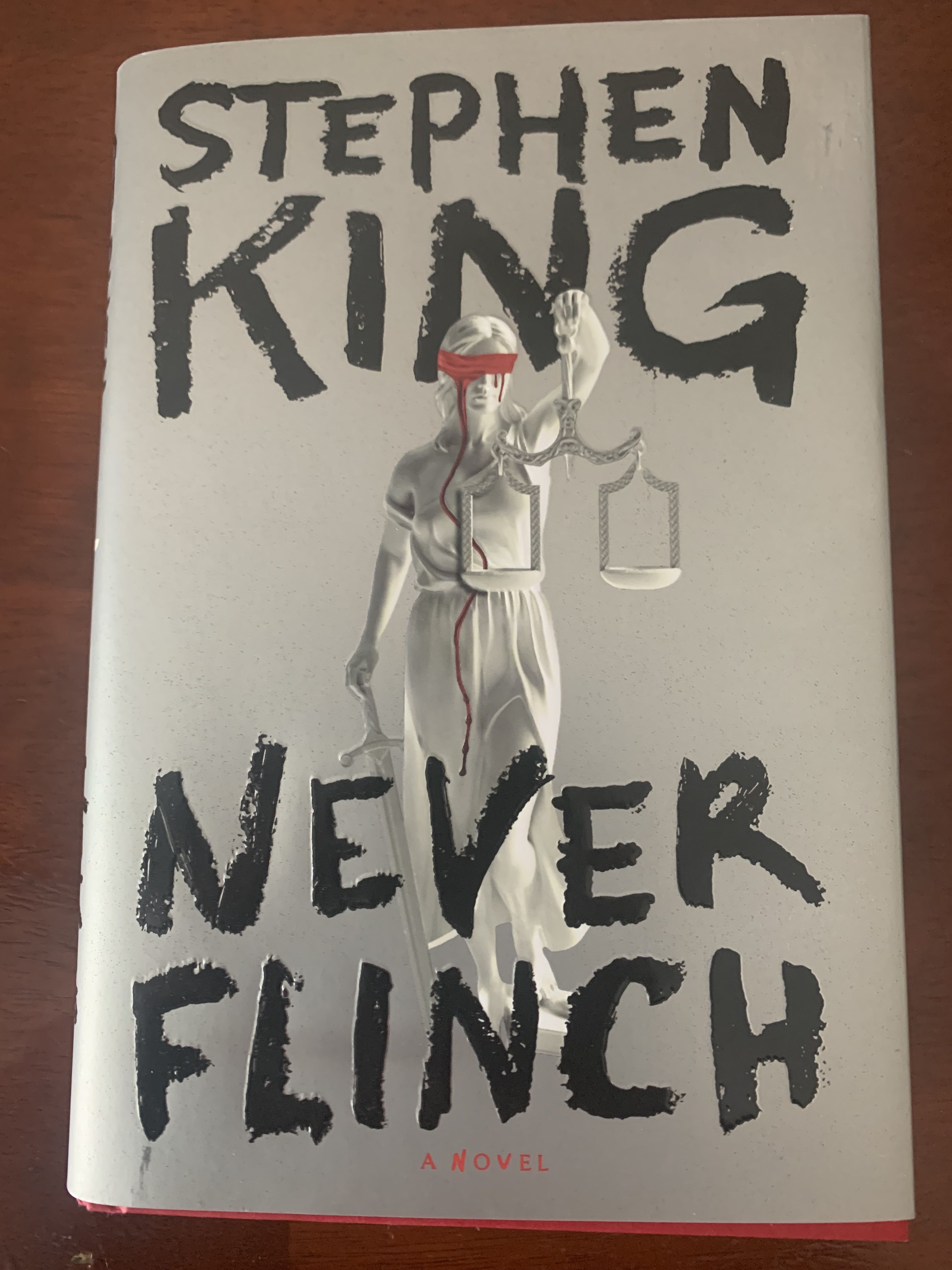
Holly Gibney is back in Stephen King’s 2025 book, Never Flinch, and this time, she’s not fighting supernatural beings or octogenarian cannibals. Instead, she’s shed her Sherlock Holmes personal in her private investigative agency, Finders Keepers, for that of bodyguard to a rabble-rousing feminist touring the country. It just so happens that two twin, very human, forces are coalescing around Holly and the other characters. The first, is a recovering alcoholic serial killer with daddy issues, and the second is a split-personality pro-life vigilante with mommy issues.
I know there is chatter among Constant Readers (King’s fanbase) that they are tired of the Holly Gibney universe King keeps returning to — outside of the Dark Tower series, it was also rare for King to repeat characters — but the way I look at it is rather simple. Stephen King is 77 years old. He’s been writing best-selling books for more than 50 years, and in that time, has written 60 novels and novellas and 200 short stories. I’m going to cherish anything we still get from the master of horror for as long as he’s willing and able to do it. If he wanted to do a fourth Holly Gibney book (she’s appeared in more, but I believe this is the fourth with her as the main character), then I’m going to read a fourth Holly Gibney book! I also just enjoy when King is more grounded in reality, even if he doesn’t always quite pull it off.
Let’s stay on Holly specifically. An irritating character trait of Holly’s was King made her smoke incessantly in the prior books. In this one, she’s quit the habit, albeit, she still pines for the relief of a cigarette. She does, however, goofily retain the use of “poop” to describe situations that are, well, “bullpoop.” Also, and I don’t know if this is the first time, but King explicitly states Holly is white. Perhaps it’s Cynthia Erivo’s incredible portrayal of Holly in HBO’s The Outsider TV adaptation that’s in my head, but I pictured Holly as Black. Nonetheless, there is a throughline between Holly and her two antagonists in the book. Don Gibson (I have to think King made one of the villains named Don intentionally), who goes by Trig or Trigger, is the alcoholic serial killer with daddy issues. He frequently hears his “daddy’s” voice in his head. Indeed, his father is the one that echoes the namesake of the book: never flinch. Don does not want to flinch. Christopher Stewart is a twin, and his twin, Chrissy, died of heart failure as a child. Instead of helping him through his grief, his mother allows him to lean into it as he becomes Chrissy in a split-personality way. He hears his mother’s voice in his head. He’s also used as the point-of-the-spear by Real Christ Holy Church in Wisconsin, the radical kind of church that wants to kill pro-choice feminists. Holly, for her part, oscillates between hearing her detective mentor, Bill Hodges’, words of wisdom, and her recently departed mother’s snide cracks and old sayings.
The impetus behind Gibson’s killing spree, aside from those daddy issues, is a case where a man was framed as a pedophile by a colleague at his bank, miffed he didn’t get the promotion. The framed man is then killed in prison. Gibson was one of the jurors who ruled the man guilty. He’s now killing more than a dozen innocent people to atone for his guilt. He sees himself as the guiltiest one of all. Holly is tangentially investigating the case, or trying to deduce who the killer could be, by way of her relationship with Izzy, a detective with the Buckeye City Police Department. One of the biggest swing-and-a-miss (pun intended because there is a baseball game that’s pivotal to the ending of the book) of Holly’s deductive prowess in the book is accusing the defense attorney on the aforementioned case, Russell Grinsted, of being Trig. She “deduced” this by asserting Grinsted is an anagram for Trig, but that only works if, as Holly tells Izzy, you take away the letters N, S, D, and E. That’s not an anagram! That’s not how that works. Holly beats herself up over it, but sheesh, that’s bad. Further flummoxing me is that neither Holly nor Izzy thought to look into each of the jurors. Maybe it’s because, as the Constant Reader, we learn early on that Trig is Gibson, one of the jurors, that I’m thinking this way, but it would seem a natural line of investigation to check the jurors out. After all, they could be feeling guilty, and thus, have motive, to lash out after the framed man is killed in prison.
To pivot from my nitpicks there, Kate is the “rabble-rousing feminist,” who is touring the country, and as luck would have it, her tour brings her to Buckeye City. Kate’s right-hand woman is Corrie. Corrie initially takes the brunt of Stewart’s attempts to scare Kate when he (as Chrissy) throws bleach in her face and then nearly kills them with anthrax. That’s when they decide to bring in a woman as a bodyguard and that woman is Holly. The other thread here is Barbara and Jerome, Holly’s two Finders Keepers sidekicks, for lack of a better word. Both are published authors — Barbara of a poetry book and Jerome a novel. A famous singer, Sista Bessie, comes out of retirement, and as it happens, loves Barbara’s poetry book and not only wants to adapt one of the poems into a song for her tour, but wants Barbara to sing it with her. Barbara does and can’t believe her good fortune. That leads to Jerome also taking up the role of bodyguard for Sista Bessie. Finally, the final thread is an upcoming “Guns and Hoses” charity baseball game between the Buckeye City Police Department and the Buckeye City Fire Department Izzy is being forced to pitch in.
All three of these items — Kate’s tour stop in Buckeye City, Sista Bessie, who is singing at the game and at the same venue later as Kate, and the charity game — all converge on the same weekend. Which brings our serial killer and our vigilante together, incidentally, as they’ve staked out the same abandoned hockey rink. Gibson wants to go out with a fiery bang by kidnapping and killing Corrie, Kate, Barbara, and Sista Bettie in that rink because it’s where he has the strongest memories of his dad (who he suspects, by the way, of killing his mother). Stewart just wants to kill Kate and tries to kill Gibson when Kate is brought into the ice rink. Instead, Gibson kills him. But that convergence of events also brings our heroes together. As brash as she is, Kate went to the ice rink alone to save Kate; nearly octogenarian herself, Bessie went to the rink to save Barbara (she was only able to slip away from the crowd because a riot occurred after a fight started during the charity baseball game), who is like a daughter she never had; and Jerome and Holly together when Bessie realizes she’s too old and Holly finds Kate’s note of what she was planning. Holly shoots Gibson dead right away, and everyone is rescued and saved in the end.
The reason I said earlier that King doesn’t always pull it off when he goes for grounded is I particularly don’t find him as convincing (or authentic) when he’s writing politically-motivated characters like Kate or Stewart. (I also don’t think pro-life detractors of Kate’s would actually pay to attend her shows in order to boo her.) That said, King made Kate more compelling and caring than she initially seemed, and of course, the character played well off of Holly, who is diametrically opposite of Kate — insecure and doubtful of herself, and who shies away from the limelight. I also thought the tie-in with Trig and Alcoholics Anonymous was interesting, creating the challenge of figuring out Trig’s real identity because of the inherent anonymity of AA meetings.
King wrote a more horrifying book in terms of abject disgust with his previous Holly outing, 2023’s Holly, with the octogenarian cannibals, and a tighter, unnerving, and more compelling book with 2018’s The Outsider (it’s so interesting that Holly, Barbara, and Jerome know supernatural entities exist and just go about their life, although the trauma of it lingers), but I enjoyed Never Flinch because of the disparate, killer threads and how they converged in the end. It’s perhaps one of the more straightforward crime books King’s written, with a relatable, flawed character at the forefront in Holly. Constant Readers, try to enjoy this and King while you can.

 Milam's Musings