
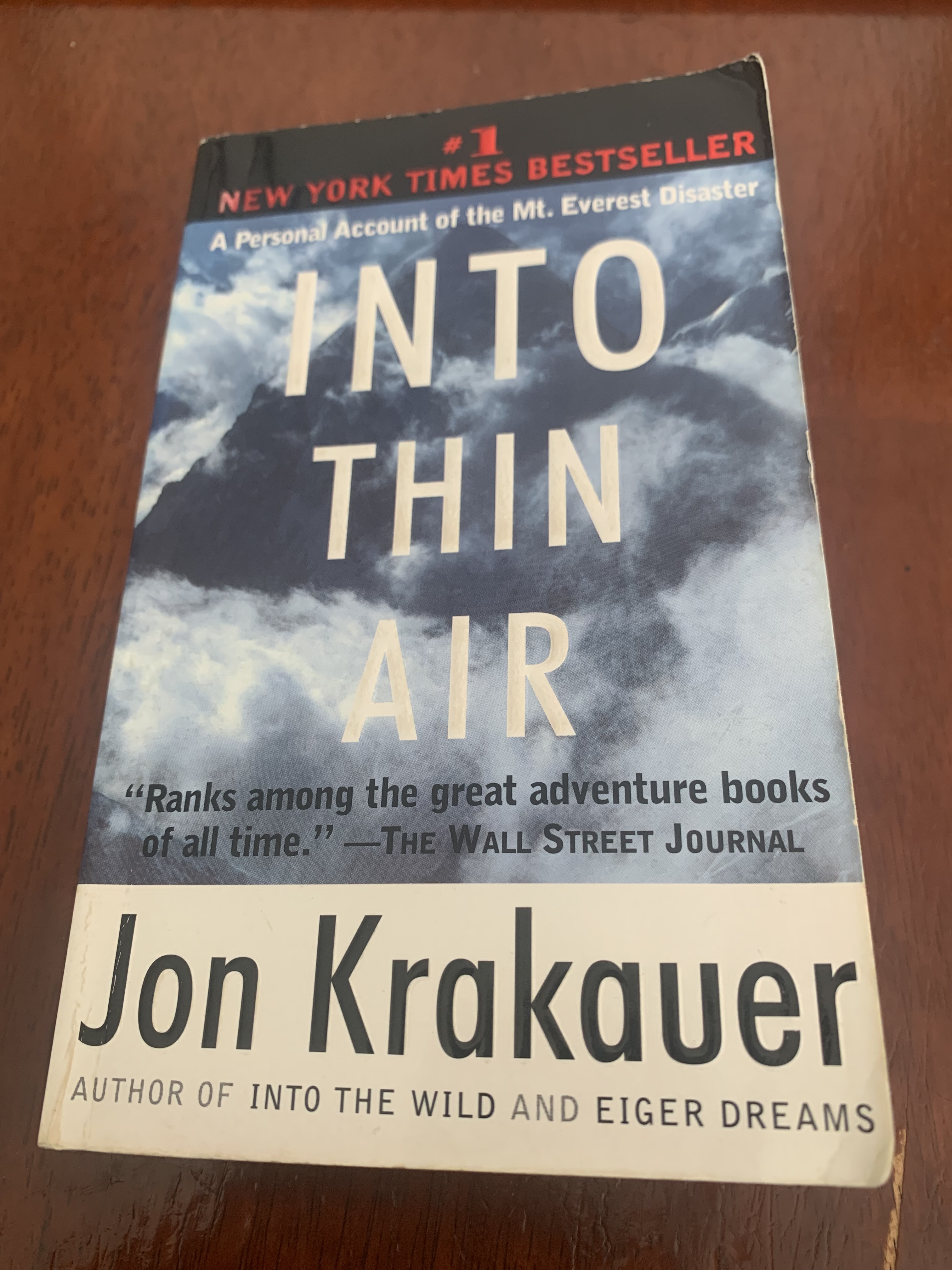
While skydiving (which I’ve done three times) or bungee jumping (which I will never do) may be best described as daredevil, hedonistic adrenaline rush acts, climbing Mount Everest is its antithesis. To climb Everest is an embrace of pain, endurance against one’s limitations, and flirtation with the grace, or lack thereof, proffered by the mountain and Mother Nature. And yet. People climb it. As the famed British alpinist, who was on the first three expeditions to climb Everest in the 1920s, George Leigh Mallory, said to a reporter when asked why he wanted to climb the mountain, “Because it is there.” Such is the impetus behind much exploration of the world around us, and some people’s unyielding curiosity with the parameters of our mortality. For to climb Everest is to court Death along the way. Whether an experienced mountaineer daring a solo climb without supplemental oxygen, or doing so as a commercial guide, or one of the generations of Sherpas, the Buddhist helpers who carry loads and run miles of rope lines, or the many foreigners, from dentists to physicians to rabble-rousing Texans, who pay thousands of dollars in the hopes of making it to the summit, I think there exists within all of us a desire to be tested — to know who we are under pressure in a way pressure has of revealing. Most of us will have that seed of desire covered over by the drudgeries of daily life and dreams deferred, but others will allow it to blossom until they’re at the top of the world, which itself is only half-way through the excursion. Adding a journalist to the mix sounds like a bad set-up for a joke, but there is actual deadly seriousness to doing so. The presence of a journalist, arguably, adds a certain level of aplomb to the climb; to succeed is to be in the annals of history, as written by a direct observer, so it is as well to have failed. Jon Krakauer grapples with his involvement in a Mount Everest expedition disaster and the daring of those who climb Mount Everest in his harrowing, unputdownable 1997 book, Into Thin Air: A Personal Account of the Mt. Everest Disaster.
Misery and pain abound, with horrific deleterious maladies on offer if something goes wrong, whether through human error (almost always human error) or your biology just … happens, or nature just … happens, up to and including death. Why would anyone subject themselves to this? Krakauer did and spent fleeting seconds at the summit, where he surmises you might as well be on the moon, if you needed rescuing. He made it to the summit, but was so delirious and exhausted and concerned about his oxygen levels, there was no time to bask in the glory of his childhood longing, merely a longing to breathe rich, thick air again. And yet. I find such profundity in that and yet. Humans are remarkable creatures who can push themselves beyond what seems conceivable and keep going. And some do it again and again, making multiple climbs to the summit. The climb is so unpredictable and so dangerous that people who suffer through all the misery and pain (and the cost!) sometimes need to turn around mere minutes and feet from the summit lest they risk certain death. As Krakauer states throughout his book, getting to the summit is one thing; it’s the descent that is the hardest. And when you’re talking about being 26,000-plus feet in the air (we regularly fly at heights tantamount to the peak of Everest!), with the thin air, crushing winds, below zero temperatures, and solar radiation, it strips away everything, any hedonism or ego, any desires or dreams, and you’re left with who you are at your core: someone who is going to take that next step or not. (Sometimes you will only because of what Krakauer called “summit fever.”)
Krakauer was offered by his longtime magazine editor to join an expedition to Everest; the impetus was more so to document the commercialization of Everest, as those who could afford the evermore exuberant price tag of $70,000 or more, flocked each climbing season to the mountain. This also led to pollution of the mountain (leftover oxygen canisters, for one). Multiple commercial expeditions competed at the same time for “clients,” like Krakauer. He joined Rob Hall’s expedition, the Adventure Consultants Guided Expedition. A New Zealander, Hall was an experienced climber, who was regimented in his approach and tightly controlled every nuance and variable as best he could to get his clients safely to the summit. That’s what’s rather extraordinary about these commercial enterprises, derided as they are by the purists. There are a lot of moving pieces to get nearly a dozen people up a mountain, most significantly being the oxygen canisters, rope and other gear, including tents for shelter, and of course, maintaining communication with Base Camp via (at the time) satellite phones and faxes. Indeed, what started as a story about the commercialization of Everest, I think, ultimately showed the expertise and brilliance of guys like Hall who were leading such expeditions and their dedication as guides to their clients. Notwithstanding, of course, what happened later.
In 1852, Everest was deemed by Bengali computer (his actual occupation, not the device, but fitting!) Radhanath Sikhdar to be 29,002 feet. Modern surveys with lasers and Doppler satellite transmissions changed the number upward by a mere 26 feet to 29,028 feet, or about 5.5 miles above sea level. Even more interesting to me is that it would still be another 101 years before someone reached the summit of Everest. I still can’t wrap my head around doing the climb without supplemental oxygen or the help of the Sherpas, but quite a number of people have, some multiple times. Particularly audacious to me are those who have done the Seven Summit circuit corresponding to the highest peaks on each of the seven continents. Amusing enough, some alpinists or mountaineer purists don’t even consider Everest the most challenging mountain because it’s the tallest. In other words, other mountains, like K2 (the second tallest mountain), are considered more technically challenging and thus, worthy of approbation more than the commercialized guided climbs of Everest. I don’t know, I’m going with the tall one here, owing to altitude and other climate concerns at that height. Anyhow, what I also didn’t realize, again owing to the altitude issue, is how long an investment climbing Mount Everest is, which is why the joke is, if you’re decently fit with disposable income and time to take off from work, you can conceivably make it with the help of a guide to the summit. A guided expedition takes two months, which includes the initial push to Base Camp. Base Camp alone seemed arduous to me at 17,598 feet up, or still 11,430 before the summit (more than two miles!). Next comes the rounds of acclimatization periods where Krakauer and his group would climb to various camps established higher up the mountain to adjust their bodies to the thin air (such that Base Camp’s air felt luxuriously thick). And then, the summit push itself dictated by unpredictable time and weather conditions, as well as by other expeditions and climbers, i.e., trying to avoid bottlenecking and creating hazards in the push.
As with any story, including harrowing climbs to the summit of Everest, where the competitive nature of the guided expeditions is belied by the shared human experience of climbing and trying to survive, there is always going to exist a human villain beyond the inherent obstacle of the mountain and Mother Nature (not villainous; they just are). Those two are givens. They are to be conquered, at their grace and whim. The human factor may be a given, too, but it’s an unfortunate one in such dire straits. In my humble estimation, Ian Woodall of the South African expedition is the villain of Krakauer’s story. Not only did he, a Brit, take advantage of South Africa’s newfound independence and pride to form an expedition to climb Everest funded by the Johannesburg Sunday Times, but when Hall and Scott Fischer (an American of the Mountain Madness Guided Expedition) coordinated how the push to the summit would go among the many expeditions on in early May 1996, Woodall wouldn’t coordinate, and when those in Krakauer’s expedition needed Woodall’s radio to communicate with Hall, who was in an emergency situation descending the summit, he refused. I also have a lot of blame leftover for the Taiwanese expedition, which was exceedingly inexperienced and stupid. Between Woodall’s stubbornness and the Taiwanese expedition’s inexperience, it created an untenable bottleneck in the push to the summit that portended disaster. Conversely to villainy, someone who stood out to me in Krakauer’s story as a hero was American Neal Beidleman, the third-in-command guide of Fischer’s expedition. I believe Krakauer credits him with saving five lives, and more to the point, he was helping to save the lives of people who weren’t technically his clients to “guide.” I was so impressed by his perseverance, endurance, and compassion.
Related to the emergency that befell Krakauer’s team and a few others, ultimately, it doesn’t matter how much experience you have on that mountain, and Hall and Fischer alone provided plenty of it, experience falls by the wayside at the behest of Everest and Mother Nature. Hall did make the human error of waiting for his American client Doug Hansen to reach the summit instead of turning him around (he had turned Doug around the year prior only 330 feet from the summit and then cajoled him to try it again in 1996, so, perhaps he felt pressure to ensure Doug reached it this time), to be fair, but when a hurricane-level blizzard pounded the mountain, a mountain teeming with exhausted, oxygen-deprived, sleep-deprived, disoriented men and women, it was bound to be deadly. The other human error one could identify was Lopsang Jangbu Sherpa’s actions, Fischer’s loyal climbing sirdar from Nepal. Out of perceived loyalty to Fischer, he wanted to ensure Sandy Hill Pittman, a famous American socialite documenting her experience, made it to the summit, so, he literally towed her up. That depleted his strength and oxygen. Perhaps if he hadn’t been so depleted, he may have been able to help when emergency struck the mountain since he was one of the strongest, most capable climbers there. While he would survive, Lopsang would unfortunately perish shortly after during another expedition on Everest.
A number of people turned back just before reaching the summit. What’s interesting is that Krakauer never reflects on this himself. In other words, his push to the summit is treated as a fait accompli. There was never any consideration to turning back. Repaired marriage to his wife Linda and all. His life at stake and all. He was one of the few of his expedition who ultimately made it to the summit. Again, with the descent, though, is where disaster loomed. Andy “Harold” Harris, also from New Zealand, was Hall’s second-in-command as a guide. Harris became evidently disoriented and in distress when descending the mountain (he thought the oxygen canisters were empty despite actually being full and miscommunicated as much to Hall), but it never occurred to Krakauer that the guide would need help. Because of that guide-client relationship, he reflected, he dismissed red flags that Harris needed help. Furthermore, he mistakenly thought he saw Harris return to the safety of the camp when in fact it had been someone else (Mike Groom, I think, of the same expedition). Harris was presumed dead thereafter. Krakauer made the misidentification mistake in his initial magazine article after the expedition, much to his own guilt and embarrassment and especially to the pain of Harris’ widower and family. It is particularly Harris’ death that most weighs upon Krakauer. But as one of his fellow climbers who survived told him, at those altitudes, everyone was doing their best to survive and help others, at least to the extent that it wouldn’t further endanger others in so helping. There is only so much any one individual could do under such conditions.
To give you an idea of what was happening more than 5 miles above sea level during the storm: 69 mile per hour winds (keep in mind, it’s blowing snow and ice at you; one of the climbers had his corneas lacerated and so many had hideously grotesque frostbite) and the wind chill created temperatures that felt like 70 degrees below Fahrenheit. And again, oxygen issues presented themselves, too, in the form of hypoxia, where the body is not getting enough oxygen. Everyone was dealing with various maladies and conditions even before the summit push, much less dealing with the weather thereafter. Krakauer, for instance, likely had two cracked ribs from a nagging cough and could barely breathe without pain.
The human body has an innate, evolutionarily optimized desire to survive. It is extraordinary what the human body can be put through and still survive. No better example of that exists in this story than Dr. Seaborn Beck Weathers, the aforementioned rabble-rousing Texan, who Krakauer initially didn’t like, comparing him to Rush Limbaugh, but who he came to respect for his tenacity and stoicism. Because of a preexisting condition, at some point during the push to the summit, Beck became virtually blind, having to mirror the steps of others to continue moving up. When the storm comes in earnest, Beck, along with Yasuko Namba, who would have been the oldest Japanese woman to reach the summit, were left for dead. It was determined to be too risky to mount a rescue operation. Miraculously, though, through a night in those conditions I previously described and quite literally layers of ice on their exposed faces, both Beck and Namba were still alive. So, when I said they were left for dead to succumb to the conditions, I meant that literally. More remarkable still is that Beck, who had a terribly frostbitten hand and went into a comatose state at one point, eventually came back to consciousness and managed to stumble his way into the camp. What the hell. Somehow, still more remarkable is that nobody thought he would survive through morning. Another windy storm hit destroying his tent and because of the wind, nobody could hear his cries for help until Krakauer happened to stick his head in. Krakauer didn’t think Beck would survive through the morning thereafter. He did and Beck, along with “Makalu” Gau Ming-Ho, I believe, the leader of the Taiwanese expedition, would be helicoptered out to the nearest hospital (after a rather daring helicopter landing, twice, no less at the insistence of the U.S. Embassy in Nepal). Beck’s arm, nose, and such would be amputated because of the frostbite, but he survived. Just remarkable, to say the least.
Overall, 12 people died on May 10-May 11, 1996, I think five from Krakauer’s expedition alone. At the time, it was the deadliest accident on Everest since people started climbing it 75 years previously. (Two avalanches in 2014 and 2015 surpassed this death toll, with 22 deaths and 16 deaths, respectively.) Krakauer, as a journalist and as a human dealing with the weight of what he experienced — he never attended a funeral prior to this, much less felt directly responsible for someone’s death in Harris — argued this was a story that needed to be told and needed the space a book could afford as opposed to a feature length magazine article. Moreover, he argued, much to the chagrin of those advising him, it was necessary to write the book while the events of the Everest climb were still potent in his mind without the benefit of time and distance. Indeed, because of its close proximity to the peril on Everest and Krakauer’s clearly raw emotions about it, Into Thin Air is all the more better for it. Unnerving, horrific, but also profoundly moving and beautiful in unexpected ways as a testament to the human spirit and human camaraderie, Into Thin Air is among the best nonfiction books I’ve ever read. Krakauer is an expert storyteller, who conveys the far reaches of human endurance and idealism, which is why he captured that essence so well here and in his other famous book, 1996’s Into the Wild. The wilderness, Mother Nature, is where idealism and romanticism go to die, however, whether one technically survives or not.

 Milam's Musings
3 thoughts