
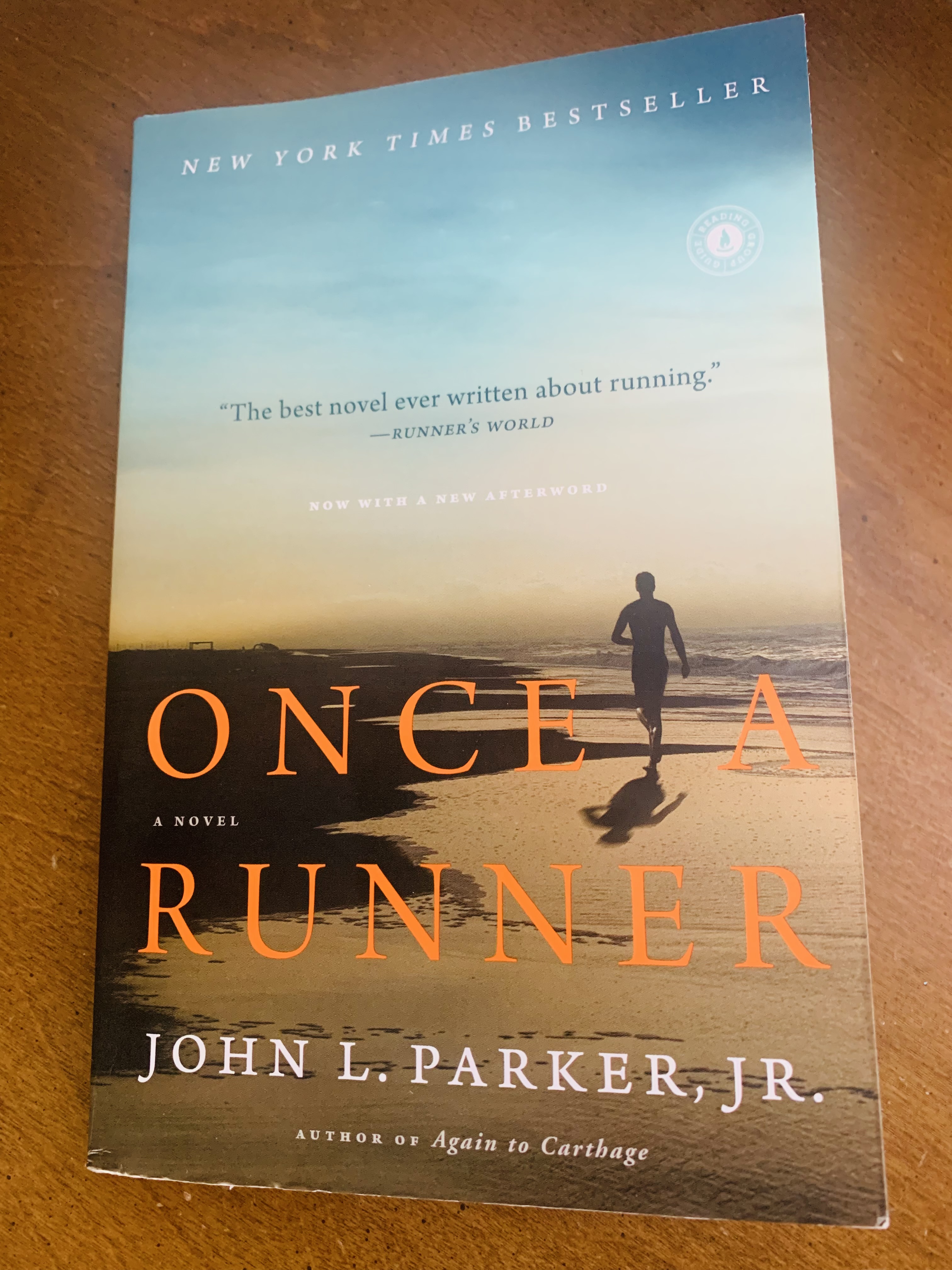
There is no secret to why runners run. At least, not anything that would make discernible sense to those of us (me included) who do not run. Yes, there are the usual responses bandied about, if flippantly out of exasperation with the question, such as personal and/or team glory, therapeutic and health benefits, and attaining a closer connection with nature (unless you’re an indoor’er, I suppose). But none of those suffice to explain why someone would willingly run five, or 20 miles a day. For fun, or sport. While reading John Parker, Jr.’s 1978 book, Once a Runner, I thought back to Jon Krakauer’s 1997 book, Into the Thin Air about those who climb Mount Everest, and the flippant reason an acclaimed climber gave for why they would climb it: because it’s there. Of course, there is nothing there for a runner in that way, but the open air in which to move, but it amounts to the same justification fundamentally. Because. That still fails to suffice or rationalize it. If you wanted to peel back further, I think some people relish the notion of pushing themselves to the precipice of what they can physically and mentally withstand, and then going that extra step just to see. Parker, a champion collegiate runner, who was also the editorial director of Running Times magazine, wrote this fictional tale of running for a classic reason: because it was a book he wanted to read and it didn’t yet exist. He brings a certain je ne sais quoi to the effort — humor, whimsy, philosophical meditations, and indeed, a Thoreauvian ardor and hardscrabble sheen to running’s solitude and solidarity in equal measure. In other words, as someone who doesn’t run, Parker’s running book, nonetheless, evoked that abyss-seeking-and-seeing yearning in me, that connection with our basest physical and mental abilities, and the kick, that sense that there is always one more gear left in us. Somehow both aspirational and deeply nostalgic (for something I don’t do!) and melancholy, Once a Runner is a beautiful ode to one of the oldest sports in the world.
I am utterly fascinated by elite athletes, or those who are otherwise elite at their chosen thing. Someone who devotes every waking breath of determination, practice, training, and endurance to excelling at one very particular skill. To be among the absolute best in the world at it, if not the best. The makeup of such people is hard to conceptualize: how they can be so driven to compliment their standout talent. In Parker’s book, the fictional Quenton Cassidy, who attends Southeastern University in northern Florida in the 1970s, is one such person. He wants to be a great racer and more specifically, to beat the fictionalized John Walton, who seems modeled after the real life New Zealander John Walker, the first man to run the mile under 3:50 in 1975. Walton is coming to Southeastern University, so Bruce Denton, a gold medalist Olympian in racing, takes Cassidy under his wing to train him. What intrigued me about the grueling training is that for months on end, Cassidy secluded at Denton’s cabin in the woods in that aforementioned Thoreauvian way, ran 20 miles a day, every day. He did the stomach-churning, knee-weakening interval training, where Denton requested a set of 20. Then, another. And then another upon which Cassidy collapsed into bed, only to arise in the middle of the night to pass bloody urine. It reminded of the depiction of the journey to elite status in the 2014 film Whiplash. The point, though, is, I would have assumed the training would be different for running the mile. To my untrained, ignorant eye, that sounds like training for a marathon or an ultra marathon. Wouldn’t training for the mile be more focused on speed rather than endurance? But later, from how Cassidy describes what the four laps around the track are for the mile, it does seem like endurance is everything. Endurance gets you through the two middle laps after the euphoria of the first lap and then ensure you’re able to finish in the fourth lap. It’s that endurance training that allows for the “kick” at the end, which is that last little bit in the oxygen reserves that allows you to finish strong at the end of a race and often means the difference between first and second place. (An aside, but what about the start?! When we’re talking about tenths of a second determining the outcome of a race, how do you train to have a good start in terms of reacting to the start and getting off the marker?)
But I mostly jumped to the end. The reason Cassidy is training out in a cabin instead of with his teammates at Southeastern University is because he was suspended from the school for daring to start a petition against the athletic director, who was trying to curtail long hair and “inappropriate” dress. The president of the university is a curmudgeon, with an inflated sense of grandeur. He was previously a Florida Supreme Court Justice who successfully fought against admitting Black students into the law program at Southeastern University. These are the sociopolitical elements of Parker’s milieu he infuses into the book. So, while Cassidy is running for something, he’s also necessarily having to run against the establishment, or rather, outside the bounds of the establishment. Indeed, though, there is also the fun and whimsy I mentioned, with Cassidy a prankster with his teammates, particularly people new to the team, who enjoys a libation at times, too. He even had a girlfriend, Andrea, but it fizzled out quickly because she knew, and he was quite upfront about, the fact that racing was number one in his world and anyone or anything, including Andrea, would be number two. That’s the other side of elite athletes or elite anythings: often they sacrifice the personal accouterments in favor of a higher calling, for lack of a better phrase. While that is still very much personal, it’s in a different way than most people operate.
Running is such an interesting sport, too, because of those tenths of a second, those inches. Cassidy literally trained for months for a race that’ll take less than four minutes and to hopefully be tenths of a second better than someone else. How do you possibly train and will yourself an extra tenth of a second or more better than the next person? Cassidy tries to explain, “He sought to conquer the physical limitations placed upon him by a three-dimensional world (and if Time is the fourth dimension, that too was his province). If he could conquer the weakness, the cowardice in himself, he would not worry about the rest; it would come.” In other words, to get that tenth of a second better, you gotta do it. You gotta run. Every day, even when you don’t feel like running. That’s how he’ll transcend the “health nuts,” and “Zen runners” and the joggers and those connecting to nature. Running not because it’s altogether enjoyable, at least in the parts that constitute the whole, but because it was necessary. Again, though, to be clear, Cassidy is a competitive runner. As he later noted shortly after the passage I just quoted, he was willing to die to win and was unimpressed with those who “disavowed such a base motivation.” “You are not allowed to renounce that which you never possessed, he thought.” Running was freedom because once you get down to the basest elements, i.e., the willingness to die for something, in that way, you’ve also become more free than anyone else. You’ve become someone unchained by that which constrains most. That’s how Cassidy saw it, at least.
Parker brings his considerable talents and aplomb for writing about that which he loved (running) to bear on the race between Cassidy and Walton (and six others). Everyone’s taking their marks, with Cassidy describing his heart ready to leap out through his thin taut skin. Parker states, “They were poised there on the edge of some howling vortex they had run ten thousand miles to get to. Now they had to run one more.” It’s utter madness, ephemeral in the most tangible way, and yet, because of that, also unceasingly beautiful. The beauty of that madness outruns the race itself, which is where the nostalgia and melancholy come in. After all, Parker bookends the book with Cassidy only 26 years of age, mind you, wistfully admiring the track one more time, his glory days long behind him (he couldn’t transcend Time after all). But anyway, back at the markers. Walton seemed to be easily running ahead of everyone, including Cassidy, but he “kicked” too soon, 500 yards out. That allowed Cassidy to best him in a heart-pounding, intense climax to the book. I was almost teary-eyed! It was like reaching the crescendo in Whiplash. All that elite devotion paid off, consequences otherwise be damned.
For runners of all kinds, competitive or not, Parker’s book has to be considered a must-read. Surely, they will relate to Cassidy’s journey in only the way a runner could. But also, for non-runners, again, such as myself, Parker’s book was a delightful, pulse-pounding lap around the mind of a runner. And in the end, Parker did the kick exceptionally well for us.

 Milam's Musings