
Spoilers!
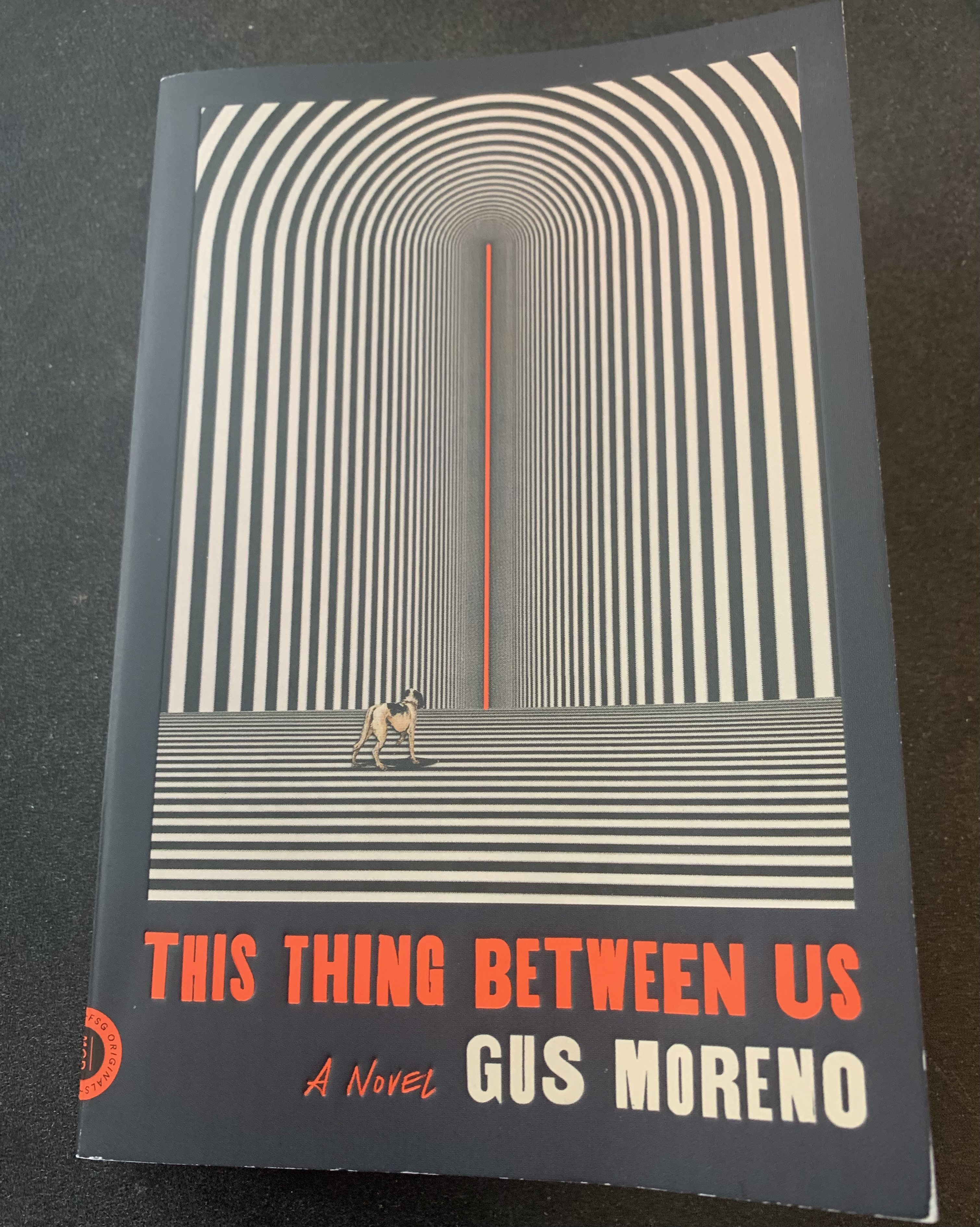
Grief is sitting in your house feeling like the loved one gone is still there, but unreachable. Grief is wanting to tear down the “wallpaper of your brain” because it’s incongruous to the new reality. Grief is learning how to call heaven hell. Grief becomes “this thing between us” when death occurs. These are the concepts Gus Moreno presents to deal with his own grief, albeit in a techno-supernatural, gory way, in his debut 2021 book, This Thing Between Us.
Thiago is the worst kind of Mexican according to his family, friends, and especially his mother-in-law, Diane: one who can’t speak Spanish. A further mark against him with her is his family being screw-ups and criminals. Also, his job is with Lyft and similar apps. But she reasons, her daughter, Vera, who can speak Spanish, is old enough to make and learn from her mistakes. Oof. This Thing Between Us is told from the perspective of Thiago writing to Vera about everything that unfolded after her unexpected, tragic death. So, second-person point-of-view, but instead of the “you” being the reader, it’s Vera. She was killed when a local would-be gang member robbed someone at the train station and in his attempt to flee, accidentally knocked Vera down the stairs resulting in her death. Thiago and Diane, then, are trying to deal with their grief, and grief is very individualized in the way people navigate within it. Diane wants to be “in it,” as it were, to not lose her connection to her daughter, whereas Thiago, using Diane’s life insurance payout, decides to move to a remote cabin in Colorado to escape his grief. Of course, our “baggage” comes with us when we travel or move, and grief most certainly does as well. But he reasons, at least he’s away from people ostensibly close to Vera who are waiting for him to “move on,” as if that is a real option or outcome of one’s grief journey.
We learn that Vera and Thiago brought Itza into their condo, which is an Alexa-like device that can help with all manner of daily life’s machinations. According to a brief Google search, Itza can mean “shadow,” representing mystery and depth, and indeed, having such a device in your home can be like having an extra shadow. In the case of Vera and Thiago, their Itza becomes a nefarious shadow because it operates when it ought not to be, along with other ghost-like occurrences. In fact, the inciting incident that led, if you want to suggest as much, to Vera’s death is that Thiago set the alarm on the Itza for Vera to wake up for work. The alarm didn’t go off. She was late and instead of taking Thiago up on his offer to drive her, she decided to take the train. Thiago smashes the device, which he believes may have contained a demonic spirit, as ludicrous as such a notion seemed to him.
In Colorado, Thiago comes across an affable, homeless Saint Bernard he names Wilford Brimley, owing to its appearance. I bought the book because of the gorgeous cover featuring a dog (I don’t read the synopsis of any book, as I prefer to go in blind, so, the covers make a difference!); I’m always down for a main character and his dog solving a mystery! Turns out, Moreno is a cruel, daring author because Brimley is killed by a cyanide explosion less than a week into his budding relationship with Thiago. Apparently, farmers use such devices against livestock prey. It’s an effective plot point though for two reasons. First, it only deepens Thiago’s grief, and secondly, it’s how the supernatural elements of the book intensify. Prior to his death, Brimley and Thiago happened upon a mysterious Stonehenge-like wall in the forest beyond the property. After Brimley’s death, the wall not only moves closer to the property where Thiago buried Brimley, but Brimley is “resurrected” by the wall. When Thiago doesn’t embrace this “Not-Brimley,” the Not-Brimley turns violent and nearly kills Thiago. Diane showed up to visit Thiago just in time to help him escape and seek medical assistance. There is an evil spirit, a demon, who seeks to be “pulled from the wall,” the “flux” area between the living and the dead. This demon kills the local veterinarian, who then tries to attack Thiago and Diane. For what it’s worth, Diane is all in on fighting back against the evil spirits with Mexican rituals; she even calls up all her friends and family from Mexico for ritual assistance. Unfortunately, Diane is the latest person to be folded into Thiago’s unyielding grief after the veterinarian attacks. Two moments in Moreno’s book gave me chills and made me flinch. First, the demon initially seemed stymied by the salt Diane placed outside the door to the cabin. The demon swipes it away with a smirk. When you see that happen, you know all hope is lost. Second, as I alluded to earlier, Diane and the demon have this exchange:
“Claim your seat at the banquet.”
“What’s that?” Diane said.
“Where Vera resides. Where they all reside, and the sound of their mewling carries to the shore.”
“Vera’s in heaven,” your mom said.
“You will learn to call it that.”
Oof, horrific and haunting. What a line. Shortly after, she was sucked into the void of this demon and killed. Thiago was nearly killed, too, before local police showed up and shot it.
At the end of the book, Thiago plans to kill himself. It’s the only escape he can see from his unyielding grief and its stand-in, the unyielding demon. I’ll be dead, but the cook [another stand-in for the demon, hence “the banquet” metaphor as well] will lose. He sees only the darkness capable of washing away his grief, hurt, and pain.
What a beautifully macabre, haunting, creepy debut book. Death felt like an inevitability here, and indeed, for Thiago, it was. Short of being the end, Thiago saw it as beginning anew extricated from grief’s maw. I hope in writing this book, Moreno found comfort and an outlet for his real-life grief with the loss of Carol. In his Acknowledgements, Moreno presents this lovely sentiment, counter to what we normally hear, “May we never do you justice. May there always be more to say.” I sure hope Moreno has much more to say after this stunning, unforgettable debut.

 Milam's Musings
One thought