
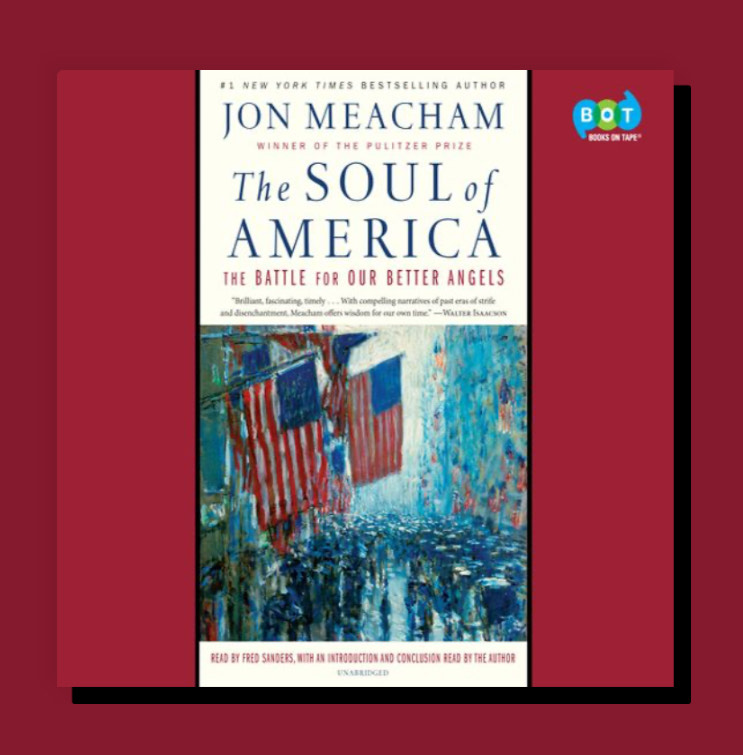
Even when the “better angels of our nature” are besieged, seemingly with a bleak outlook, America is worth fighting for. As a country founded on the idea of freedom and representative government, as opposed to blood and soil, the Constitution, the Bill of Rights specifically, and the Declaration of Independence are our “sacred scripture.” Thomas Jefferson meant “happiness” in the “pursuit of happiness” to mean public happiness that justified the existence of the government; it was the first time a government was centered around us, the public, rather than the governors. It is also in such documents, espousing the ideas of our birth, that enabled those denied and deferred from such ideas and the dreams the means by which to secure their liberties and their rights. It was the harkening back to those scriptures that encouraged people to turn to the better angles of their nature. Not without struggle, consternation, and death, to be sure, but it happened. History is a balm in that way against the cynicism of the age, to think that this Donald Trump moment of the past 10 years and counting is the beginning of the epitaph for America. That it’s the first step into the grave of our 250-year experiment in democratic rule. Indeed, I sometimes bristle at that which feels unprecedented even in our history, and yet. Nothing is inevitable and certainly, no political “victories” or “movements” are final. Esteemed historian Jon Meacham rouses the indomitable spirit foundational to America in his 2018 book, The Soul of America: The Battle for Our Better Angels. Obviously, Meacham is writing the book after the first election of Trump to the presidency, where many people began to wonder if America was turning its back on progress in myriad ways, domestically and abroad. Worse still, as our elected leaders are reflective of the people who hold the ultimate power and will, people wondered what had happened to the character, or the soul, of the American people to reflect the worst version of ourselves in Trump. In that context, it may seem hokey or corny or perhaps naive to write about turning to the “better angels of our nature” in the MAGA Era. The angels are losing. The second successful election may have been even more demoralizing after Jan. 6 and so much else. But as Superman reminds us, kindness and earnestness are the new punk rock, and Meacham is one such earnest soul.
There is all manner of prefacing I could do about the presidency and focusing on the presidency (as Meacham also does), but the way our system of government is constituted now, all the power and focus is on the presidency; ergo, it made sense for Meacham’s The Soul of America to orient its lens on the American presidency through triumph and tumult. Meacham’s starting point is that because the presidency holds such vast power and status in our system, the presidency isn’t just an administrative or engineering job; it is “preeminently a place of great moral leadership.” The greatest presidents had clarity of thought about our ideals when it was most needed. Meacham argued that the burden of the presidency “opens up his soul.” For 44 of the men who have served as president, I believe that to be true. Which is to say, every person who has occupied the presidency, except for Trump, have been cowed by its awesome power and responsibility. They have bowed before the stature of the office itself. Humbled by it. Insecure, narcissistic, incapable, incompetent, awful men have occupied the office, but I think they still understood their positioning in relation to it. Richard Nixon resigned, ultimately. On the other hand, much to the chagrin of the chattering class who assumed it would be the case, Trump and his character and disposition was not at all humbled or cowed by the presidency. If anything, it only accentuated Trump’s worse traits and shielded him from accountability for those defects. Again, this is where I sometimes fall into the despair of the “unprecedented.” For all that one can say about past presidents — and there is much one can — Trump is aberrantly unfit for, and lacks understanding of, the presidency. Trump simply goes against everything we ostensibly believed previously (again, just 10 years ago even!) made a great president: temperament, high moral character, less is more (less theatrics), speaking for the whole country rather than being the president of only those who voted for him, empathy, and putting down threats to the country (instead, he fomented one!). And yet, he won … twice. How does one grapple with that and what it says about our character and soul as Americans and as America? We are the state and the state is us. But let’s continue on back through history. It is through history, Meacham rightly implied, where we find solace of a kind.
The complexity of history:
- The American Civil War, where 11 states seceded from the Union to form the Confederacy with the express, stated goal of protecting the institution of slavery (from Alexander Stephens’ “Cornerstone Speech”: “Our new government[‘s]…foundations are laid, its cornerstone rests upon the great truth, that the negro is not equal to the white man; that slavery—subordination to the superior race—is his natural and normal condition. This, our new government, is the first, in the history of the world, based upon this great physical, philosophical, and moral truth.”). They were willing to fight and die for the institution of slavery. To such an extent, in fact, that in 1866, Mississippi was earmarking 20 percent of its budget to wooden limbs. But even before the ashes had settled on that conflict, the Lost Cause narrative was taken up by those who perpetrated the Civil War, including Jefferson Davis, the President of the Confederate States. His argument that the Confederacy fought for “state’s rights,” is abhorrent. One must ask, a state’s right to do what exactly? Then, there were the fawning Robert E. Lee obituaries, and of course, he’s still venerated in our time. Frederick Douglass was perturbed, too, and wrote, “It seems a soldier who killed the most people even for an awful cause is the best Christian.” Oof, but accurate.
- The first iteration of the Ku Klux Klan was formed by six “bored” Confederate veterans in a law office. A law office. Fortunately, Ulysses S. Grant put down the KKK.
- All this to say, the country devolved into a Civil War, and then thereafter, already began myth-making about its origins, and essentially, the “losers” won, nevertheless, for the next 100 years in the form of Jim Crow, black codes, and repeated terror campaigns via the KKK. With that context, it’s difficult to imagine our moment being the one where this grand experiment ends, that it is our moment where we cannot come out the other side having turned a positive corner. Because yes, everything I mentioned was bad, but also, the Union won the war, slavery ended, and a second American founding occurred with the Reconstruction Amendments. All of that mattered. That is the story of America.
- At the turn of the 20th century, Theodore Roosevelt was a president who championed progressive causes, but you also take that with the bad of the rise in eugenics and trying to attach a scientific basis to racial superiority. Meacham said Roosevelt was a “white Anglo-Saxon expansionist.” Which is to say, he worried about “race suicide,” if whites didn’t procreate more. Sound familiar?
- Woodrow Wilson is regularly recognized as one of the most virulently racist presidents we’ve ever had. It was not only under his presidency where the infamous 1915 film, Birth of a Nation, was screened at the White House (to be fair, he did try to distance himself from it), but the KKK saw its second resurgence. Could you imagine living in an America where every state has a contingency of KKK members? Where KKK members held 11 governorships, 16 Senate seats (16!), and had 75 House members? That was America by 1923. Even at the 1924 Democratic National Convention, there was a fight among the delegates about whether to include within the Party’s plank a denunciation of the KKK. There were 300 delegates with allegiance to the KKK. The plank failed. In history, we find solace.
- The KKK brought with it not just terrorism against Blacks, Jews, and Catholics (effectively they were living in a totalitarian state), but the KKK was anti-intellectual, too. They were “opposed to the sweep of modernity.” Again, sound familiar? The propagators of such ideas may change, but the ideas themselves are quite recycled. Optimistically, the KKK died out that go-around because of enough institutional pushback. Meacham mentioned the repetition from journalists: they kept repeating over and over again what was wrong with the KKK. I think that’s useful today, especially as young voters come into the political arena who may not have heard any number of factual reports about Trump from 10 years ago.
- Another notable negative Woodrow Wilson item is the first World War domestic dynamic. Eugene Debs, a frequent presidential candidate for the Socialist Party of America, was tried, convicted, and sentenced to 10 years in prison for merely speaking out against the war. Could you imagine that today? I know Trump’s rhetoric on the First Amendment is atrocious and he’s tried to wield the power of the state against his enemies, but an actual prison sentence for clearly protected First Amendment speech? That was then upheld by the Supreme Court of the United States? Feels unfathomable now. (President Harding at least commuted Debs’ sentence.)
- The United States Post Office got in on the censorious act, too, helping to censor more than 400 publications writing against the war.
- But then Wilson is also the president who helped usher in the 19th Amendment granting women the right to vote. That is the story of America. It’s … complicated.
- Calvin Coolidge is a great microcosm of the American soul and character torn asunder. Meacham provided this great quote from Coolidge, “Whether one traces their Americanism 300 years back to the Mayflower or three years ago, what matters is present Americanism.” Again, that’s what makes America so great is that anyone from anywhere can be an American. Yet, Coolidge also signed into law the very restrictive Immigration Act of 1924.
- Meacham argued that the 1920s and the 1930s were a huge test for whether the American people, like many people the world over, would give up democracy and give into totalitarianism. With the Great Depression as a stress point, where one out of every five people was unemployed, it’s rather remarkable America didn’t fall into fascism. I think Meacham largely credited the steady hand and high moral character of President Franklin D. Roosevelt with ensuring we didn’t devolve. He quoted FDR as saying, “Americans would rather die on their feet than live on their knees.” I sure hope such a sentiment remains true.
- Of course, that doesn’t mean those years were easy, though. You had Charles Lindbergh and his America First movement. I wrote more about that in my review of, Those Angry Days here. America First sounds familiar, huh?
- In something I hadn’t heard before, Wall Street businessmen plotted a coup against FDR in 1934. General Smedley Butler, who the businessmen tried to recruit to lead the violent coup and become dictator thereafter, vehemently rejected such overtures. He was a hero in manner and character. I need a Smedley Butler film, please and thank you.
- Huey Long, the former United States Senator at the time, who is a decent analog to Trump. He appealed to low-information voters and the fearful middle class. He was flamboyant. And his detractors said to challenge him was like “challenging a buzzsaw.”
- People in the 1930s worried that Americans were susceptible to suggestion and there were too many media tools available in which to achieve nefarious ends. Again, that sounds familiar, with the way people worry about the levers of social media being used to steer suggestible Americans.
- Like with every president Meacham highlighted, FDR is not without blemish. His worst (in no particular order) are the internment of Japanese Americans during WWII (which the Supreme Court also upheld); his lack of attentiveness and more pressing concern for Jewish refugees fleeing the Holocaust; and his lackadaisical attitude toward civil rights for Black Americans. What’s interesting, Meacham mentioned how in 1988, President Ronald Reagan signed a bill providing reparations for those interned and formally apologizing. That sort of conservativism is dead.
- President Harry S. Truman was personally racist and came from a Southern heritage where they venerated Robert E. Lee. However, he was moved after WWII soldiers, upon returning stateside and were beaten, to integrate the armed forces. Truman said, “I’m everybody’s president.” When a woman challenged him on integration, Truman began to read from the Bill of Rights and encouraged all Americans to read it more often. Incredible.
- The 1950s is perhaps the biggest echo to now. Coming off of WWII, America was unfathomably wealthy, relatively unscathed compared to peer countries, and though issues, like civil rights, lingered and the Korean War was around the corner, it was a time of peace. And yet. It’s also a time that saw the rise of McCarthyism at the beginning of the decade thanks to Joseph McCarthy. He generated an unfounded, far-reaching fear of communism and communist infiltrators and influence in the United States, from government to business to entertainment to private homes.
- This time was so wild that the creator of sugar daddy candy (and “tar babies” candy), Robert Welch, accused President Dwight Eisenhower of being a communist. Eisenhower! Welch would go on to found the John Birch Society, a far-right advocacy group (which later would face the internal institutional pushback, as the telling goes, when the towering conservative figure, William F. Buckley, forced them to the margins, i.e., was a gatekeeper).
- There was pushback, though, against McCarthyism.
- Republican Senator Margaret Smith (the first woman to serve in both houses of Congress) argued against McCarthy, saying his path was a way toward national suicide.
- There was of course, the famous, “Have you no decency, sir?!” line from, interestingly, a different Welch, Joseph Welch, a lawyer representing the U.S. Army, directed at McCarthy.
- Edward R. Murrow, the legendary broadcaster, did something that would be anathema to current media: He said McCarthyism was made possible because of the American people. He was right.
- Even Eisenhower, in his way, addressed it in a speech Meacham believed should hold as much esteem as Eisenhower’s Farewell Address in 1961, when in 1954, he argued against fear: “I don’t mean to say, and no one can say to you, that there are no dangers. Of course there are risks, if we are not vigilant. But we do not have to be hysterical. We can be vigilant. We can be Americans.”
- People also argued that McCarthy was hurting our prestige abroad, again, with echoes of Trump criticism today.
- McCarthy’s ultimate downfall was that a “person could not remain at the center of public life and controversy indefinitely.” Or as Meacham quotes the Bible, “To everything there is a season.” Certainly, I’m waiting for Trump’s because he absolutely defines being at the center of public life and controversy for 10 years and counting.
- The reason I compared our present time to the 1950s is that in our present time, the first Trump term came when the American economy was doing well, crime was way down, and so on, and yet, Trump won on a fear-based platform of needing to “make America great again.”
- It must be said there is also a direct throughline, somehow, from McCarthy to Trump: Roy Cohn, McCarthy’s chief counsel, then later became the “fixer” who helped Trump in his real estate days.
- The reason I compared our present time to the 1950s is that in our present time, the first Trump term came when the American economy was doing well, crime was way down, and so on, and yet, Trump won on a fear-based platform of needing to “make America great again.”
- George Wallace, the former governor of Alabama, who ran for president in 1968. Perhaps his most infamous quote came from his 1963 inaugural address as Governor, saying, “In the name of the greatest people that have ever trod this earth, I draw the line in the dust and toss the gauntlet before the feet of tyranny, and I say segregation now, segregation tomorrow, segregation forever.” There are people alive today who were alive for Wallace’s speech and old enough to understand it. We are an incredibly young country, which is yet another sliver of solace.
- President Lyndon B. Johnson, who signed the Civil Rights Act of 1964 and the Voting Rights Act of 1965, did so as a Southerner, who had to actively rally his former colleagues in Congress to support the measures. One of the great quotes from Johnson Meacham leaned on was Johnson addressing how it may be difficult for people to embrace the future, a future that included Black people with full rights and equal protection under the law. But that the old ways had to crumble, “and crumble it must.” I wish we had leaders who talked as clear-eyed as Eisenhower and Johnson today.
Meacham talked about the “moral utility of history,” and the moral utility of history is to provide lessons for those of us in the present. After all, again, quoting Truman, “the people are responsible for the government they get.”
Some of the lessons and advice Meacham provided:
- You have to get into the political arena, as it were, which could mean running for office (and goodness knows we need as many people of good character doing so!), but mostly he meant voting, having opinions, and being engaged on the issues. I think an unfortunate contingent of people have given into nihilism in the Trump age. That nothing matters, or that the downfall of America is fait accompli. I am not willing to preemptively acquiesce in such a manner.
- Americans are naturally a rebellious people from our foundation through to the present moment. And the people have absolutely been rebelling in large numbers against the second Trump administration. I participated in one such #NoKings rebellion.
- Resist tribalism. This has been a clarion call since the founding, and of course, far too many Americans fall prey to it.
- Use facts and reason; there is a discernible reality. Unfortunately, the most powerful man in the world lives in his own alternate reality, which is then buttressed by myriad media sycophants and taken as Gospel by his followers. But they aren’t the majority of people, merely perhaps now, only the loudest.
- The importance of a free press and how many presidents have not only recognized this, even when they’re frustrated by negative coverage, but they’ve embraced the press, often joining in on the jokes at their expense.
I’m not sure what Meacham would say about the soul of America, or the character of Americans, who elected Trump a second time. That is, they not only saw everything about that man in 2016 and elected him as president, but they saw the way he was as president through COVID-19 and through his refusal to accept the results of the 2020 Presidential Election and the fruits of that refusal with Jan. 6, to name two prominent examples, and still elected him again. But using this book as a guide, I think Meacham would say, the American story is still being written, is still unfolding, and while the “better angels of our nature” may be battered and beaten down, they’re not out of the fight yet. As long as Americans of good will and good character are still here, it’s always possible for the “better angels of our nature” to overcome and win the day. To believe otherwise is to give up on America, which I don’t see an option at all. Thank you, Meacham, for the rousing reminder.

 Milam's Musings