
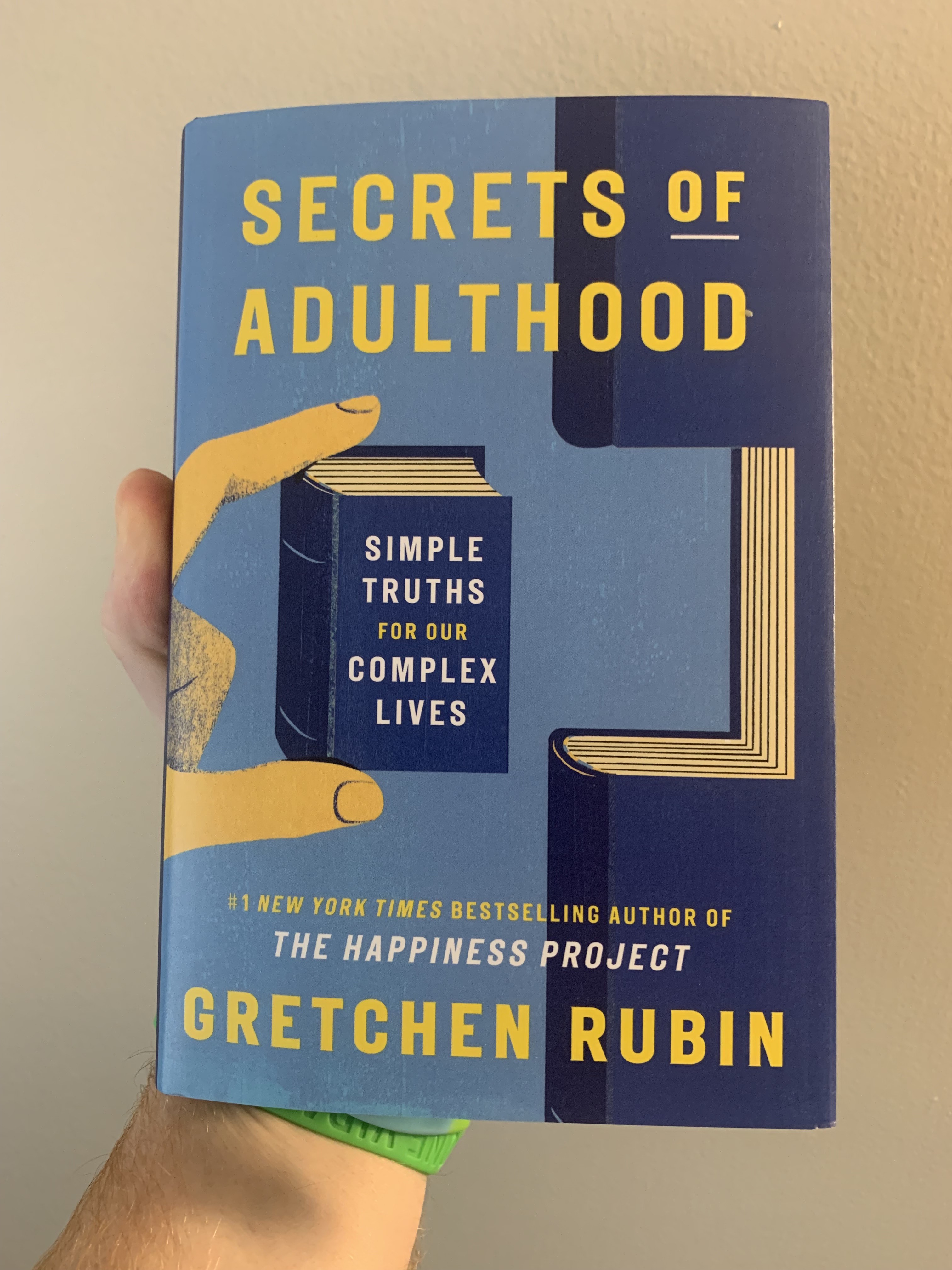
For as long as humans have been communicating with each other, we’ve probably also been trying to communicate the inner turmoil we go through in trying to live what Aristotle and other philosophers have called the good life. Contemporarily, that communication can get lost in the miasma and saturation of overindulgent, paper-thin self-help books (one of the few things I’m cynical about!). But I do love a profound aphorism, those pithy sentences that are far more layered and resonant than their size might indicate, and of course, contain a truth about how to live the good life, or at least, something approximating it. After all, there are gradations and variances in how one can live the good life or achieve the good life. Aphorisms manage to be a microcosm of that kaleidoscope of human experiences. Gretchen Rubin, who researches and writes about happiness, is out with a new book in 2025 called, Secrets of Adulthood, featuring a collection of her own aphorisms. She aimed to write a small book that planted these aphoristic seeds in our brains and perhaps, practical pithy tips for daily living. The constraint of brevity forces creativity and imagination, which also reflects our understanding of an idea; those who best understand an idea can summate it efficiently. The real magic in aphorisms, though, is how they reflect our commonality as humans; we realize we’re not alone in struggling to understand our position in life intimately and up to the vastness of life in the cosmos. That’s why I think Rubin collected her own aphorisms for decades. As I alluded to, also where necessary, Rubin added amusing anecdotes to accentuate the aphorism, the anecdote itself acts as a Trojan horse for the aphorism. You don’t realize the aphorism is coming until it’s there. I found the ones she used about The Beatles and Dustin Hoffman particularly laugh-out-loud funny. Finally, what makes Rubin’s book of aphorisms so delightful, is that you can finish it one lazy Sunday afternoon — the perfect kind of day for a profundity intake.
As one of Rubin’s aphorisms elucidates, “Selection matters. We can’t make sense of a textbook in which every sentence is underlined.” To underline everything is to say nothing matters; to repeat all the pithiness from Rubin’s book is to not give you an opportunity to experience them. Instead, I highlighted only a few that I’ll go over with my thoughts.
In the opening, Rubin says she doesn’t care much for looking at Andy Warhol’s art, but he has a great aphorism, “Nobody really looks at anything; it’s too hard.” The truth there is that to gaze upon anything, as it were, is to see the truth of the thing, and to be reminded of the pain (and happiness!) inherent to the human condition, or smaller truths, of course. Avoidance is easier than engagement.
One of my favorite quotes that I was wielding in the 10th grade (I weaved it into a poem read before the class), which is actually a proverb (the difference between those and an aphorism is the latter typically have an author associated with them), goes, “The path to hell is paved with good intentions.” Ruth provides a similar concept with the aphorism, “Good intentions mean nothing unless they inspire practical actions.” My amendment there in keeping with the proverb would be, Good intentions mean nothing unless they inspire good, practical actions. Perhaps that is redundant, as good intentions imply hoping for good results, but the proverb argues it’s not enough to hope. In other words, we like to think almost everyone has good intentions, but for it to matter, they need to consider and think through if the “doing” of the thing springing from good intentions will result in good actions.
“People don’t talk enough about how comforting work is.” [Rubin’s emphasis.] Obviously, there is a way in which leaning into this comfort can become a form of avoidance and escapism, i.e., unhealthy workaholism. However, work — and as Rubin reminds us, “work” doesn’t have to be work-work, as it could also be love-work, friendship-work, life-work, etc. — can be a source of comfort and a vital piece of the good life that is overlooked. It’s more common, and comforting one might say, to bemoan and dread work. The word work itself seems antithetical to comfort!
“We know if something is important to us if it shows up in our schedule, our spending, and our space.” Something I came to realize through my maturation both in how I interacted with others and how others interacted with me is this aphorism. We’re all busy; we all lead complex lives that demand much of us in many different directions. But if you want to include someone in your life, you will find the time, the money, and the space. To do otherwise is itself a “tell.”
One of Rubin’s funnier aphorisms was, “Much of the appeal of an ice-cream truck comes from the fact that we’re never sure when it will appear.” That was in her section about adventure and cultivating adventure. In that way, you could interpret her aphorism as encouraging us to create situations in which an ice-cream truck may be right around the corner. And embracing unpredictability instead of preplanning everything; adventure implies unpredictability.
And a gut-punch of an aphorism, “One day, now will be a long time ago.” [Rubin’s emphasis.] The unyielding passage of time, and a close companion aphorism to this one (The days are long, but the years are short) are always floating in my brain. Buddha would like this one, too, because there is something to be said for being present in the present because the present will one day be a long time ago indeed.
Let’s add another punchy aphorism (they’re all punchy), “Approval from the people we love and admire may be gratifying, but it’s not enough to be the foundation of a happy life.” So, I disagree with this one. I’ve never found approval from people I love and admire gratifying because I’m constantly doubting its authenticity via imposter syndrome and other insecurities. If a family member likes my writing, for example, it must only be because they’re family, not because the writing was actually good. While I do need to deal with the insecurities, it’s good to know that regardless, the foundation for a happy life is beyond the approbation of others.
Nearly every time I’m traffic, I think about this aphorism from Rubin (although, it’s most certainly not hers), “I admire nature, and I am also nature. I resent traffic, and I am also traffic.” The former is one of the most profound realizations you come to as you better understand the world and yourself and so much can flow from it. The latter is in a similar vein but relatable to everyday experience. I find it to be grounding in not being someone who engages in road rage and bemoans the traffic. I ought to not bemoan that which I am!
Rubin has a great section of aphorisms related to housekeeping and I live by this aphorism, “Don’t put things down, put them away.” An example is that I’m one of those travelers who will unpack right away (both at the destination and upon coming home). It’s one of those little things that makes life better and the good life more obtainable. On the other hand, this one I struggle with, “Someplace, keep an empty shelf; someplace, keep a junk drawer.” Yes, I have a junk drawer, but I do not have an empty drawer. The existence of its emptiness demands my filling it! To leave it empty would motivate me to remove the item harboring the emptiness altogether.
After reading Jon Krakauer’s book, Into Thin Air, about climbing Mt. Everest, this aphorism is spot-on, “Sometimes it takes more discipline to quit than to persist; mountain climbers regularly die in storms because they won’t turn back before reaching the summit.” It’s okay to know our limits and certainly, one ought to respect Mother Nature.
How about a fable? Everyone knows the fable of the Hare and the Tortoise racing. The Hare zooms off and overconfident, he naps. He wakes as the Tortoise crosses the finish line. Rubin pushes back against the usual takeaway from the fable that “slow and steady wins the race.” She argues a more fitting moral would be “those with great gifts can be defeated by their own arrogance and idleness.” She quotes Marie von Ebner-Eschenbach’s acerbic moral takeaway, which I found resonate: “Since it’s famous victory over the hare, the tortoise thinks it’s a sprinter.” Just as we forget we are traffic when we’re in traffic, we also forget how many external confluences, and luck, contribute to our successes rather than merely our own abilities. We over-index our abilities, which is not arrogance in the way of the hare, but ignorance.
After the one-two punch that was Superman and The Fantastic Four: First Steps, it’s the summer of kindness being the new punk rock, and in that way, this Rubin aphorism is apt, “Enthusiasm is a form of social courage.” Enthusiasm is sometimes ridiculed or discouraged because it’s cringe or even cynically thought to be inauthentic. But think about the last time you talked to someone you found out was as enthusiastic about something you were enthusiastic about; it’s one of life’s greatest thrills.
Yes, I regularly think about the passage of time and being traffic while in traffic, and I also think about the primary medical intervention for thousands of years was bloodletting. That intervention killed George Washington! Or at least, it certainly didn’t help his ailment. Wrongness has no expiration date, then. “We can be wrong for a very long time without noticing. Bloodletting was a common medical treatment for two millennia.” It makes you wonder what we’re getting very wrong in our own time?
The aphorism that most resonated with me in terms of self-reflection, though, was, “Solicitude, even when heartfelt, can be tiring.” I think the kids today are calling that “love bombing.” Although I reject the idea of trying to influence anyone with it; solicitude for me is more that I enjoy doing it than that I expect anything out of it. So, I struggle with this one! My love language is solicitude. I pride myself on showing compassion, attentiveness, and mindfulness for others. But Rubin is right, obviously. It can be tiring for others when it’s too much and not what they need in that moment. I’ll keep trying to learn how to more appropriately apply my solicitude.
At the end of her book, Rubin offers simple secrets for adulthood that can be applied to daily life. Another way of saying it is, these are her little “life hacks.” What’s funny is how opposite I am from this one, “If you’re dreading a family occasion, bring a guest. Many difficult people behave better in front of outsiders.” While I think the second sentence is sometimes true, the very reasons I may dread a family occasion are also the very reasons I would not bring a guest. Maybe I’m overthinking this one, but it also doesn’t feel right to use a guest, someone you ostensibly care about, as a shield for family drama and dynamics. Similarly, another one I struggle with is, “If possible, have a challenging conversation while walking.” I don’t know why, but I’ve always been someone who needs to be in the right setting and mindset to have those challenging conversations and sometimes walking doesn’t feel right. I can definitely say over the phone doesn’t, either. Depending on the severity of the “challenge,” I’d prefer the conversation to be in-person.
There are a few aphorisms I jotted down in my notes that I’m still mentally marinating on. I’d love your feedback on what you think Rubin means by these:
“Curiosity is not the same thing as a thirst for knowledge.”
“Working is one of the most dangerous forms of procrastination.”
“The easiest time to get onto a tennis court is when a big match is being televised.“
“Easy children raise good parents.”
Rubin’s book is a delightful quest (she has an aphorism about the quest being more fun than a jaunt!) into our own minds, what it means to be human and indeed, what it could mean. I borrowed this book from a friend, but it’s absolutely a book, if I owned it, I’d regularly return to. I like, as Rubin calls it, the “mic drop” appeal of the aphorism. A mic drop for the intellectual side of the brain, but also the emotional. If you’re into these powerful bite-sized quotes, I highly recommend her book, Secrets of Adulthood.

 Milam's Musings
One thought