
Spoilers!
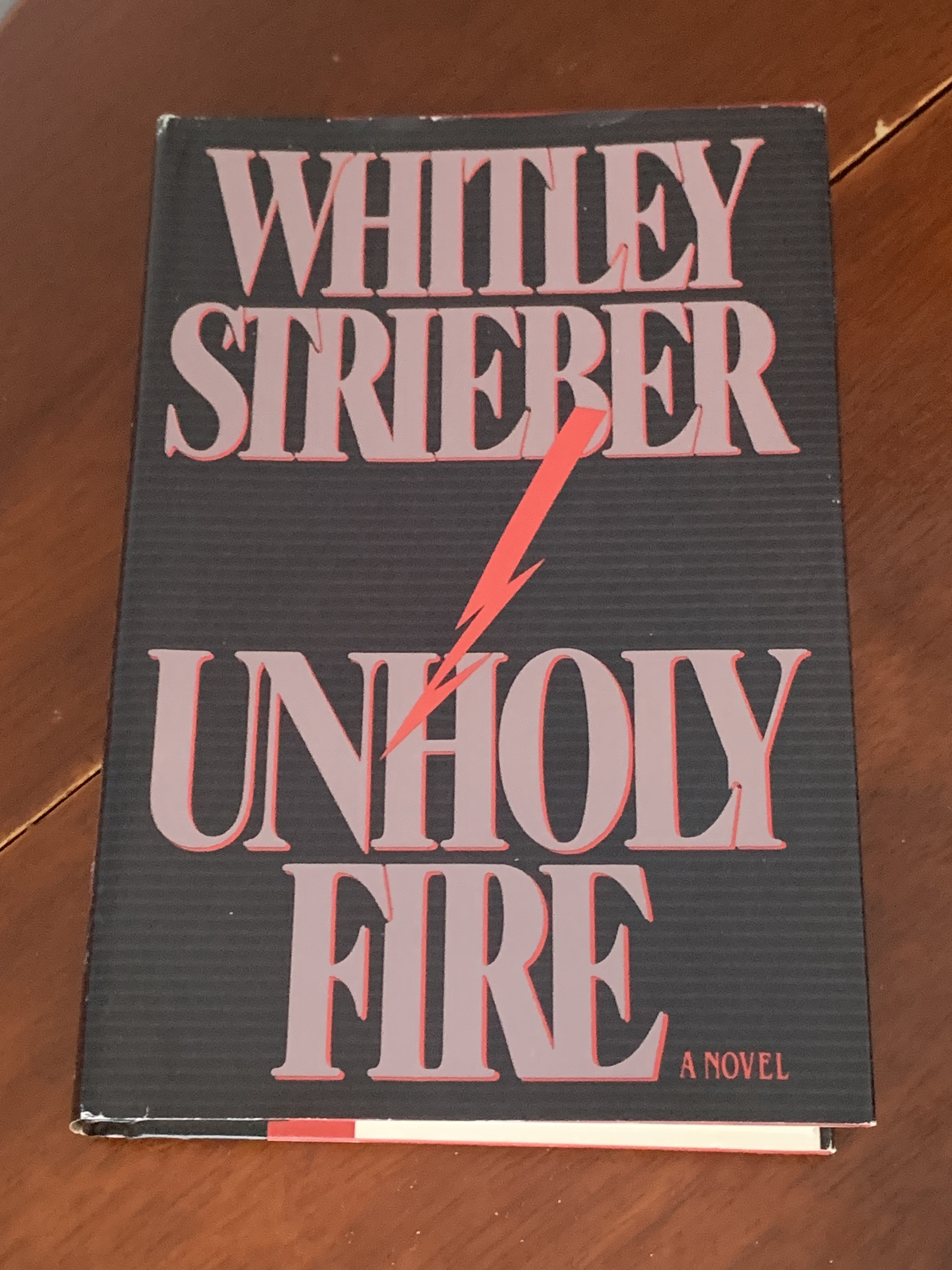
Macabrely poetic and unsettling in the way only books of the divine and the demonic can truly obtain (for me at least), Whitley Strieber’s 1992 book, Unholy Fire, is quite literally about the sins of the Fathers and an all-too human evil besieging a holy place.
God is not the Church, or the church, or the accouterments therein. God is the people. So thinks Father John Rafferty, a rather progressive priest, which draws the ire of the more conservative wing of the Church. They’re ready to oust him for helping the homeless, those with drug addictions, and homosexuals suffering from AIDS. After a murder of a young woman takes place at his Mary and Joseph Church in New York City, it’s not so much the murder itself that provides the impetus, but that Father John was allegedly close with the victim, so much so, that at her funeral, he said, “The priest is weak.” In other words, breaking a vow of celibacy was worse for the public image of the Church than a grisly murder taking place within the holy walls of one of its churches.
Admittedly, Strieber’s book had a peculiar beginning. I felt as if I’d been dropped into the middle of a book or a sequel. I was lost at first. He opens the book with Father John being seduced by Maria Julie (interesting that she has the same initials as the church; I’m sensing a metaphor!) into some sort of sexual liaison. That serves to infuriate Father John’s curate, fellow priest Father Frank, who is also sleeping with Maria. The reason I was befuddled is I didn’t yet have enough knowledge or understanding of why Father John would give into Maria’s temptations, especially after being a man of the cloth for more than 30 years. Nonetheless, shortly thereafter, Maria is bludgeoned to death in Mary and Joseph. New York City police detectives Kitty and Sam are on the case and they almost immediately turn their focus to the priests, Father John, Father Frank, and an old infirm priest, Father Tom. Partly because they quickly learn of Father John’s relationship with Maria, but also partly because they can’t imagine how someone else could have gotten into the church at that hour.
Frank seemed like the likeliest suspect, of the priests, because of Father John also sleeping with Maria (motive: jealousy) and because he was the youngest and most physically capable of the priests. That said, I was initially eyeballing George, who was the leader of the ultraconservative Christos sect of the parish, as the suspect. Then George is killed, too, so there went that theory! But what I really appreciated about Strieber’s book is that detectives Kitty and Sam were competent. They just couldn’t compete against Father Frank, or rather, an inside job, as it were. Yes, Father Frank was the killer, and as the book indicates, his serial killer signature was fire. Depending on how you interpret it, Father Frank had either a violent version of dissociative identity disorder — the kindly gentle giant of a priest as one personality and the murderous personality that believed itself a devil sent to purify the Church with fire — or he was genuinely possessed by Satan himself. Regardless, Frank, the man, was abused as a young child by a venerated priest in the family, his uncle. To Tom’s credit before he was murdered by Father Frank, he figured out Frank’s murderous ways before anyone else and attempted an exorcism of his own. Unfortunately, he was too feeble at that point to perform it. Father John is also of the belief that Father Frank is possessed by a demon and despite nearly being killed in an initial climactic scene with Frank, tries to exorcize him at the end of the book. I’d argue he did so to mixed results. Much of Mary and Joseph burns down in the ensuing confrontation. That’s when Father John, who was ousted in favor of Father Frank, realizes the Church is the people and the hearts seeking refuge and salvation rather than the physical trappings of the church itself.
After a somewhat slow, confusing opening, Strieber’s book kicked into high gear the rest of the way until its fiery end, as I said, often with poetic flourishes and an unsettling antagonist on the prowl in the holiest of places in the holiest of garbs.

 Milam's Musings
One thought