
Spoilers!
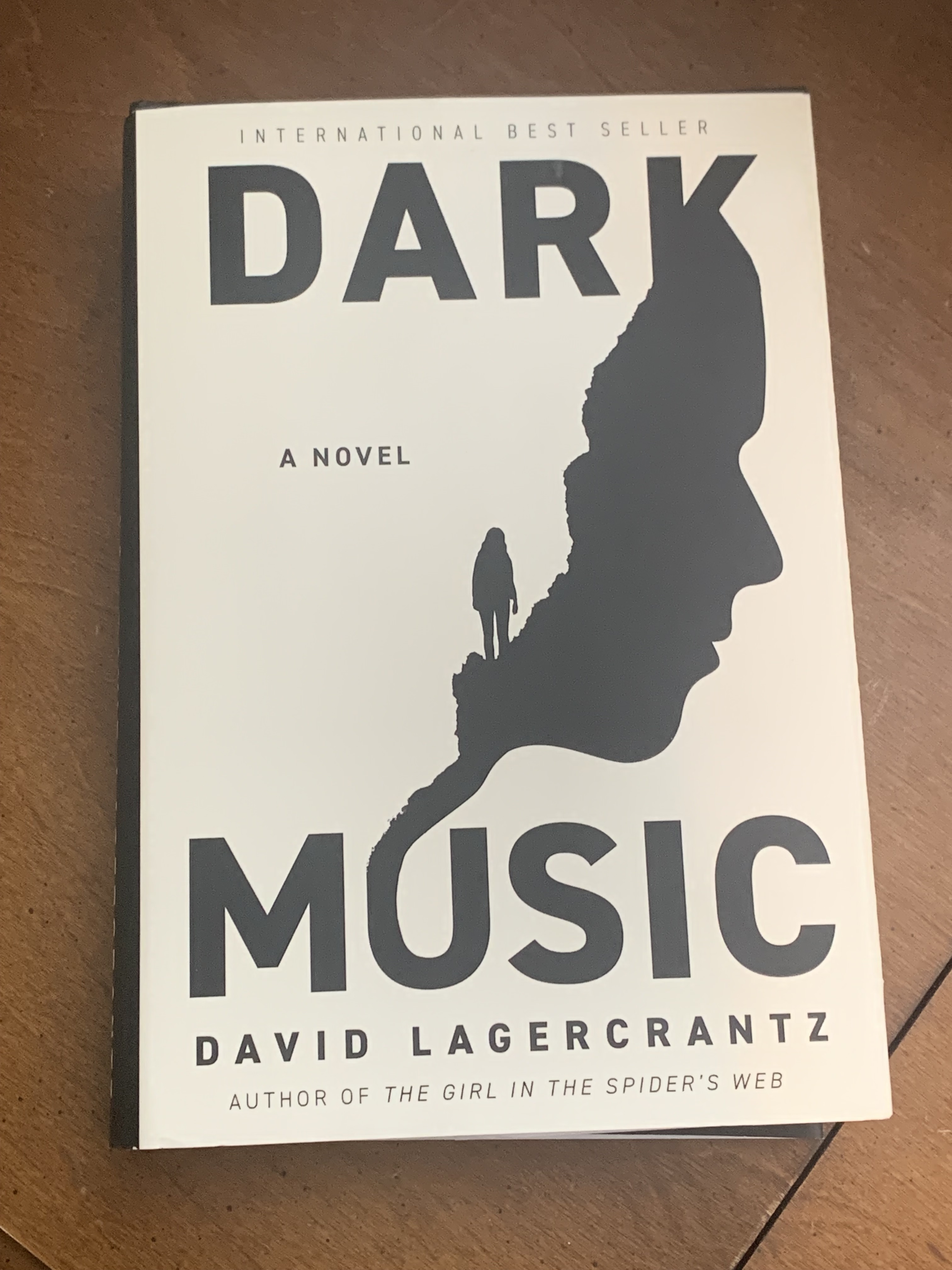
The worst thing that can happen to a society, a people, a person, is an infrastructure erected that brings with it permission for malevolence, wherein destruction seizes the moment. Counterintuitively, this infrastructure is designed so that it can destroy; it is far easier to destroy a thing than to build or rebuild it. In authoritarian regimes, women and other so-called undesirables who are affronts to this new infrastructure are killed, threatened, banished, diminished, and otherwise subjugated. The next assault envelopes the culture: books, music, television, and film. Such positive, artistic culture is seen as threat to the always-flimsy authoritarian facade. With his 2021 book (translated into English by Ian Giles in 2022), Dark Music, Swedish author David Lagercrantz demonstrates the ways in which the destruction of the moment, as it were, becomes the trauma of the ages. Lagercrantz combines a stated inspiration from Sherlock Holmes with Khaled Hosseini’s 2003 book, The Kite Runner, which is to say, bringing a fun whodunit to the real problems of Afghans during the Soviet invasion of the 1980s and the resulting rise of the Taliban. Dreams deferred, radicalization, torture, murder, vigilante justice, and at the center of it all is Lagercrantz’s unique take on a Holmesian character in Professor Hans Rekke, who is besieged by alcoholism, drug addiction, and an acute bipolar disorder, oscillating between manic and depressive episodes. But he’s also, in the shadow of Holmes, adroitly observant, dry-witted, persistent, and in his way, gentlemanly. These factors, both the fun of Rekke, with the resonance of the authoritarian blight upon society and culture, ensured Dark Music‘s place as one of my favorite reads of the year. I highly, highly recommend it.
Set in 2003 Sweden, Jamal Kabir, a refugee from Taliban rule of Afghanistan, where they tortured him, is living his life as a soccer referee when he is bludgeoned to death after a game. The local police, including Micaela Vargas, the daughter of a Chilean political refugee, believes Costa, the belligerent, often violent father of one of the soccer players, killed Jamal. Everything is circumstantial — Costa seen entering the woods, remerging with a bloody jersey, previously accosting Jamal during the game — but seems airtight, nonetheless. That is until Vargas and the other detectives, who are far more close-minded and with a curmudgeonly disposition than she is, meet with Rekke to receive his insight into how to interrogate a confession out of Costa. Interrogation techniques from his time with the San Francisco Police Department is Rekke’s specialty. So much so that the Americans, upon waging their War on Terror after 9/11, asked for Rekke’s assistance as they interrogated suspected terrorists housed at Guantanamo Bay. Rekke soon realizes that the prisoners were not only being grotesquely tortured, but it was obvious in some respects many of them were only saying what those perpetrating the torture wanted to hear to end the torture. The Swedish government is also complicit; they are using rendition to ship suspicious Swedes to black sites to be tortured in conjunction with the U.S. government. Torture brings us to the first metaphor of the title: dark music is a reference to the Americans using music as a torture device, interestingly, called “white torture.” In the backdrop of all this is, of course, the imminent real life revelations of torture (ridiculously euphemistically called “enhanced interrogation techniques”) at Abu Ghraib prison in Iraq. Because of Rekke’s “dangerous knowledge” about the torture and the Swedish government’s complicity, the Americans devise a smear campaign against Rekke to discredit him and his green card with the U.S. is also revoked. His rich wife soon divorces him, too, growing bored and/or exasperated with his introspective games. What a digression, but back to the point, when the detectives visit Rekke initially, they realize how wrong they are about everything pertaining to the case and that most likely, Costa is innocent. The curmudgeonly detectives didn’t want to hear that, however, and dismiss him. Vargas, who does believe Rekke and wants to push the issue, is instead reassigned away from the murder investigation. Doing so is also due to her not playing ball with an investigation into her brother, Lucas. Police believe him to be part of a gang and the police want Vargas to flip on her brother. She won’t; thus, she’s reassigned. (Later, Rekke will observe, if from a fleeting encounter, that Lucas is a sociopath and Vargas knows this, but doesn’t want to address it.) It also doesn’t help Vargas’ case that she’s a woman in a male-dominated profession, a dark-skinned Chilean refugee, and from Husby, a district in the Järva borough in Stockholm, which apparently is looked down upon by other Swedes. She comes from a low-class background, in other words.
Soon after the smear campaign and divorce, Rekke goes into one of his depressive episodes. He attempts to kill himself by jumping in front of a subway train. Fortunately, Vargas happens to be there, and using her own power of intuition and observation, she saves him. Back at Rekke’s new apartment, Lagercrantz offers this haunting, entirely accurate, depiction of Rekke’s depression as Rekke tries to explain it to Vargas, “Well, I would say then that depression has its phases. At times it simply hums through your arteries, a semitone too low, and shuts you out from the world. All the voices and laughter you hear on the other side exist only as reminders of everything that you are incapable of, and that’s bad enough. But slowly, depression retunes itself and raises the volume. It begins to scream in red, unbearable tones, and then you reach a point where you no longer want to be part of it.” Oof. Therein is our second metaphor from the title of the book: depression is the dark music of the mind, body, and soul. Also of intrigue is that Vargas’ father ostensibly died by suicide (she seems skeptical). I’m sure Lagercrantz will unfurl that thread in future books.
Vargas and Rekke soon realize that what they thought they knew about Jamal may not be true. Indeed, the inverse is the case: He was with the Taliban, a perpetrator, not a victim. He was with the Taliban during their 1990s crusade against music, where they smashed musical instruments and outright killed people who possessed them. This, despite seemingly Jamal being someone who was once a violist. This is where the third metaphor for the title of the book comes in: the aggressive way authoritarians crack down on freedom through suppressing “dark music” in their eyes, as the Taliban did in Kabul. Vargas and Rekke also soon learn of the death of Latifa Sarwani, who was shot in the back of the head and her violin destroyed in April 1997 in Afghanistan. They believe the two murders (Jamal’s and Latifa’s) are linked, but they don’t know how. That is until they learn about Latifa attending a Moscow classical music school in the 1980s (apparently, during the Soviet occupation of Afghanistan, there was a “cultural exchange” of sorts occurring). She was the star violinist. A boy named Hassan Barozai, who grew up in Pakistan, was initially infatuated with soccer until he saw someone conducting classical music. Then, he wanted to do that. When he also arrived at the Moscow classical music school, he heard Latifa playing the violin and next became infatuated with her. Unfortunately, he wasn’t as good on the violin and was relegated to what is apparently the butt of jokes in string quartets: the viola. Latifa doesn’t look at him the same way anymore. So, he quit the school, returned to Afghanistan, and was radicalized by Gamal, one of the leaders of the Taliban, who was remorselessly killing and destroying Afghan musical culture. The irony of someone so passionate and enthralled by music becoming a foot soldier to its careless destruction, but also, seeing Latifa as the embodiment of that deferred dream. Rekke later surmises that this a human folly, the “urge to kill something that once burned within us.” It’s most sad. In 1997, Gamal insisted, almost like a gang initiation, that Hassan kill Latifa. He did. Hassan implored her to play the violin one more time, then with Gamal watching, Hassan put a bullet in the back of her head and they smashed the violin. The music died with Latifa.
Latifa’s family, though, a bruiser of a brother and a doting father, would not let it rest. They knew the Taliban would not bring justice for Latifa’s murder because they were the killers. Rekke even acknowledges the virtue of vigilante justice when he and Vargas confront the father and brother in Cologne, Germany. He essentially said when lawlessness permeates the land, then it is understandable when those seeking justice go outside the law. No just law exists anymore! As Rekke further puts it, he’s sympathetic to those who “filled a void in the legal system.” Nonetheless, he and Vargas have the father and son arrested for Hassan’s/Jamal’s murder. To my point at the start about when an infrastructure is erected that brings permission for malevolence, Rekke explains, “I think this dark desire to crush that which is unattainable ticks within us in secret. But sometimes — such as during the Cultural Revolution in China — a system is created that legitimizes it. Our desire to destroy is given an ideological superstructure, and that’s when things can go very wrong.” Certainly. And it doesn’t only happen in seemingly far-flung places and times like Afghanistan in the 1990s with the Taliban or with Mao in China in the 1966, but I digress.
Lagercrantz sets up the ending of the book with a new mystery to be solved, that of a presumably dead wife who is pictured at St. Mark’s Basilica in Venice. Which is great because prior to that, Vargas was rewarded with a return to the murder inquiry (hence why she went with Rekke to Cologne) and Rekke was asked to join the police force as a consultant. More adventure awaits with these two! I can’t wait to read more of Lagercrantz’s work with Rekke and Vargas at the helm. Rekke was far from a perfect protagonist. As I mentioned, he had his addictions and he was also a self-aware, but unwavering snob. Vargas was headstrong, but also timid in places (like not wanting to see her brother for what he is). But his snobbishness juxtaposed to her background, his manic to her focused, made for great reading. And importantly, solving the mystery wasn’t all due to Rekke, Vargas helped a great deal and in fact, ultimately was the reason they were turned on to the father-son as culprits.
One final note, naturally, Lagercrantz mentions a few classical pieces throughout the book. I think my favorite, though, as I’m also an admirer of the unyielding beauty of the violin, is Meditation from Thais by Jules Massenet. It is stunning. Check out a rendition for yourself (and not that kind of rendition):
As I said, Lagercrantz’s book is one of the best books I’ve read this year and it deserves a lot of credit for not being a wholesale derivation of Sherlock Holmes. Rekke is a three-dimensional, dynamic character, as is Vargas, with distinctly their own personality quirks. But just as importantly, Dark Music is elevated by the themes and story at the heart of it: the power of music and the danger of authoritarians who seek to destroy it and everything it represents in a society.

 Milam's Musings