
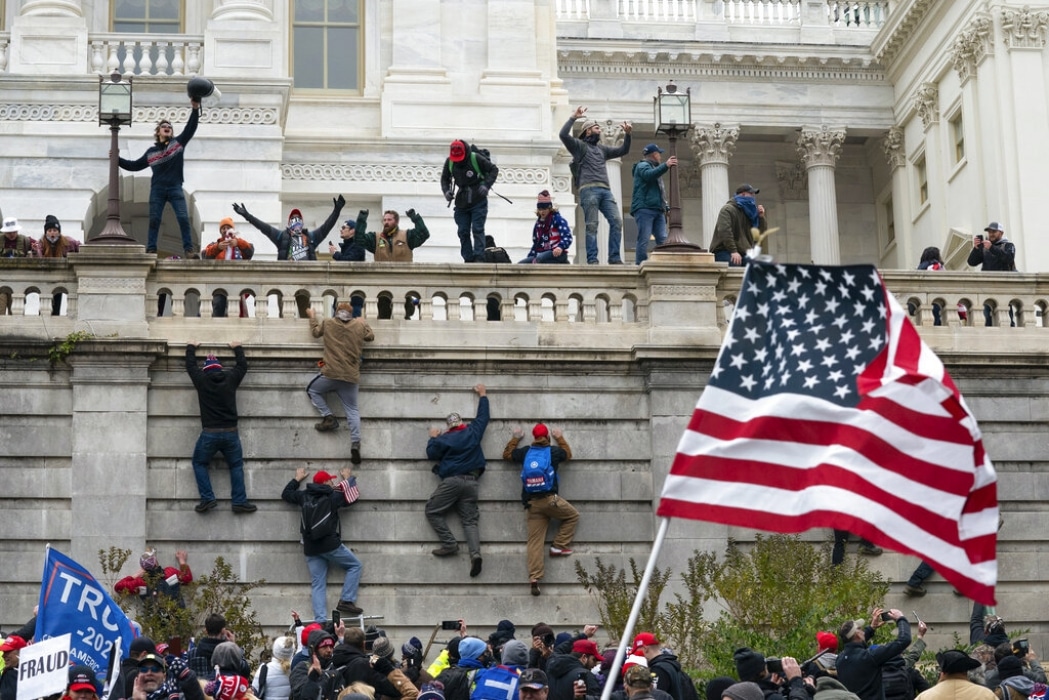
Violence is more uncommon than people believe, which another way to say that is, most people are not violent. Violence is not going up contrary to what people believe, much less is it rampant. Our cities are not apocalyptic hellscapes. And specifically, politically motivated violence for the past 50 years is exceedingly rare in the United States, thankfully. So rare is it that it should not be taken as a fait accompli that politically motivated violence is on the rise the past 10 years. The overwhelming majority of Americans, Democrats and Republicans, do not support political violence against those across the aisle. That’s my first point about political violence. My second point is that fundamentally speaking, most people support politically motivated violence in the abstract, but not in the way you’re perhaps thinking about.
Let’s rewind to three days ago, September 10. Charlie Kirk, founder and CEO of Turning Point USA, an influential conservative youth organization, brought one of his “prove me wrong” events, where he “debates” people, to Utah Valley University. Shortly after the event began, Kirk was shot and killed.
Charlie Kirk should not have been killed. His children growing up without their father is a tragedy. The suspected shooter is in custody (although, it should be said, in spite of the fumbling Kash Patel-led FBI investigation), so, justice is already underway.
But Charlie Kirk was not a good person. He was not a person who did right by his two ostensible, most strident beliefs: his faith and his commitment to free speech. His unnecessary death, and the tragedy for his family, does not change that. In the Desert News article I linked previously, Kirk positioned himself as not friendly to far-right or radical right-wing rhetoric based upon “deep-internet theories” around white supremacy, misogyny, and antisemitic views. This is true enough inasmuch as there appear to be far-right folks who thought the Charlie Kirks of the world didn’t go far enough in their conservativism.
Charlie Kirk was not a good person — and as someone who is not religious, I nonetheless feel comfortable saying his actions as an extension of his faith are contrary to the faith’s teachings — because he used his considerable platform and “movement” to ostracize and castigate those deemed “others,” primarily, trans people, Muslims, Black men and women, and he helped fan the flames of Jan. 6, 2021 (both by providing people and supporting the Big Lie about the 2020 presidential election) , the political violence moment of our time, where 1,500 people who attacked the U.S. Capitol where pardoned by President Donald Trump. In other words, Charlie Kirk was a hate- and fear-monger. And no, he was not a strident free speech advocate. Turning Point USA hosts “Professor Watchlist” and “School Board Watchlist” to harass professors, teachers, and school board officials. See this FIRE roundup here. He called for Mehdi Hasan, a British-American broadcaster to be “sent back to the country he came from.” Going to college campuses to be “proven wrong” was not an invitation for good faith, enlightened debate where two sides try to arrive at some semblance of the truth, or at least, there’s an understanding that one side could be persuaded. Kirk went to college campuses to get clicks for his media empire. He was not operating in good faith. Finally, I’d be remiss if I didn’t point out the outlandish way in which the right is trying to get anyone and everyone fired for whatever they’re saying about Kirk online. See here, here, here, and here for examples of this both outside and inside the government.
Charlie Kirk should not have been murdered. Charlie Kirk should not be valorized in death.
No, “the left” didn’t kill Charlie Kirk. “They” didn’t kill Charlie Kirk. Using that sort of language is continuing the demonizing, othering Kirk spent his life’s work fostering, so, I suppose then, it’s no surprise it occurs in the wake of his death.
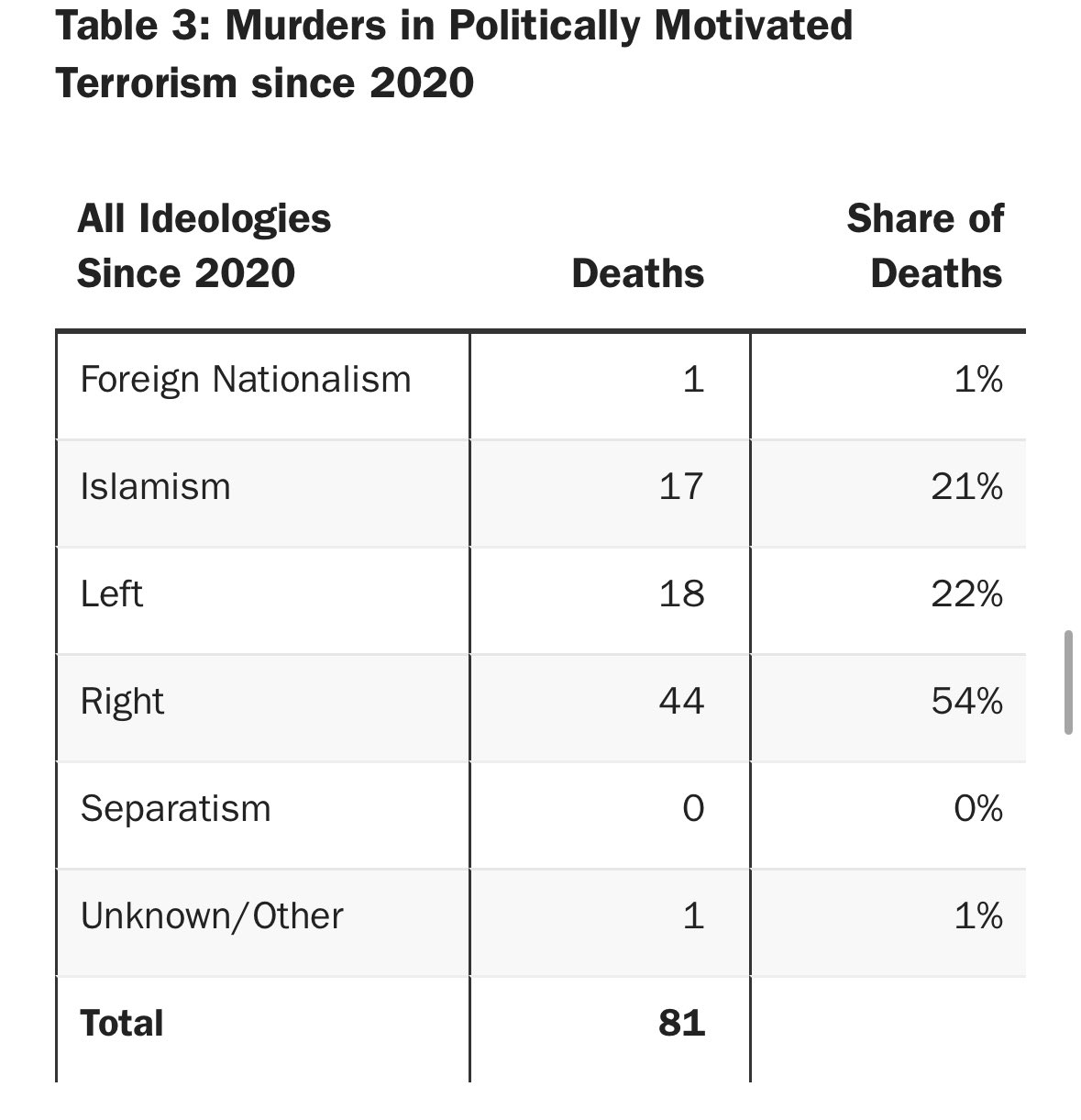
But if we are going to discuss political violence, then we need to be clear-eyed about it’s prevalence and its perpetrators. The biggest caveat when discussing politically motivated violence is that those who seek to harm and kill others for politically motivated reasons do not often have mappable political ideologies. Such people do not fit neatly into the “left” or the “right.” That said, inasmuch as one can discern motive when such attacks do occur, here is how it shakes out just since 2020:
If you go back to 1975:
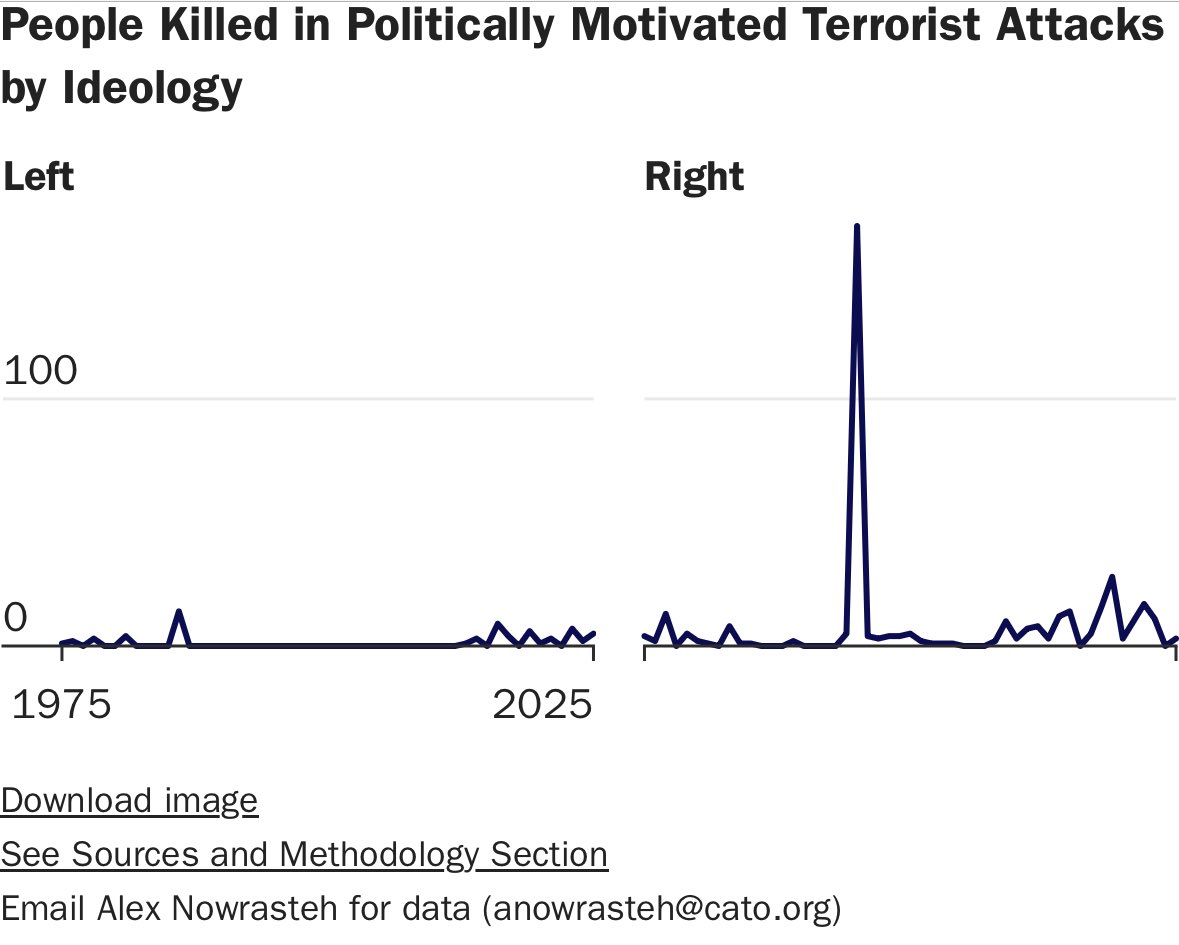
That dramatic blip for the “right” is obviously the Oklahoma City Bombing in 1995. Again, here’s the link to Nowrasteh’s post about it.
Nobody can rationally, logically, or factually discuss political violence in the United States for the past 10 years without talking about Donald Trump, the current president of the United States, who has done more than any singular figure in modern American life to foment political violence, excuse political violence, and indeed, as mentioned, pardon political violence. That’s why some of what I see on social media bemoaning where we are as a country rings hollow when I know such people not only voted for Donald Trump, but do not make this clear-eyed assessment of his central role in where we are as a country. See here for a roundup of his comments. Most recently, the president of the United States posted an AI image of himself going to war with Chicago, captioned, “‘I love the smell of deportations in the morning …’ Chicago about to find out why it’s called the Department of WAR 🚁🚁🚁.” If your justification for such a post is he was joking, then even on those terms, it’s a troubling thing for the president of the United States to joke about. I could go on and on litigating how Trump has embraced and absolved political violence when done in his name, such as when he probably didn’t care about his own vice president being hanged by a mob of his supporters or just yesterday when he said he didn’t care about radical right violence. But I’ll leave you with this: Contrary to what The New York Times and others have reported about Trump about Kirk’s death being a “deeply personal loss” for the president, this doesn’t seem like the reaction one gives when asked about the deep, personal loss of someone:
He is utterly incapable of empathy, even for someone supposedly close to him and clearly important to his re-election. How so many Americans, including a wide contingent of faith-based Americans, voted for such a man multiple times will be baffle me for the rest of my life.
As to my opening claim: most people support politically motivated violence in the abstract, but not in the way you’re perhaps thinking about. No, most Americans do not support murdering human beings the way in which Charlie Kirk was killed. (Which is also why I find the doomerism about people “cheering Kirk’s death” to be overplayed because there will always be those people you can find, but the vast majority of people are not that way.) However, what Americans have historically supported and have supported in the modern era is bombing other countries and/or supporting other countries doing said bombing, policing with no accountability, hence the backlash to even trying to bring a modicum of accountability to the police after Ferguson or the George Floyd killing (which Kirk was also awful about), arrests and deportations of immigrants (like with policing, any potential interaction with armed individuals of the state is by its nature violent), the death penalty, and so on. In other words, all of those items are politically motivated violence and death. We just don’t think of it in that manner when it’s funneled through what we call government. At the deeper philosophical level then, perhaps that’s part of the problem. Certain kinds of violence are not seen as violence in the first place, merely the solution to a “political problem,” whereas other forms of violence are indeed problematic.
In closing, let me reiterate that politically-motivated violence is exceedingly rare in the United States and taking it as a proven fact that it’s rising is not shown in the data. That said, politically motivated violence, such as the murder of Kirk, does have an outsized deleterious social effect, which I do worry about. Kirk’s death is not the death of a martyr for his faith or free speech. He did not live a life worth envying or copying on either front. While his death is tragic for his family, we can be honest and open about the way he lived his life. Finally, perhaps if we truly considered the ways in which we endorse politically motivated violence when it’s done against “others” in the name of government and political solutions, perhaps that itself would go a long way toward “toning down the temperature” in the country.

 Milam's Musings
Brett, your essay made me stop in my tracks: this is what critical, rational, and compassionate discourse could look like. Thank you for taking the time to gather your thoughts, articulate them, and share with us.
LikeLiked by 1 person
Thank you so much for reading and your kind thoughts. 😊
LikeLike
Amongst all the hot takes and ranting this is a welcome change – well said
LikeLiked by 1 person
Thank you!
LikeLike