
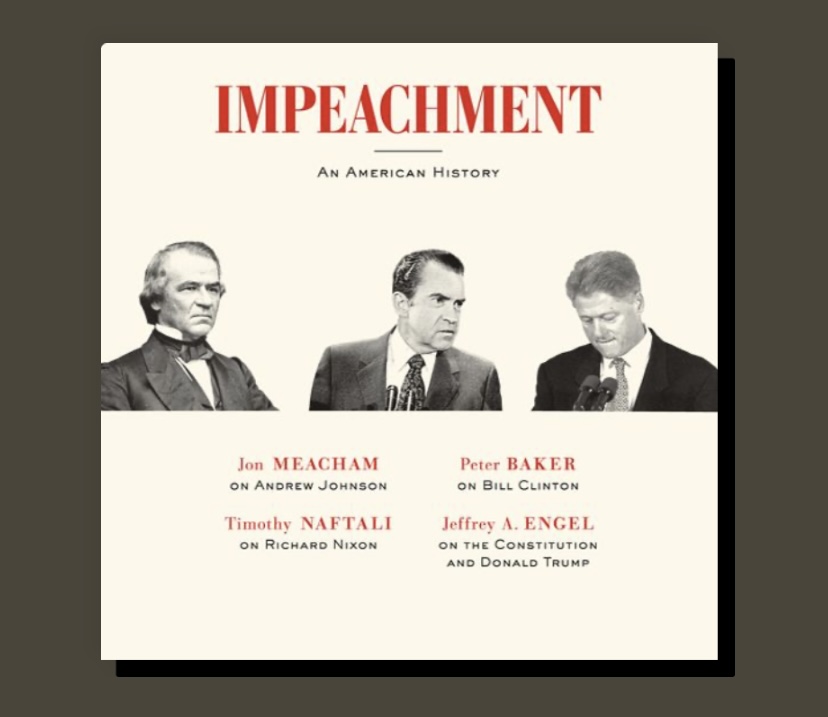
Impeachment is the necessary bulwark the Founding Fathers placed in the United States Constitution to ensure someone unfit to be president of the United States would not remain in the office — their behavior so egregious, encompassing any manner of treason, bribery, or other high crimes and misdemeanors, and so deleterious to the body politic of America, that the next election cycle would not suffice. The fatal flaw in the Founders’ plan, which they couldn’t have conceived, was that Congress, who holds the power to remove presidents and judges (which is why I always argue they wield the most power among the three “co-equal” branches in theory), would not care to hold such an egregious person accountable and remove them from office via the impeachment mechanism. That such people, like the president themselves, would place party over country, their self-enrichment and advancement over the betterment of the country. Impeachment: An American History is a 2018 book by Jeffrey Engel, Jon Meacham, Timothy Naftali, and Peter Baker that takes readers through the history of impeachment during the Founding Era through to its first attempted use on President Andrew Johnson, then Presidents Richard Nixon and Bill Clinton in the modern era. The book was written, obviously, prior to Trump’s first impeachment in 2020 related to Ukraine President Volodymyr Zelenskyy. Of course, impeachment talks permeated the political discourse before Trump assumed office after winning the presidential election in November 2016 (for good reason, mind you).
Engel is a historian of presidential history; Meacham is a historian, noted for his presidential biographies; Naftali is a historian who has written about the Cold War and counterterrorism; and Baker is a reporter with The New York Times, who covered Clinton’s impeachment in real time, the basis of his first book, and has reported on five other presidents. The way the book is constructed, Engel covers the Founding Era and the conclusion; Meacham covers the impeachment of Johnson; Naftali the impeachment of Nixon; and naturally, Baker the impeachment of Clinton. In my Notes app, I jotted down this question at the start of the audiobook: Does impeachment disrupt the political process, as they claim, or does the act worthy of impeachment itself do that? To me, that is the question always at the heart of impeachment and in general, holding politicians accountable. In the United States, even though we purport to say nobody is above the law, in practice, the president is above the law. We prefer them to be pardoned for any crimes (Nixon) or to “look forward instead of backward” instead of litigating the past (Obama as it regarded Bush and torture) and it certainly would be beyond the pale to actually send a former president to prison for attempting a coup (see: former Brazil president Jair Bolsonaro or former South Korean president Yoon Suk Yeol, both examples just from 2025). Given I asked the question, you know where I stand: it is the corrupt president who corrodes that body politic, not the attempts to hold that individual accountable, be it impeachment, criminal charges, or prison time. To be fair, part of the authors’ argument that impeachment itself can be corrosive is when, for example, Clinton’s three GOP-led impeachment politicians were hypocrites, i.e., having secret extra-marital affairs of their own. They also say that it is an interesting counterfactual to wonder how the 21st century would have unfolded had a.) Clinton not shown it was possible to ride out a scandal instead of stepping down; and b.) those GOP politicians weren’t hypocrites. In other words, one could make a compelling throughline argument for Clinton’s successful effort to stave off impeachment for personal moral failings (and rise in popularity during the impeachment) led to Trump. That is too simplistic in many ways, but it certainly also didn’t help matters that Trump literally faced Clinton’s wife, Hillary, in the 2016 presidential election, either.
Before I go further, let me make my position on impeachment abundantly clear. My interpretation of the authors’ viewpoint is that impeachment should be rarely and solemnly used because, again, its very use is damaging to the body politic. My position is that our country would be in better shape if we, as the public, and Congress as the stewards of the public will, utilized impeachment far more often to hold corrupt presidents accountable. The downstream effect, then, ideally, would be ensuring better people occupy that office. If we’ve learned anything from the Trump years, it is that we’ve taken for granted how much that particular office (for the purposes of this discussion) relied upon assuming people of good character occupied it.
Speaking of people of good character and where that assumption came from, as should be no surprise to anyone with a modicum of understanding about our Founding Era, for the founding fathers, who were far more diverse in thought on how to organize a government than hagiographic portrayals of them may indicate, the one item they could agree upon: George Washington was their paradigm for what would make a good president. They were clear-eyed that not every president would match this paradigm (and clear-eyed that Washington himself was not perfect), but it served as a way to understand that severe deviations from it could and should result in impeachment from office. It can never be emphasized enough the two most remarkable things Washington did that were without precedent in the history of the world. First, he led an army against the greatest empire known to man at that point with sometimes the sheer force of his will, won, and then gave up that power. Second, after being president for two terms, despite their not yet being a 22nd Amendment establishing a two-term limit on the presidency, Washington stepped down from power, establishing that norm until the 1947 Amendment. Extraordinary.
Again, the Founders worried about an executive whose very presence “would become too much a cancer on the Republic and need to be removed.” While time may seem like a better remedy when the people voted for the person, sometimes a person’s nefariousness cannot be endured (a paraphrase, I believe, of Engel’s words). But of course, then, we have to parse what the Founders meant by the words they used in the impeachment clause. We understand treason and bribery well enough, but what about “and other high crimes and misdemeanors”? Contrary to what politicians, pundits, and the public decried throughout Trump’s two impeachments and even going back to Clinton’s, the Founders did not necessarily mean literal, indictable crimes. Rather, “high crimes” refers to a crime against the Republic, however that is determined and to whatever extent the severity. Similarly, misdemeanors are an assault against civil society and government itself. The person accused of such “crimes” violates the public trust and the duties of their office. Another way of stating all of this is that, again, contrary to the aforementioned outcries, of course impeachment is a political act and determination! Because it is a political question of whether the president is violating the public trust and their sworn duties as an officeholder. One of the biggest misunderstandings regarding impeachment is that the president has to have committed an actual crime to be impeached. (The second biggest is that the Nixon years made us expect a specific “smoking gun” that would lead to impeachment. What if the president (Trump) was regularly acknowledging smoking guns instead? He’s unprecedented in that, there is no attempt at a cover-up. It’s all out in the open. And yet.
I’ve long said I need to read more about the post-Civil War period in American life, Reconstruction, and how President Andrew Johnson, who succeeded Abraham Lincoln after his 1865 assassination, undercut Reconstruction’s efforts. That’s why I enjoyed this first section on Johnson by Meacham. For an example of how Johnson stymied Reconstruction’s efforts, he opposed the 14th Amendment, which grants U.S. citizenship to all persons born or naturalized in the country (birthright citizenship). That very amendment is under attack again. Republicans were ready to reignite the Civil War, in a manner of speaking, over Johnson’s action rather than have “treason and traitors triumph.” Not that I would have wanted America to continue having eruptions of war amongst its own people, but ultimately, we did let “treason and traitors triumph” for the next 100 years. These Republicans feared, for good reason, that our experiment in democracy was over, the presidency was losing legitimacy, and tribalism would win the day. Does any of that sound familiar?
Impeachment against Johnson was initiated by the House of Representatives in 1868, primarily over the charge that Johnson violated the Tenure of Office Act by removing Edwin Stanton from his position as Secretary of War. The Senate didn’t want Johnson removing department secretaries without their consent. Again, I love reading about a period where Congress is opposing the president at every turn for his malfeasance. I also wonder how historians ultimately feel about Lincoln putting Johnson on his ticket as vice president (where he showed up to inauguration day drunk). Is it Lincoln’s greatest mistake? Or would he not have even made it to the presidency without Johnson on the ticket? Nonetheless, Johnson was impeached by the House, but acquitted by the Senate, which has a much higher bar for impeachment than the House (a supermajority, or two-thirds of the Senate). Meacham said the legacy of Johnson’s impeachment is that Congress can’t impeach a president merely for not liking his policies, style or character, and administration of his office. What this first impeachment of a president portended for the next 100 or so years was that impeachment had a high bar to clear and it almost had the connotation of being uncouth. It was a mistake to have used it. Meacham said if the impeachment had gone through, then it would have ensured “Congressional supremacy.” To which I say, good! Our system would likely be better if we stopped concentrating so much power and attention to one person and one office, which then has the corollary that, when that person uses the office to enrich themselves or otherwise debase it, it has outsized deleterious effects on the country.
I was fairly familiar with Nixon’s impeachment for the Watergate break-in, which is really the story of his impeachment for attempting to cover-up the Watergate break-in, after reading Garrett M. Graff’s fantastic 2022 book, Watergate: A New History. Still, I found Naftali’s section on Nixon interesting. We obviously tend to overlook that impeachment was ramping up against Nixon because he ultimately resigned office, the first president to do so. But impeachment was ramping up and it’s likely had Nixon not resigned, he would have been the first president impeached and removed from office. There are two fascinating items about Watergate I want to highlight: 1.) The break-in occurred in June 1972 and being percolating therein. Nixon would be re-elected later that year in a landslide win against George McGovern. I find solace in that, to some extent, given our current situation. 2.) Most Americans were not paying attention to the Watergate scandal, despite dogged reporting, and even after 16 months of this scandal going on, nobody in Congress was seriously considering impeachment until the Saturday Night Massacre on October 20, 1973, where a number of resignations at the Department of Justice occurred after Nixon dismissed special prosecutor Archibald Cox. Again, it was the cover-up that doomed Nixon. What’s so darkly amusing to me is that impeaching Nixon for the Watergate cover-up made sense, but impeaching him for tax evasion and the bombing of Cambodia? That was seen as a bridge too far. Politics is weird. The takeaway Naftali had about Nixon’s impending impeachment was the bipartisan nature of it between Democrats and Republicans. Spoiler alert, but in Clinton’s, everything was largely divided along party lines, and today, during Trump’s second administration, no Republican would dare try to oust him. That said, during the prior Trump administration, we did see the first Republican Senator to vote to convict a president of his own party for impeachment with Mitt Romney of Donald Trump during his second impeachment in January 2021.
Clinton is such a sleazeball. Every time I hear or read anything about him, I walk away thinking that. And it’s not just the sleaziness — the affairs with women going back to the 1970s, including alleged sexual misconduct, and of course, the power dynamic of the Monica Lewinsky affair, making it dubious whether it was truly consensual — but also the hubris to do it while president and then become indignant when anyone attempts to call it out. Again, you see the blueprint Clinton and the Democrats of the 1990s created used during the Trump years. Disheartening, to say the least. There is even a throughline going into the past with Clinton: He was galvanized by Nixon’s villainy to run for Congress, which ultimately failed, and notably, Clinton was already cheating on Hillary at that point.
The impeachment of Clinton started with the Paula Jones civil lawsuit, where she alleged Clinton sexually harassed her in 1991 while he was Arkansas Governor and she a state employee. During discovery for that suit, Clinton perjured himself regarding his sexual relationship with Lewinsky. In September 1998, the Starr Report came out by Ken Starr, the independent counsel for the House Judiciary Committee. The report sought to demonstrate a pattern from Clinton of these affairs and attempted cover-ups. Clinton lied for seven months not only to the public, but his own family, prior to August 1998, where he admitted to it in a grand jury testimony. Clinton’s poll numbers went up anyway. After the scandal broke, support for Clinton was at 71 percent (which is difficult to imagine a president receiving that today!). Public support did dip to 55 percent after the Starr Report, but went back up to 71 percent after the House approved two articles of impeachment against Clinton. Essentially, the public thinking was, yes, he’s a sleazebag, but what does that have to do with his job as president? We hear this defense now. Clinton was impeached by the House, but like Johnson, acquitted by the Senate. Would I have voted to impeach Clinton and remove him from office? Yes. I say that not even with the hindsight of the parallels to his story and that of Trump’s. If we truly believe a president is not above the law, then we need to act like it.
[I mentioned before the hypocrisy of the GOP, who were attempting to persecute the case against Clinton. New Gingrich, the House Speaker at the time, engaged in an extra-marital affair with a House of Representatives staffer in 1993 (and while his wife had cancer). Bob Livingston was going to succeed Gingrich as House Speaker until he declined after revelations of his own extramarital affair. Tom Delay, the House Majority Whip, was another one. Another Republican, Dan Burton, fathered a child during his adultery. Dennis Hastert, who became House Speaker after Gingrich, was later convicted for hush money payments to teenage boys he’d sexually abused.]
It goes without saying where I stand on the Trump presidency, especially given how I stand on impeachment. Any number of items at this point ought to be impeachable offenses during Trump’s second administration (enriching himself through cryptocurrency, mobilizing the military in L.A., the kidnapping and deportation of U.S. residents to foreign prisons, his actions on tariffs, defying court orders, his campaign of retribution at the Justice Department, dismantling federal agencies, and on and on and on it goes, and yes, I would impeach him for this, too). But in a sane world, a.) he never would have become president in 2016 in the first place; and b.) accepting the former, he would have been barred from ever holding elected office again after Jan. 6 and his second impeachment, and then faced his myriad criminal charges. Alas.
If you want a better understanding of American history, impeachment, find solace in other turbulent times in America that we eventually moved past, and want to become an ardent supportive of the impeachment power like me, then Impeachment: An American History is a nice primer on the cases of Johnson, Nixon, and Clinton, and what lessons to draw in our present day.

 Milam's Musings